Assigned readings
The capstone joint doctrine publication and the keystone operations pub that carries its logic into execution, the course's working synthesis of military organizational properties, one naval capstone chapter for contrast in voice, a pre-doctrinal note on strategy for the strategic seam, and three canonical theory works that supply the contingency-theory baseline this session stress-tests.
Joint Publication 1, Doctrine for the Armed Forces of the United States (2013, incorporating Change 1, 2017)
Read Chapter I (theory and foundations: war, warfare, levels of warfare, joint functions, law of war) and Chapter II (unified direction, chain of command) closely; skim Chapters III–V for the grammar of command authorities (COCOM, OPCON, TACON, support); read Chapter VI section 4 on what doctrine is; and do not skip Appendix B, "The Profession of Arms." Treat every definition as a design decision.
../sources/joint/jp1_doctrine_for_the_armed_forces_2013_ch1_2017.mdJoint Publication 3-0, Joint Operations (2017, incorporating Change 1, 2018) — Chapter I only
Read Chapter I, "Fundamentals of Joint Operations": the strategic and operating environments, unified action, the levels of warfare, and the 12 principles of joint operations. JP 3-0 is the keystone operations pub; read it as the layer where JP 1's capstone organizational logic becomes instructions for running an operation. Note the archive fact: this 2017/Change-1-2018 edition is the last publicly posted one — the 2022 revision is unclassified but CAC-gated.
../sources/joint/jp3_0_joint_operations_2017_ch1_2018.mdCourse synthesis: Military Organizational Properties (working document for this seminar)
Read in full. It states the course thesis this session teaches: five environmental conditions, fourteen operating principles each paired with a failure mode, the three-level architecture, and six central paradoxes. We will test its claims against JP 1's actual text throughout the session.
../01_military_org_properties.mdNaval Doctrine Publication 1, Naval Warfare (2020) — Chapter I, "Who We Are," only
Read for contrast in register: where JP 1 writes in the voice of law and structure, NDP 1 writes in the voice of identity and culture — attributes, command philosophy, mission command "shaped by centuries of independent global operations." Two capstones, two retention mechanisms; the comparison seeds Sessions 02 and 05.
../sources/navy/ndp1_naval_warfare_2020.mdJoint Doctrine Note 2-19, Strategy (2019) — Preface and Chapter I
Skim the Preface and Chapter I for the pre-doctrinal seam between strategy and doctrine. A JDN is explicitly "not authoritative" — it feeds future doctrine rather than binding the force — which is why it grounds the strategic level without commanding it. Read it as evidence that the publication system types even its own drafts.
../sources/joint/jdn2_19_strategy_2019.mdBurns, T., & Stalker, G. M. (1961). The Management of Innovation. Tavistock.
Read for the mechanistic–organic distinction: rigid, vertical, rule-governed systems fit stable environments; fluid, lateral, loosely-roled systems fit changing ones. This session asks what happens to that mapping when the environment is not merely changing but hostile and adaptive — and why the military refuses to pick a pole.
doi.org/10.1093/acprof:oso/9780198288787.001.0001Galbraith, J. R. (1974). Organization design: An information-processing view. Interfaces, 4(3), 28–36.
The uncertainty–design link: as task uncertainty rises, organizations must either reduce the need for information processing (slack, self-contained tasks) or increase capacity (vertical systems, lateral relations). Watch how JP 1's doctrine-plus-decentralized-execution package is a third answer Galbraith only gestures at: pre-position shared understanding so the channels are needed less.
doi.org/10.1287/inte.4.3.28Thompson, J. D. (1967). Organizations in Action. McGraw-Hill. Chapters 1–2, 6–7.
Read for two ideas: organizations under norms of rationality buffer their technical cores from environmental disturbance; and interdependence type (pooled, sequential, reciprocal) dictates coordination cost. The military inverts the first idea — its core is deliberately exposed to the environment — and lives at the expensive end of the second. Pair with Lawrence & Lorsch (1967) on differentiation and integration, cited in the register.
doi.org/10.4324/9781315125930The environment: five conditions that break the classical assumptions
Contingency theory says structure must fit the environment. The military's environment includes an intelligent opponent, irreversible failure, and the physical destruction of the organization itself — conditions classical theory never priced in. Every distinctive military structure traces back to at least one of them.
Begin with the course synthesis's central claim: militaries are not exotic, non-human organizations. They are human organizations designed for an unusually severe operating environment, and their operating principles make sense only against that environment. The synthesis compresses the mandate into a single sentence worth keeping on the table all semester:
They must translate political direction into coordinated action, including the controlled use of lethal force, against an intelligent opponent who is actively trying to deceive, disrupt, injure, and destroy them.
JP 1 (2013, incorporating Change 1, 2017) supplies the doctrinal grounding. Its theory chapter defines war bluntly — "War is socially sanctioned violence to achieve a political purpose" — and reaches for Clausewitz to characterize the environment: war combines "friction, chance, and uncertainty," which "often combine to cause 'the fog of war,'" placing "a burden on the commander to remain responsive, versatile, and adaptive in real time." The strategic security environment, it says, "is characterized by uncertainty, complexity, rapid change, and persistent conflict," in which "uncertainty, ambiguity, and surprise will dominate the course of regional and global events" (JP 1, ch. I). Note the epistemic stance: uncertainty is not an exception to be engineered away but the permanent operating condition the organization is designed for. Doctrine treats friction the way Simon (1947) treats bounded rationality — as the premise, not the problem.
Distilled to its essence, war is a violent struggle between two (or more) hostile and independent wills, each trying to impose itself on the other. As Clausewitz states, "war is a violent clash of wills."
The course synthesis decomposes this into five environmental conditions. State them precisely, because each one deletes an assumption that classical organization theory relies on:
Condition 1 · Adversarial
The opponent is intelligent and adaptive
Not market competition, not regulatory turbulence: an opponent who conceals and fabricates information, destroys infrastructure, attacks leaders and communications, exploits predictable procedures, and adapts after observing you. The organization must execute while someone is actively trying to make the plan fail — and any stable routine becomes a target.
Condition 2 · Irreversible
Failure may be irreversible
Casualties, territorial loss, escalation, civilian harm, lost legitimacy. Business decisions are mostly recallable; these are not. The organization must combine speed with restraint: it cannot wait for perfect information, but it cannot treat experimentation casually either. March's (1991) exploration–exploitation dial has a hard stop.
Condition 3 · Self-degrading
The organization itself will be physically degraded
Leaders killed or isolated, communications cut, supplies interdicted, units separated, plans obsolete on contact. Ordinary organizations assume their own continuity; a military is designed to continue operating after parts of itself have failed. This is the condition with no civilian analogue at scale, and it drives more of the design than any other.
Condition 4 · Coercible membership
Members may be ordered into extraordinary personal risk
Employment normally carries a right of withdrawal from danger. Military service, within legal and ethical limits, does not. That single fact raises the required levels of legitimacy, trust, leadership competence, and shared identity far beyond what incentive design alone can produce — and explains the cultural machinery Session 06 examines.
Condition 5 · Subordinated
Force must remain subordinate to political authority
An organization holding coercive power cannot be an autonomous professional guild. Its role is candid advice and lawful execution, not substitution of military for civilian judgment. JP 1 states it on its first page of purpose: the Armed Forces "function within the American system of civil-military relations and serve under the civilian control of the President, the Commander in Chief" (JP 1, Preface).
Reading the conditions together
The design problem is conjunction, not any single condition
Hospitals face irreversibility; utilities face degradation; police face subordination. Only militaries face all five at once, plus an adversary targeting the organization itself. The seminar's claim is that the combination — not any one condition — selects for the distinctive military package.
Now run the classical predictions against these conditions. Each of the four theory anchors makes a claim that survives only partially:
| Classical claim | What the military environment does to it | The doctrinal design response |
|---|---|---|
| Burns & Stalker (1961): turbulent environments select organic forms |
The environment is not merely turbulent but strategic: the adversary studies your structure and exploits whatever is predictable. A purely organic form would lose the interoperability that lets separated units combine; a purely mechanistic one would be exploited and then decapitated. Prediction breaks at the pole |
A layered hybrid: mechanistic interfaces (terminology, reporting formats, command relationships fixed in doctrine and law) wrapped around organic execution (mission-type orders, disciplined initiative). Standardize what must be predictable so people can improvise where adaptation is necessary. Course synthesis, principle 6 |
| Galbraith (1974): rising uncertainty → invest in information-processing capacity or reduce the need |
Capacity investments (vertical information systems, lateral relations) presuppose surviving channels. Here the channels themselves are attacked — condition 3 makes capacity fragile precisely when uncertainty peaks. Prediction holds, one branch collapses |
Weight shifts to need-reduction, achieved in advance: doctrine, drills, and commander's intent pre-position shared understanding so that units can act correctly without messages. JP 1: mission command "empowers subordinates' initiative to make decisions based on understanding what the commander wants rather than on constant communications" (ch. V). JP 1, ch. V |
| Lawrence & Lorsch (1967): uncertain environments demand high differentiation plus costly integration |
Confirmed, and then legislated. The Services are deliberately kept differentiated — distinct domains, cultures, and Title 10 responsibilities to organize, train, and equip — because domain mastery requires it. The integration bill is enormous and permanent. Prediction strongly confirmed |
A standing statutory integration layer: the joint force construct, combatant commands, and the CJCS's doctrine authority, imposed by the Goldwater-Nichols Act (1986). JP 1 names the payoff "synergy" and the mechanism "joint interdependence" — and warns that "jointness is not automatic and it is perishable" (ch. VI). JP 1, chs. II, VI |
| Thompson (1967): organizations buffer their technical core from environmental disturbance |
Inverted. The military's "technical core" — the force in contact — is the part deliberately exposed to the most hostile environment imaginable. You cannot buffer the thing whose function is contact with the enemy. Prediction inverted |
Buffer the coordination capacity instead: a National Military Command System required to be "responsive, reliable, and survivable"; a Defense Continuity Program ensuring mission-essential functions "under all circumstances, including crisis, attack, recovery, and reconstitution"; pre-scripted command succession at every echelon. JP 1, ch. V |
The session's analytic move
Treat doctrine as data, not exhortation.
JP 1 is an organization's explicit, reviewed, legally grounded statement of how it intends to convert political direction into coordinated action under the five conditions. Where a firm's org chart is an artifact of history and politics, capstone doctrine is a reasoned design document with a stated rationale — which makes it unusually good evidence about what organizational forms survive contact with extreme environments. That is the method of the whole series.
Doctrine: what it is, what authority it carries, and where it stops
JP 1 defines joint doctrine as "fundamental principles that guide the employment of US military forces" — authoritative, but explicitly subordinate to commander's judgment. That carefully engineered authority gradient is the design insight of the section.
What kind of artifact is doctrine? JP 1's own answer is functional. The purpose of joint doctrine is "to enhance the operational effectiveness of joint forces by providing fundamental principles that guide the employment of US military forces toward a common objective." Its content is distilled experience: "Using historical analysis of the employment of the military instrument of national power in operations and contemporary lessons, these fundamental principles represent what is taught, believed, and advocated as what works best to achieve national objectives" (JP 1, ch. I). And its mechanism is standardization with a stated payoff: doctrine "standardizes terminology, training, relationships, responsibilities, and processes among all US forces to free joint force commanders and their staffs to focus their efforts on solving strategic, operational, and tactical problems" (ch. I, emphasis added). That last clause is Galbraith's information-processing argument in doctrinal prose: standardization is not conformity for its own sake; it is a device for conserving scarce attention and channel capacity so they can be spent on the genuinely uncertain parts of the task.
Doctrine provides a military organization with a common philosophy, a common language, a common purpose, and a unity of effort.
The authority question is where the design gets subtle. Doctrine must bind — otherwise it cannot standardize — but it must not bind absolutely, or it becomes the predictable script the adversary exploits and the substitute for judgment the environment punishes. JP 1 threads this needle with a precisely worded escape clause:
Joint doctrine is authoritative guidance and will be followed except when, in the judgment of the commander, exceptional circumstances dictate otherwise. Doctrine does not replace or alter a commander's authority and obligation to determine the proper COA [course of action] under the circumstances prevailing at the time of decision; such judgments are the responsibility of the commander. Joint doctrine is not dogmatic—the focus is on how to think about operations, not what to think about operations.
Notice the structure of the clause: the deviation right is assigned to a specific role (the commander), conditioned on circumstances, and paired with responsibility — deviate, and you own the outcome. This is not weak standardization; it is standardization with a priced exit. Compare Hansen, Nohria & Tierney (1999): doctrine is a codification strategy that explicitly refuses to let the repository replace the person. The judgment stays load-bearing.
JP 1 also positions doctrine inside a three-way taxonomy that the 2013 revision formally established ("a taxonomy relating to policy, strategy, doctrine, and concepts" — Summary of Changes). The distinctions matter because each artifact type has a different relationship to time and to authority — and the system even reserves a pre-doctrinal instrument for the seam between strategy and doctrine: the non-authoritative Joint Doctrine Note 2-19, Strategy (2019), which grounds the strategic level without yet binding the force.
Policy
Directs
"Policy can direct, assign tasks, prescribe desired capabilities, and provide guidance for ensuring the Armed Forces of the United States are prepared to perform their assigned roles; implicitly policy can create new roles and a requirement for new capabilities" (ch. VI). Policy commands; it need not reflect what the force can currently do. With the exception of JP 1 itself, "joint doctrine will not establish policy" (ch. I).
Doctrine
Distills
"Joint doctrine is based on extant capabilities (i.e., current force structures and materiel)" and incorporates "time-tested principles" (ch. VI). It looks backward at validated experience and binds the present — with the commander's escape clause. It is the organization's memory made operational, the subject of Session 02.
Concepts
Speculate
"Joint concepts are idea-focused and are not constrained by existing policies, treaties, laws, or technology" (ch. VI). They propose how the force might operate against future problems, then face "unbiased trials conducted under controlled conditions" before anything migrates into doctrine. Exploration is institutionally quarantined from exploitation — March (1991) built into the publication system.
Finally, precedence: "joint doctrine takes precedence over individual Service's doctrine, which must be consistent with joint doctrine" (ch. VI). The knowledge system is itself hierarchical — a capstone, keystone publications beneath it, Service doctrine beneath those — which is why the seminar can treat the doctrine hierarchy as an organizational memory architecture in Walsh & Ungson's (1991) sense. Session 02 takes that up directly; Session 03 examines the factory that produces and revises it.
That hierarchy is not just asserted by the capstone; the layer beneath it declares the relationship in its own voice. Joint Publication 3-0, Joint Operations (2017, incorporating Change 1, 2018) is the keystone operations publication — the pub that tells joint force commanders how to actually run an operation — and it opens by naming its place in the stack:
Joint Publication (JP) 3-0 is the keystone document in the joint operations series and is a companion to joint doctrine’s capstone JP 1, Doctrine for the Armed Forces of the United States. It provides guidance to joint force commanders (JFCs) and their subordinates to plan, execute, and assess joint military operations.
Read the two documents together and the cascade from charter to execution is legible. JP 1 establishes the organizational logic — jointness, the levels of warfare, the joint functions, unity of command; JP 3-0 carries that same logic into how the force operates, describing the "fundamental keystone constructs—such as unified action and joint functions—that apply regardless of the nature or circumstances of a specific joint operation" (ch. I). Unified action — "the synchronization, coordination, and integration of the activities of governmental and nongovernmental entities to achieve unity of effort" (ch. I) — is the operational form of the same integration problem Section 04 traces in the command structure: where JP 1 downgrades the goal to unity of effort whenever unity of command is impossible, JP 3-0 makes unity of effort across non-military partners the operating discipline of every campaign. And where the classical predictions bent, JP 3-0 records the bend in doctrine's own accounting: it recognizes not JP 1's nine principles of war but twelve "principles of joint operations," having added restraint, perseverance, and legitimacy: "Experience gained in a variety of IW situations has reinforced the value of three additional principles—restraint, perseverance, and legitimacy" (ch. I). The keystone pub is JP 1's design logic under the load of contemporary operations — the principle set grows exactly where the adversarial, legitimacy-constrained environment of Section 02 pressed on it.
Archive-closing caveat
We read the 2017/Change-1-2018 edition because it is the last publicly posted one.
The current JP 3-0 is the 2022 edition, which — like JP 1's own 2023 volumes — is unclassified but no longer publicly posted; it is CAC-gated. This is an institutional fact worth naming in a seminar that treats doctrine as public organizational-theory data: the primary evidence base is quietly closing. The 2017/2018 text we quote remains the authoritative public statement of the keystone-to-capstone relationship, and nothing in the 2022 revision is understood to disturb it.
One force from many: unified command and the grammar of authority
JP 1's answer to differentiation is not merger but a standing integration layer — the joint force — governed by a legally precise vocabulary of graduated command authorities. Authority here is not a single dial; it is a typed system.
The Services are deeply differentiated organizations: distinct operating domains, distinct cultures, distinct statutory duties under Title 10 to organize, train, and equip forces. JP 1 does not fight this differentiation; it builds on it. "All Service components contribute their distinct capabilities to the joint force; however, their interdependence is critical to overall joint effectiveness. Joint interdependence is the purposeful reliance by one Service on another Service's capabilities to maximize complementary and reinforcing effects of both" (ch. I). Jointness "implies cross-Service combination wherein the capability of the joint force is understood to be synergistic, with the sum greater than its parts." This is Lawrence & Lorsch's (1967) finding made statutory: the best performers are simultaneously highly differentiated and highly integrated — and the integration does not happen by goodwill. It is compelled by law (Goldwater-Nichols, 1986), enforced by a doctrine hierarchy, and exercised through a standing command structure.
The structure begins with a deliberate split. "The President and SecDef exercise authority, direction, and control of the Armed Forces through two distinct branches of the chain of C2" (ch. II): an operational branch running President → Secretary of Defense → combatant commanders, for missions and forces assigned to their commands; and an administrative branch running President → Secretary of Defense → Military Department Secretaries → Service forces, for everything else — raising, training, equipping, administering. Every soldier, ship, and squadron sits in both branches at once. The design separates the authority to employ the force from the authority to prepare it, so that warfighting command is unified across Services while institutional stewardship stays with the Services that possess the domain expertise.
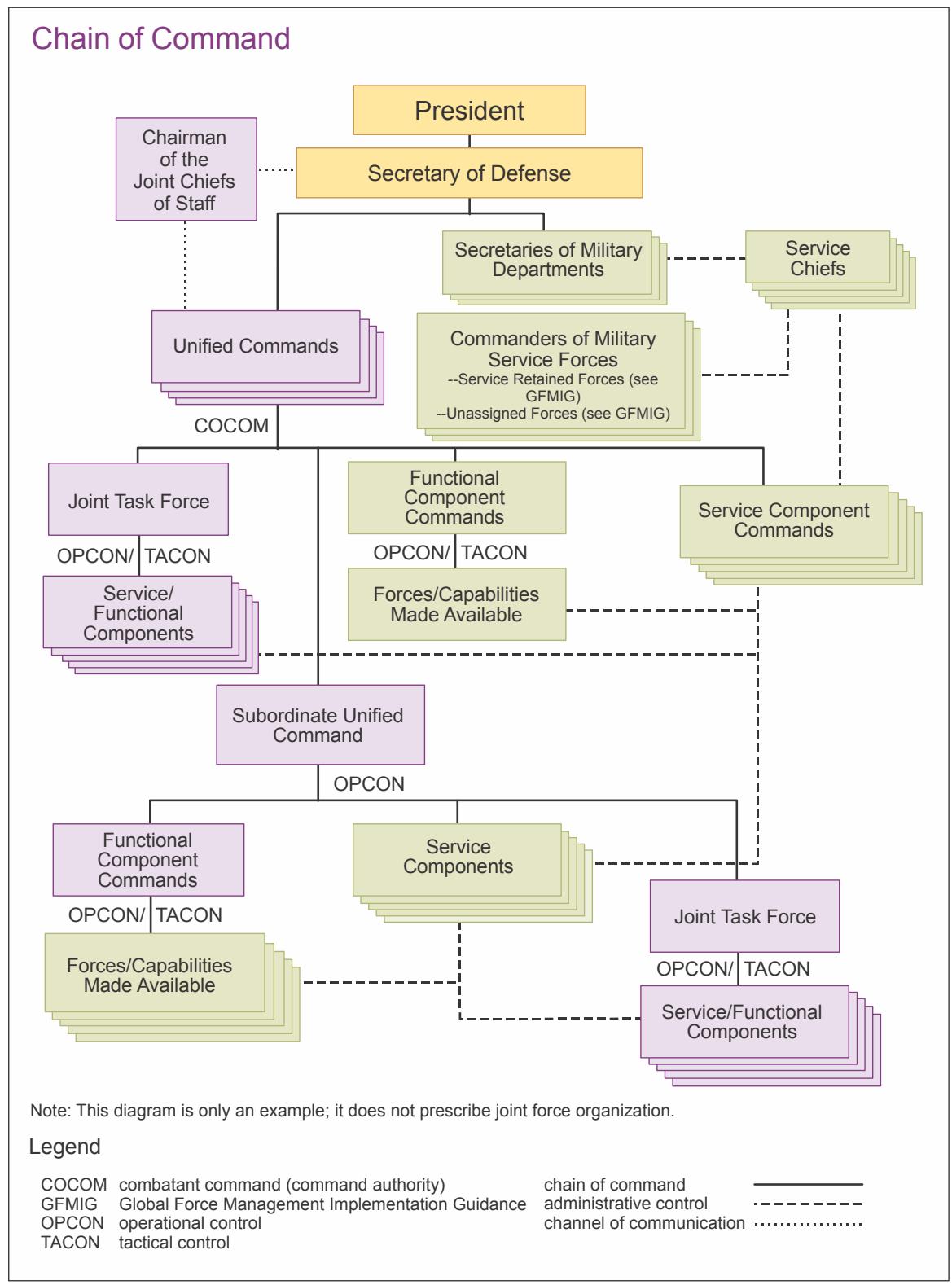
Two features of this diagram repay close reading. First, the Chairman of the Joint Chiefs — the highest-ranking officer in the Armed Forces — sits on a dotted line: "the CJCS, however, may not exercise military command over the CCDRs, JCS, or any of the Armed Forces" (ch. III). The nation's senior military professional is by law an advisor and a communications conduit, not a commander. Professional advice is structurally separated from command authority — a deliberate institutional check worth holding against Aghion & Tirole's (1997) formal-versus-real authority distinction: the CJCS holds enormous real authority (agenda, advice, doctrine) and essentially no formal command. Second, unity of command is defined with unusual precision: "all forces operate under a single commander with the requisite authority to direct all forces employed in pursuit of a common purpose," and "two commanders may not exercise the same command relationship over the same force at any one time" (ch. V). Where unity of command is politically impossible — interagency, multinational — doctrine downgrades the goal honestly to unity of effort: "coordination through cooperation and common interests" (ch. V).
Within the operational branch, authority is not a scalar but a typed vocabulary. JP 1 devotes an entire chapter to four command relationships plus supporting authorities, each with a defined scope, a delegation rule, and an exclusion list:
| Authority | What it grants | Delegation rule and design logic |
|---|---|---|
| COCOM (combatant command) | Full command over assigned forces: organizing, employing, assigning tasks, designating objectives, authoritative direction over operations, joint training, and logistics. | Vested only in combatant commanders by Title 10 §164; "cannot be delegated or transferred." The apex authority is deliberately non-transferable — one identifiable owner per mission set. Non-delegable |
| OPCON (operational control) | Organizing and employing forces, assigning tasks, designating objectives — but not directive authority for logistics, discipline, internal organization, or unit training. | Delegable to any echelon at or below combatant command. The workhorse authority: enough to run operations, deliberately less than ownership. Delegable |
| TACON (tactical control) | "Limited to the detailed direction and control of movements and maneuvers within the operational area" — direction of action, nothing else. | Delegable further still; cannot change a subordinate's function. Lets a commander borrow capability without acquiring the borrower's institutional obligations. Delegable |
| Support | An obligation of one commander to "aid, protect, complement, or sustain" another; four graduated categories — general, mutual, direct, close. | "By design, a somewhat vague but very flexible arrangement" whose specifics are written per-case in an establishing directive. Doctrine explicitly chooses incompleteness plus a contracting mechanism over false precision. Deliberately vague |
| ADCON / coordinating authority / DIRLAUTH | Administration and support (ADCON); consultation without power to compel agreement (coordinating authority); direct liaison between units (DIRLAUTH). | Non-command authorities, named as such. The vocabulary even types its weak relationships, so that no one mistakes consultation for command. Coordination, not command |
Read as organizational theory, this table is a decision-rights instrument of remarkable resolution. Where a firm might distinguish "solid line" from "dotted line," JP 1 distinguishes at least seven typed relationships, each answering in advance the questions the course synthesis says must never need renegotiation under fire: who commands, what forces, what mission, what may be decided, when authority transfers, who succeeds. And succession is itself pre-scripted: in a commander's absence, "interim command will pass to the deputy commander," and failing that "to the next senior officer present for duty who is eligible to exercise command, regardless of Service affiliation" (ch. IV). Condition 3 — the organization degrades — is answered not by resilience rhetoric but by a default rule that operates automatically when the chain breaks.
Sound organization should provide for unity of command, centralized planning and direction, and decentralized execution. Unity of effort is necessary for effectiveness and efficiency. Centralized planning and direction is essential for controlling and coordinating the efforts of the forces. Decentralized execution is essential because no one commander can control the detailed actions of a large number of units or individuals.
That excerpt is the series' thesis in four doctrinal sentences: centralize purpose and priorities; decentralize methods; and note the stated reason — span-of-attention limits, not management fashion. It is bounded rationality as an organizing principle. JP 1's mission-command passage completes it: mission command "empowers individuals to exercise judgment in how they carry out their assigned tasks," relying on "commander's intent" — "a clear and concise expression of the purpose of the operation and the military end state" that lets subordinates act "without further orders, even when operations do not unfold as planned" (ch. V). Command relationships fix who may decide; intent fixes what deciding well means. Session 05 gives this its full treatment as an incomplete-contracting problem.
Tension to carry forward
Every service member has two chains; doctrine calls this clarity, theorists call it matrix.
The dual operational/administrative branch is, formally, a matrix structure — the design militaries are supposed to abhor for its ambiguity. The doctrinal answer is that the two chains are typed so precisely (COCOM/OPCON vs. ADCON) that they never claim the same decision. Whether that answer survives practice — force-generation fights, dual-hatted commanders, Guard forces answering to governors in Title 32 status — is a discussion question below.
Levels of warfare and the mission grammar: how the organization partitions its problem
JP 1 partitions the use of force three ways — by level (strategic, operational, tactical), by intensity (the range of military operations), and by assignment grammar (task, function, mission). Each partition is a coordination device, and doctrine is candid that the seams leak.
The three levels of warfare "link tactical actions to achievement of national objectives. There are no finite limits or boundaries between these levels, but they help commanders design and synchronize operations, allocate resources, and assign tasks to the appropriate command" (JP 1, ch. I). Note what doctrine claims for the construct: not that reality is layered, but that the layering is useful — an admission that this is an imposed decomposition, in Simon's (1962) sense, chosen because near-decomposable problems are the only kind bounded agents can manage.
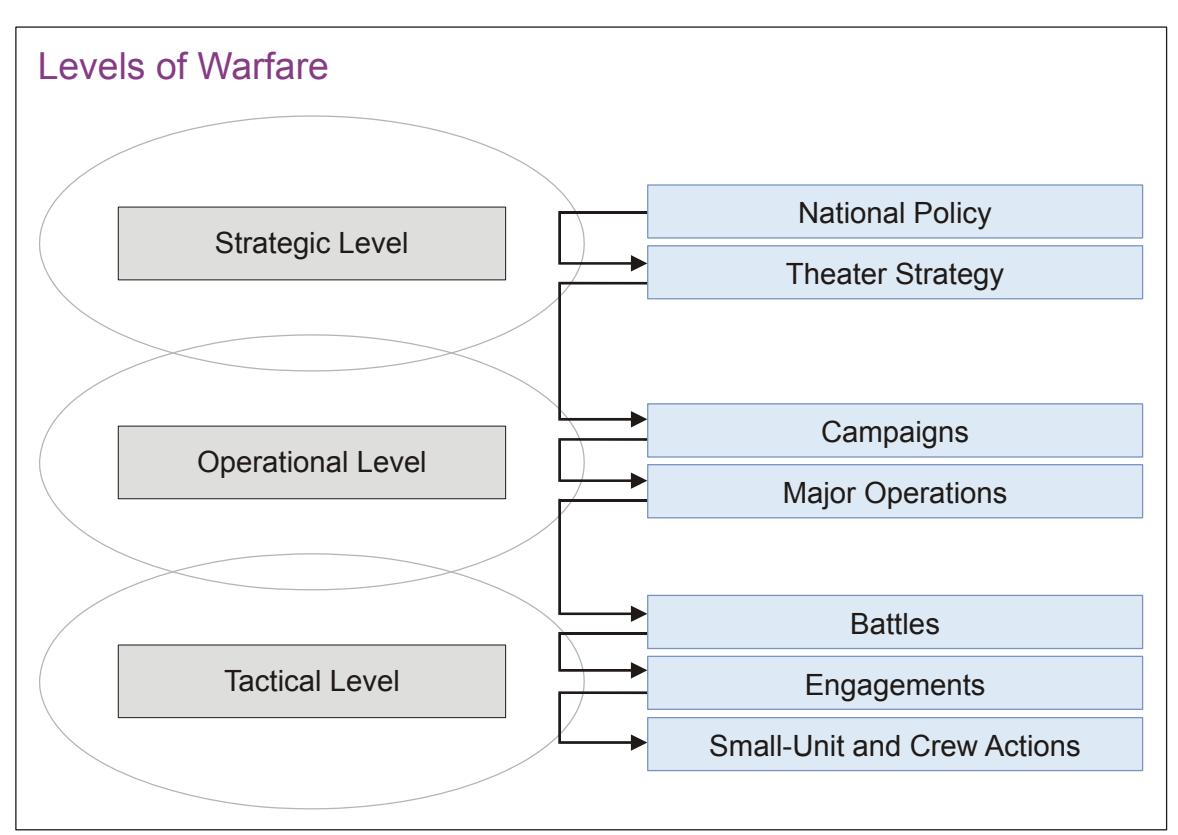
Strategic
Why are we acting, and what political outcome is required?
National guidance and resources. The President, advised by the NSC, sets policy and national strategic objectives; the Secretary of Defense translates them into military objectives; combatant commanders build theater strategies against them (JP 1, ch. I). Ends live here.
Operational
How should multiple actions be arranged to achieve the objective?
The linking level: "establishes operational objectives needed to achieve the military end states" and "sequences tactical actions to achieve objectives," using operational art — "the cognitive approach by commanders and staffs … to organize and employ military forces by integrating ends, ways, and means" (ch. I). This level exists precisely because tactical success does not aggregate automatically into strategic success.
Tactical
How do we accomplish this task against the opposition?
"The employment and ordered arrangement of forces in relation to each other" — engagements (short, sharp), battles ("a set of related engagements"), and the ordered maneuver of combat elements (ch. I). Means live here, in contact with the adversary.
Then doctrine undermines its own tidy picture, deliberately. "With today's constant 24-hour media coverage and easy access to the Internet … a tactical-level plan and resulting action can have severe operational or strategic implications. … an action by one Soldier, Marine, Sailor, or Airman on the battlefield at the tactical level could potentially cause significant disruption to operational and strategic-level planning. … In this sense, during execution all three levels overlap" (ch. I). The decomposition is load-bearing for planning and accountability, and simultaneously known to leak under the information environment's compression. An organization that partitions its problem and documents where the partition fails is doing contingency theory to itself.
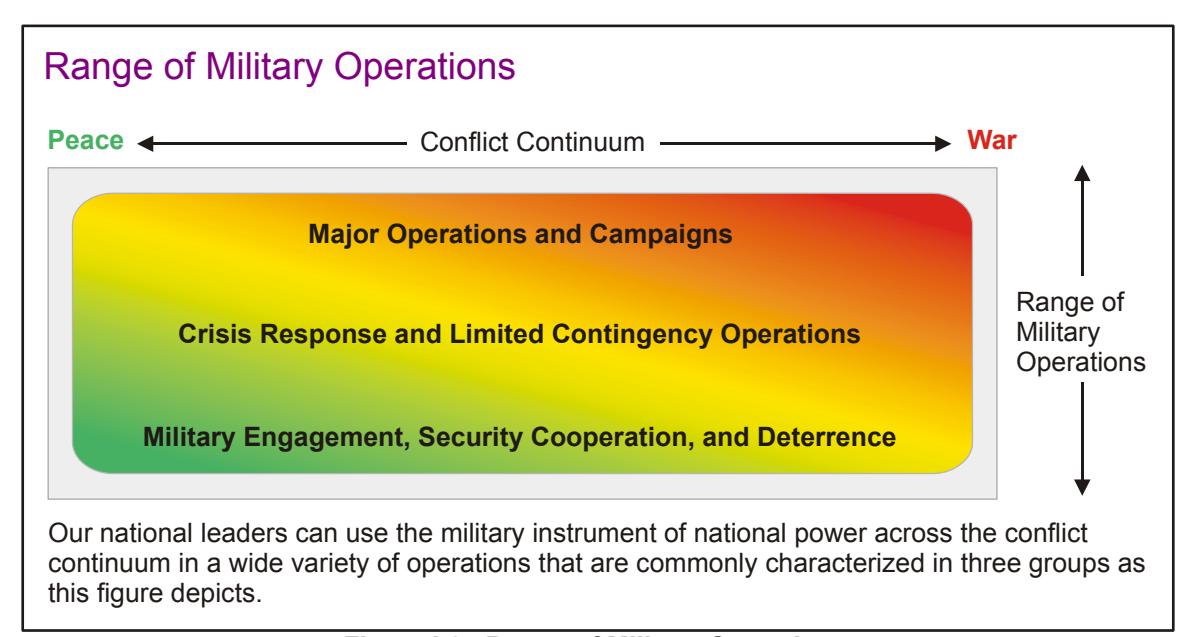
The second partition is by intensity. The range of military operations (ROMO) arranges uses of the military instrument "across a continuum of conflict ranging from peace to war" in three broad categories: military engagement, security cooperation, and deterrence (the ongoing shaping activities — deterrence being "a state of mind brought about by the existence of a credible threat of unacceptable counteraction"); crisis response and limited contingency operations; and major operations and campaigns, which "feature a balance among offensive, defensive, and stability operations through six phases: shape, deter, seize initiative, dominate, stabilize, and enable civil authority" (ch. I). The same organization must run church-quiet engagement activities and large-scale combat with the same people and structures — a range-of-demand problem no single Burns-and-Stalker pole could serve.
The third partition is grammatical, and it is the one most transferable to any organization. JP 1 distinguishes three terms most institutions blur. A task is "a clearly defined action or activity assigned to an individual or organization … imposed by an appropriate authority." A function is "the broad, general, and enduring role for which an organization is designed, equipped, and trained" — what the organization is for. A mission "entails the task, together with the purpose" (ch. I). The mission's mandatory five-part form — who, what, when, where, and above all why — hard-wires purpose into every assignment. This is the grammatical precondition for decentralized execution: a subordinate who has only a task must ask for new orders when circumstances change; a subordinate who holds task-plus-purpose can re-derive correct action locally. The five-part mission statement is intent made compulsory at every echelon.
Objective, offensive, mass, economy of force, maneuver, unity of command, security, surprise, simplicity (JP 1, Figure I-1). A compressed, memorizable heuristic set — organizational memory in checklist form, carried in heads rather than servers.
Command and control, intelligence, fires, movement and maneuver, protection, sustainment, information — the seventh (information) added by Change 1 in 2017 (JP 1, ch. I). Capabilities are grouped functionally so a commander can audit completeness: "inattention to protection can deplete combat power … inattention to intelligence can leave the force with inadequate information."
Who, what, when, where, why. "A mission always consists of five parts" (JP 1, ch. I). The why is what converts an order into a delegable intention.
Traditional (state-on-state imposition of will, "the preeminent form of warfare in the West since the Peace of Westphalia (1648)") and irregular ("a violent struggle among state and non-state actors for legitimacy and influence over the relevant population(s)") — applied "not in terms of an 'either/or' choice, but in various combinations" (JP 1, ch. I).
The profession of arms, civilian control, and the central paradoxes
The formal machinery of Sections 03–05 rests on a normative substrate JP 1 treats as load-bearing: a values-based profession under civilian control. The design is best summarized as a system of managed tensions, not a set of solved problems.
JP 1 calls the joint force "a values based organization" whose leaders' "character, professionalism, and values … have proven to be vital for operational success" (ch. I) — and then, unusually for a command document, devotes an appendix to what that means. "A professional is a person of both character and competence" (App. B). The values are enumerated — "Duty, honor, courage, integrity, and selfless service are the calling cards of the profession of arms" — and defined operationally, not ornamentally: integrity is "the cornerstone for building trust"; moral courage is "the ability to act rightly in the face of popular opposition, or discouragement"; and teamwork "requires delegation of authority commensurate with responsibility," because delegation "unleashes the best efforts and greatest initiative among all members of military teams" (App. B). Read functionally, the values appendix is the trust-production system that makes the decentralized execution of Section 04 safe: mission command runs on "a high degree of mutual trust," and trust "results from honest efforts to learn about and understand the capabilities that each member brings … demonstrated competence, and planning and training together" (ch. V). Normative control is not the soft alternative to structure here; it is the enabling condition for the structure's most important feature.
Condition 5 gets the same double treatment — structural and normative. Structurally, civilian control is wired into every chain in Section 04: both branches begin with the President; orders reach combatant commanders through the Secretary of Defense; the senior officer commands nothing. Legally, "the Armed Forces of the United States will adhere to the law of war … during all military operations," a body of law "binding on the US and its individual citizens" (ch. I) — obedience is owed to lawful authority, not to superiors as persons. The course synthesis draws the professional consequence: candid advice before the decision, objection when orders are unlawful, disciplined execution once a lawful decision is made, accountability for both giving and carrying out orders. And it names the failure modes on both sides — insubordination, where personal agreement becomes a precondition for action, and unthinking obedience, where members surrender legal and moral agency. "A capable military requires obedience without servility."
The synthesis's deepest structural claim is that mission primacy imposes a lexical ordering on the organization's considerations — and that the ordering is what distinguishes military from commercial reasoning:
-
First consideration
Lawful political purpose. The mission is not self-justifying; it inherits legitimacy from civilian direction and law. Remove this rung and mission primacy degenerates into "results justify anything" — the failure mode the synthesis flags explicitly.
-
Second consideration
Mission accomplishment. The question is not "is the expected return worth the cost?" but "what must be accomplished, what risks are necessary, and what resources must be committed?" Units and departments exist to contribute to the common objective, not to maximize local performance indicators.
-
Third consideration
Preservation of the force. Not disposability: competent leadership conserves lives and resources "because they are morally important and operationally necessary." But preservation ranks below mission — the inversion of an ordinary employer's duty structure, and the reason conditions 4 and 5 demand so much legitimacy.
-
Fourth consideration
Efficiency and administrative convenience. Last, explicitly. Readiness logic preserves surge capacity, redundancy, and reserves that peacetime efficiency logic would cut — the civilian-efficiency versus military-readiness table in the synthesis is the clearest single statement of the difference.
NDP 1 (2020) shows the same substrate in a Service voice. Its command philosophy chapter grounds mission command not in regulation but in geography and heritage: "In the not-too-distant past, Navy and Coast Guard sea captains and Marine commanders had to operate for months at a time with minimal communication back to higher headquarters. This cultivated a rich heritage of mission command that is a particular necessity in naval warfare" (NDP 1, ch. I). The epigraph it chooses is the most compact statement of the doctrine–training–initiative triangle in the corpus:
From skill and doctrine flows the initiative of the subordinate. Give the subordinate a proper understanding of the mission and proper training, and he may be relied upon to act correctly in an emergency when orders or instructions from higher authority are not available.
Finally, the synthesis insists the whole design is a system of tensions to be continually balanced, not rules to be applied. The seminar returns to these six paradoxes all term; state them now as the course's standing agenda:
Paradox 1
Obedience versus initiative
Too much obedience produces passivity; too much initiative produces fragmentation. The resolution is not a midpoint but a division of labor: superiors define purpose, priorities, and boundaries; subordinates adapt execution to reality. Sherman's warning cuts one way — "An army is a collection of armed men obliged to obey one man. Every change in the rules which impairs the principle weakens the army" (quoted in JP 1, ch. II) — Yarnell's epigraph cuts the other.
Paradox 2
Standardization versus adaptation
Without standardization, units cannot coordinate or combine; with too much, predictable procedures are exploited by the adversary and judgment atrophies. Resolution: standardize interfaces and essential drills; adapt plans and methods. Session 02 reads doctrine's "authoritative but requires judgment" formula as this paradox institutionalized.
Paradox 3
Secrecy versus shared understanding
Security protects the force from the enemy; sharing protects the force from its own ignorance. The failure mode is information as status: "a force that protects information from itself more successfully than from its adversary." Session 04's C2 material lives inside this tension.
Paradox 4
Cohesion versus candor
Cohesion enables sacrifice; candor enables correction. Strong cohesion can conceal misconduct, resist newcomers, and punish truthful reporting. "'Protecting the team' cannot mean protecting the team from truth." Sessions 06 and 08 (training, learning) depend on candor surviving cohesion.
Paradox 5
Mission accomplishment versus legitimacy
An operation can achieve its physical objective while destroying the political purpose it served. Force is therefore not evaluated by target destruction alone; legality, civilian protection, alliance confidence, and public legitimacy are part of strategic effectiveness — which is why the law of war sits in doctrine's theory chapter, not an annex.
Paradox 6
Readiness versus efficiency
A force optimized for administrative efficiency is brittle in war; one optimized only for hypothetical emergencies is unaffordable and stagnant. The design question is which capabilities must stay resilient and where ordinary efficiency is acceptable — "not whether redundancy exists, but whether it protects a genuinely critical function against a plausible failure."
Where this leaves the theory
The military is contingency theory's boundary experiment.
Every classical framework survives here only in modified form: mechanistic–organic becomes a layered hybrid; information-processing capacity gives way to pre-positioned understanding; differentiation–integration is confirmed but must be legislated; buffering is inverted from the core to the command system. That pattern — classical predictions bending in a consistent direction under adversarial, irreversible, self-degrading conditions — is what makes doctrine worth a nine-session read. The bend is the data.
Seminar discussion
Questions to structure the session's second hour.
- Degree or kind? Firms also face intelligent, adaptive opponents — competitors reverse-engineer strategies and poach talent. Is the military's "intelligent adversary" condition a difference in kind from market competition, or only in stakes? Identify precisely which classical assumption fails under an adversary that targets the organization's structure (its leaders, channels, and procedures) rather than merely its market position — and whether any firm faces that.
- Integration by statute. Lawrence & Lorsch found that high performers pair differentiation with costly integration achieved through internal mechanisms. The U.S. answer — Goldwater-Nichols — imposed integration by law over Service resistance. Is the joint construct evidence that sufficiently deep differentiation makes voluntary integration impossible? What is the civilian analogue of "jointness is not automatic and it is perishable"?
- The escape clause. Doctrine binds "except when, in the judgment of the commander, exceptional circumstances dictate otherwise." Does that clause make doctrine stronger organizational memory (because it stays honest about its own limits) or weaker (because every deviation is self-authorizing after the fact)? Compare Hansen, Nohria & Tierney's warning against straddling codification and personalization: is doctrine a straddle that works, and if so, why?
- The matrix that dares not speak its name. Every service member sits in two chains of command — operational and administrative. Militaries supposedly cannot tolerate matrix ambiguity, yet this is a matrix, resolved by typing the authorities (COCOM/OPCON vs. ADCON) so finely that the chains rarely claim the same decision. Could a firm adopt "typed authority" instead of dotted-line ambiguity? What breaks first?
- Advice without command. The Chairman — the highest-ranking officer — commands no forces by law. Aghion & Tirole would say he holds real authority without formal authority. What does this separation buy the principal (the President), what does it cost, and why do firms almost never split their senior expert's advice from line authority this cleanly?
- Levels under compression. JP 1 concedes that one tactical actor "could potentially cause significant disruption to operational and strategic-level planning." If the information environment collapses the levels during execution, is the three-level construct still carving the organization at its joints — or is it retained because accountability requires a decomposition even when causality ignores it?
- Values as design or as myth. JP 1 calls the joint force "a values based organization" and devotes an appendix to duty, honor, courage, integrity, and selfless service. Meyer & Rowan (1977) would ask whether this is load-bearing normative control (the trust substrate that makes decentralized execution safe) or institutional myth decoupled from practice. What evidence, internal to the documents we read, could distinguish the two?
- The transfer test. Take an organization you know — hospital, startup, platform firm, open-source project. Which of the five environmental conditions does it actually face, at what intensity? Using the synthesis's Part V, name one military practice it should borrow and one it should refuse — and state the environmental condition whose absence justifies the refusal.
Synthesis and bridge
What this session establishes and what it sets up.
What we established
Military structure is environmental logic, legible in doctrine.
Five conditions — intelligent adversary, irreversible failure, self-degradation, coercible membership, political subordination — jointly select the military package: doctrine as pre-positioned shared understanding with a priced escape clause; a typed grammar of command authority with pre-scripted succession; a three-level decomposition held with candor about its leaks; a values-based profession as the trust substrate for decentralized execution; and the whole held together as six managed paradoxes rather than solved problems. Classical contingency theory bends consistently, and instructively, at this limit.
Next session
Session 02 — Doctrine as Organizational Memory
Having established what doctrine is for, we examine what doctrine is: codified institutional knowledge with the "authoritative but requires judgment" property. We map the publication hierarchy as a memory architecture in Walsh & Ungson's retention-bin terms, and use NDP 1's 1994 and 2020 editions as a controlled comparison of how one organization rewrites its own memory when the environment moves.
Sources and evidence
Every material claim in this lecture traces to these documents.
Source register