Assigned readings
The Army's mission-command doctrine as the session's centerpiece, the joint capstone publication for the authority architecture, the Marine Corps' warfighting philosophy and its learning doctrine, a short Army primer for what delegation demands informationally, the Navy's cultural framing for contrast, and three theory works that make the design legible.
Army Doctrine Publication 6-0, Mission Command: Command and Control of Army Forces (2019)
The session's actual centerpiece — the Army's own mission-command doctrine, which the first draft of this session was built without. Read Chapter 1's "Principles of Mission Command" (the seven named principles: competence, mutual trust, shared understanding, commander's intent, mission orders, disciplined initiative, risk acceptance) and its "Command and Control" section. Read the Introduction closely: it documents the Army's 2012→2019 reversal on the very words, which is primary evidence for this seminar's doctrine-as-memory theme. This is where mission command is stated as an approach, not merely a method to be selected.
../sources/c2_mission_command/adp_6_0_mission_command_2019.mdJoint Publication 1, Doctrine for the Armed Forces of the United States (2013, incorporating Change 1, 2017)
Read Chapter IV, "Joint Command Organizations" (how joint forces are established and organized; commander and subordinate responsibilities), and Chapter V, "Joint Command and Control" (Section A: the COCOM/OPCON/TACON/support taxonomy and other authorities; Section B: C2 fundamentals, the ten tenets, mission command). Skim Chapter II for the dual-branch chain of command. Treat every definition as an allocation of a decision right.
../sources/joint/jp1_doctrine_for_the_armed_forces_2013_ch1_2017.mdCenter for Army Lessons Learned, Executing Knowledge Management in Support of Mission Command: A Primer for Senior Leaders (18-02, 2017)
Short — read it whole, but for this session read it as evidence about mission command's informational preconditions: the claim that mission command and knowledge management have become "a single operational concept, inseparably linked," the three failure areas observed at the Combat Training Centers, and the shared-understanding ladder. Its knowledge-management machinery (the five-step process, the maturity model, the KM team) is Session 06's material; hold it.
../sources/army/army_km_mission_command_primer_2017.mdNaval Doctrine Publication 1, Naval Warfare (2020) — command sections
Read the "Command" and "Commander's Intent" material in Chapter III, plus the Battle off Samar vignette at the front. NDP 1 supplies what JP 1's legal register omits: the three approaches to command (direction, planning, influence), the claim that mission command "seeks to reduce the need for certainty," the recurring technological pull toward centralization, and the norm that an error of judgment is faulted less than a failure to act.
../sources/navy/ndp1_naval_warfare_2020.mdMarine Corps Doctrinal Publication 1, Warfighting (1997)
Read Chapter 4, "The Conduct of War" — specifically the "Mission Tactics" and "Commander's Intent" sections, plus the command-philosophy passages that open the chapter. Where JP 1 and ADP 6-0 write mission command as doctrine, MCDP 1 writes it as a warfighting philosophy: mission tactics as "a contract between senior and subordinate," intent as the more-lasting half of every mission, and initiative "down to the lowest levels" as the animating trait of maneuver warfare rather than a procedure to be followed.
../sources/c2_mission_command/mcdp_1_warfighting_1997.mdMarine Corps Doctrinal Publication 7, Learning (2020)
Skim for the argument, not the detail: the Marine Corps' learning doctrine is the institutional machinery that manufactures mission command's trust and competence preconditions. It names "continuous learning" as the source of the judgment on which decentralized command depends — the doctrine underwriting ADP 6-0's competence principle.
../sources/c2_mission_command/mcdp_7_learning_2020.mdAlberts, D. S., & Hayes, R. E. (2003). Power to the Edge: Command…Control…in the Information Age. CCRP.
The information-age counter-argument. Alberts and Hayes push decentralization further than mission command will go: "edge organizations" that unbundle command and control, dissolve middle management, and let networked forces self-synchronize near-autonomously on shared awareness. Read it against mission command's more conservative, hierarchy-anchored delegation — they disagree instructively about how far real authority should travel toward the edge.
../sources/c2_mission_command/alberts_hayes_power_to_the_edge_2003.mdAghion, P., & Tirole, J. (1997). Formal and real authority in organizations. Journal of Political Economy, 105(1), 1–29.
The spine of the session. Formal authority is the right to decide; real authority is effective control over decisions, and it accrues to whoever holds the relevant information. Delegating formal authority buys subordinate initiative at the price of control; an overloaded principal loses real authority anyway. JP 1 reads like a field test of the whole model.
doi.org/10.1086/262063Simon, H. A. (1951). A formal theory of the employment relationship. Econometrica, 19(3), 293–305.
Read for the zone of acceptance: an employment contract sells not a specific act but the acceptance of authority over a range of acts, and it is efficient precisely when the employer cannot foresee which act will be needed. Mission-type orders are Simon's logic pointed in the other direction — contracting on purpose because actions cannot be specified. Pair with Administrative Behavior (1947) on authority.
doi.org/10.2307/1906815Edmondson, A. (1999). Psychological safety and learning behavior in work teams. Administrative Science Quarterly, 44(2), 350–383.
The enabling-condition reading. Mission command's mutual-trust tenet and the Navy's error-forgiveness norm are, in Edmondson's terms, an attempt to institutionalize psychological safety — the shared belief that interpersonal risk-taking will not be punished — because without it delegated authority goes unused.
doi.org/10.2307/2666999Formal authority made explicit: the command-relationship taxonomy
JP 1 does not gesture at "who's in charge." It defines four graduated bundles of command authority — COCOM, OPCON, TACON, support — plus three non-command authorities, and specifies for each what it includes, what it excludes, and whether it can be delegated.
Chapter V opens with the axioms. Command is "central to all military action"; inherent in it is lawful authority over subordinates, including the authority to assign missions — and accountability for their completion. Two design rules follow immediately. First, responsibility is non-delegable even when authority is delegated: commanders "may not absolve themselves of the responsibility" for missions whose execution they hand down. Second, authority is always bounded: its extent "is specified by the establishing authority, directives, and law." In Simon's (1947) terms, JP 1 writes the zone of acceptance down instead of leaving it implicit in custom — every grant of authority arrives with its limits attached. Unity of command adds a uniqueness constraint: all forces operate under a single commander with the requisite authority, and "two commanders may not exercise the same command relationship over the same force at any one time." Where unity of command is politically impossible — interagency work, coalitions — the doctrine downgrades honestly to unity of effort, "coordination through cooperation and common interests," which it treats as a complement, not a substitute.
Command is central to all military action, and unity of command is central to unity of effort. Inherent in command is the authority that a military commander lawfully exercises over subordinates including authority to assign missions and accountability for their successful completion. Although commanders may delegate authority to accomplish missions, they may not absolve themselves of the responsibility for the attainment of these missions. Authority is never absolute; the extent of authority is specified by the establishing authority, directives, and law.
The taxonomy itself is a nested set of authority bundles, each strictly contained in the one above it. Combatant command (command authority), or COCOM, is the full bundle: vested only in combatant commanders by Title 10, U.S. Code, Section 164, it covers organizing and employing commands and forces, assigning tasks, designating objectives, and "authoritative direction over all aspects of military operations, joint training, and logistics" — JP 1 enumerates twenty-four distinct elements of it, from prescribing the chain of command to convening general courts-martial. COCOM "cannot be delegated or transferred." Operational control (OPCON) is the same core — organize, employ, task, direct — minus directive authority for logistics, administration, discipline, internal organization, and unit training, and unlike COCOM it may be delegated at or below the combatant command level. Tactical control (TACON) shrinks further, to "the detailed direction and control of movements and maneuvers within the operational area"; it confers no organizational authority and no logistics. Support, the fourth relationship, is the interesting outlier — an authority JP 1 describes, remarkably, as "by design, a somewhat vague but very flexible arrangement," in which a common superior obligates one commander to aid, protect, complement, or sustain another.
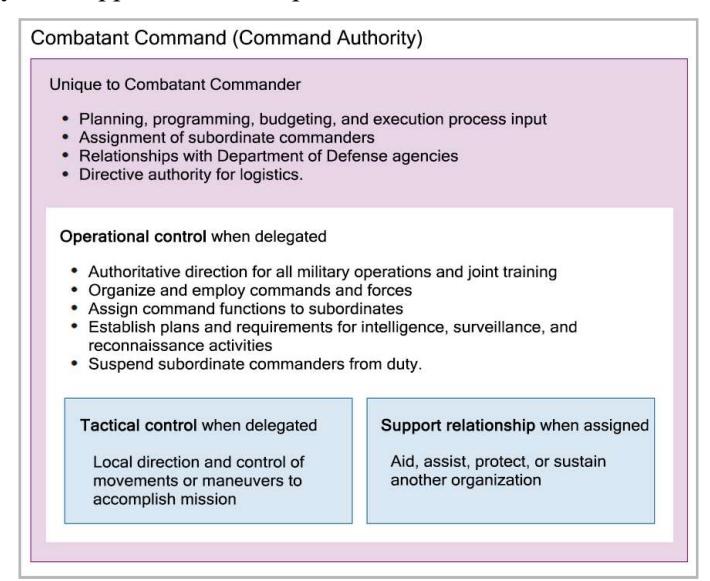
| Authority | What the bundle includes | Delegation rules and limits |
|---|---|---|
| COCOM | Full command functions over assigned forces: organize and employ, assign tasks, designate objectives, authoritative direction over all military operations, joint training, and logistics (including directive authority for logistics). JP 1, Ch. V, §2; Title 10 §164 |
Vested only in combatant commanders; nontransferable and non-delegable. Exercised through subordinate JFCs and component commanders. |
| OPCON | Organize and employ commands and forces, assign tasks, designate objectives, authoritative direction over military operations and joint training necessary to accomplish the mission. JP 1, Ch. V, §3 |
Delegable within the command at or below CCMD level. Excludes logistics, administration, discipline, internal organization, unit training — each must be specifically delegated. |
| TACON | Detailed direction and control of movements and maneuvers within the operational area to accomplish assigned missions or tasks. No power to give or change the subordinate commander's function. JP 1, Ch. V, §4 |
Delegable to any echelon at or below CCMD. Typical authority of functional component commanders over forces "made available for tasking" by other components. |
| Support | One force aids, protects, complements, or sustains another. Four categories: general, mutual, direct, close. The supported commander exercises "general direction of the supporting effort" — designating targets, timing, duration. JP 1, Ch. V, §§5–7; App. A |
Established by a common superior via an establishing directive specifying purpose, desired effect, scope, forces allocated, priority, and the degree of authority granted. Deliberately "vague but very flexible." |
Beneath the command relationships sit three authorities that explicitly are not command. Administrative control (ADCON) is direction over administration and support — organization of Service forces, resources, personnel management, logistics, readiness — the Military Departments' Title 10 responsibility. Coordinating authority grants the power "to require consultation between the agencies involved" but "not the authority to compel agreement": Mintzberg would file it under liaison roles and mutual adjustment, a coordination mechanism deliberately stripped of decision rights. Direct liaison authorized (DIRLAUTH) permits a subordinate to coordinate directly outside the chain — with the standing obligation to keep the granting commander informed. The taxonomy therefore separates three things most organizations blur into one reporting line: operational decision rights (who directs your actions), administrative decision rights (who feeds, trains, promotes, and disciplines you), and coordination rights (who may convene you without commanding you).
Theory reading
A menu of formal-authority contracts, priced by what they exclude.
Aghion and Tirole (1997) define formal authority as the contractually allocated right to decide. What JP 1 adds to their model is granularity: rather than one bit — delegate or don't — the joint force maintains a menu of standardized authority bundles, each defined by its exclusions, so that a force can be handed over for a mission (TACON), an operation (OPCON), or indefinitely (assignment under COCOM) without renegotiating from scratch. Standardizing the contract forms is itself a coordination device: every officer knows what OPCON does not include, which is exactly what makes rapid transfers of forces between commands feasible.
Two chains, one force: a matrix with explicit conflict rules
Every U.S. military unit answers to two hierarchies at once — an operational chain that employs it and an administrative chain that raises and sustains it. JP 1 does not apologize for the matrix; it writes the interface contract.
Chapter II specifies that the President and Secretary of Defense "exercise authority, direction, and control of the Armed Forces through two distinct branches of the chain" of command and control. The operational branch runs from the President through SecDef to the combatant commanders, for missions and forces assigned to their commands. The administrative branch runs from the President to SecDef to the Secretaries of the Military Departments, who — through the Service Chiefs — exercise ADCON: organizing, training, equipping, and supporting Service forces. A deployed Army brigade thus takes operational direction from a joint force commander while its personnel system, doctrine, equipment, and discipline flow through the Department of the Army. Organization theory would call this a two-dimensional matrix; JP 1's innovation is that the seam is governed by explicit rules rather than negotiation. Service component commanders are the designated interface: they answer to the combatant commander "on all matters for which the CCDR has been assigned authority" and to their Service Chief on "Service-specific matters such as personnel, administration, and unit training," with defined escalation paths — an unresolved logistics dispute goes from the CCDR through the Chairman of the Joint Chiefs of Staff to SecDef for resolution.
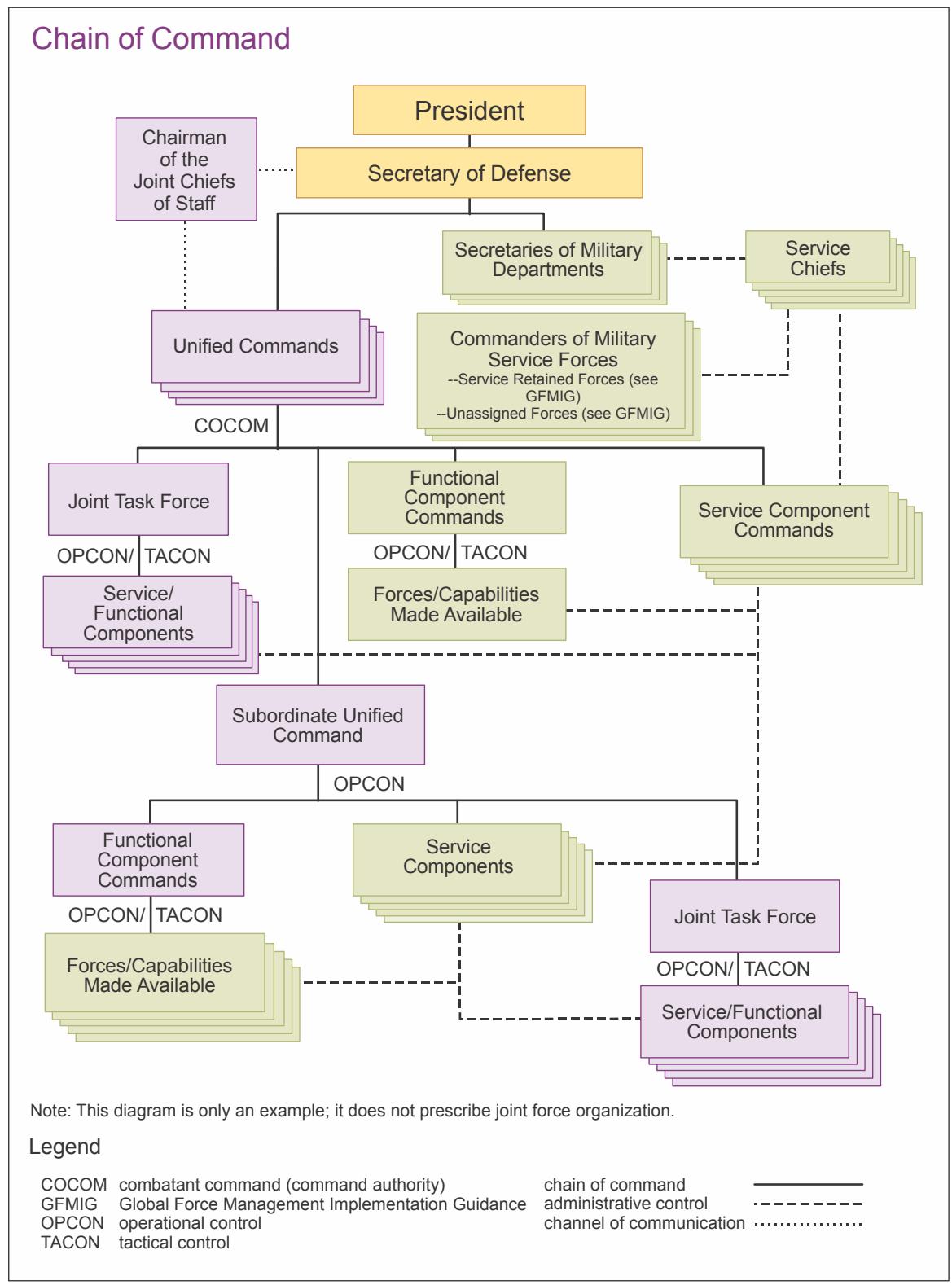
Movement between commands is likewise contractualized. The doctrine's rule is compact: "Forces, not command relationships, are transferred between commands," and every transfer must specify the command relationship the gaining commander will exercise and the losing commander will relinquish. Duration determines the default bundle — permanent or indefinite transfers mean assignment, with the gaining CCDR exercising COCOM; temporary transfers mean attachment, normally with OPCON. Only SecDef can direct a transfer, under procedures approved by the President. The result is a delegation cascade in which each echelon receives a defined bundle and passes a smaller one downward.
-
President / Secretary of Defense
Assign forces and missions. The Unified Command Plan establishes combatant commands; the Global Force Management Implementation Guidance assigns forces. Orders flow to CCDRs through the Chairman, who transmits but does not command.
-
Combatant commander (COCOM)
Prescribe the chain, delegate the rest. The CCDR prescribes the chain of command within the CCMD, organizes subordinate commands (subunified commands, JTFs, Service and functional components), and delegates OPCON or TACON — but never COCOM.
-
Subordinate JFC (OPCON)
Organize for the mission. A JTF commander exercises OPCON over assigned and normally attached forces, establishes command and support relationships between subordinate commanders, and may further delegate.
-
Functional component (OPCON / TACON)
Task what is made available. A functional component commander normally holds OPCON over own-Service forces and TACON over forces other components make available for tasking — the thinnest command bundle, matched to the narrowest scope.
Two features of this architecture deserve emphasis. First, the design embeds state-contingent authority: in a major emergency, a geographic combatant commander "may temporarily assume OPCON of all forces in the assigned AOR, including those of another command" — an authority that itself "will not be delegated," and that triggers immediate notification duties to the Chairman, affected commanders, and Service Chiefs. The org chart contains its own crisis mode, pre-authorized and bounded, rather than relying on improvisation when the contingency arrives. Second, even the vague support relationship is disciplined by paperwork: the establishing directive states the purpose, effect, and scope of support, the forces committed, its priority, the supporting commander's authority to modify the effort "in the event of exceptional opportunity or an emergency," and precisely how much authority the supported commander is granted. The supported commander gets general direction of the effort; the supporting commander retains choice of "forces, tactics, methods, procedures, and communications." That split — ends to the customer, means to the provider — is the taxonomy's smallest-scale rehearsal of mission command itself.
Delegation by design: centralized planning, decentralized execution
Chapter IV states the organizing principle outright and grounds it in a cognitive-limits argument Simon could have written: no one commander can control the detailed actions of a large force. Then it writes the reciprocal obligations of superior and subordinate.
Sound organization should provide for unity of command, centralized planning and direction, and decentralized execution. Unity of effort is necessary for effectiveness and efficiency. Centralized planning and direction is essential for controlling and coordinating the efforts of the forces. Decentralized execution is essential because no one commander can control the detailed actions of a large number of units or individuals.
Note what the justification is not. It is not that subordinates deserve autonomy, nor that decentralization is intrinsically virtuous. It is a bounded-rationality claim: central control of detail is impossible at scale, so the only design question is whether the inevitable decentralization is organized or accidental. This is Aghion and Tirole's overload result stated as doctrine — a principal who cannot process everything will lose real authority over most decisions regardless of what the org chart says; the choice is whether to formalize that loss on favorable terms. JP 1 formalizes it. A joint force commander's general responsibilities are a delegation contract in four clauses: provide "a clear commander's intent and timely communication of specified tasks" with tasks "realistic yet leav[ing] subordinate commanders flexibility in their CONOPS and the ability to take the initiative as opportunities arise"; transfer forces to subordinates for their tasks; "provide all available information to subordinate JFCs and component commanders that affect their assigned missions"; and "delegate authority to subordinate JFCs and component commanders commensurate with their responsibilities." Authority commensurate with responsibility, plus an affirmative duty to share information downward — the two transfers, of rights and of information, travel together.
The subordinate's side of the contract is equally explicit. Subordinates accomplish assigned missions, and "authority normally is given to the subordinate commander to select the methodology for accomplishing the mission." But method-freedom carries notification duties: "Any departure from the plan by a subordinate commander should, if possible, be coordinated with other commanders prior to departure from the plan. In addition, the departure must be communicated as soon as practicable to the superior." Subordinates also owe advice upward and "timely information" on their situation and progress; commanders who merely share a boundary owe each other consideration of second-order effects, timely information about their own intentions, and mutual support "as required by the common aim." In incomplete-contract terms this is the renegotiation protocol: the contract anticipates its own violation, and prices deviation not as disobedience but as a reporting obligation.
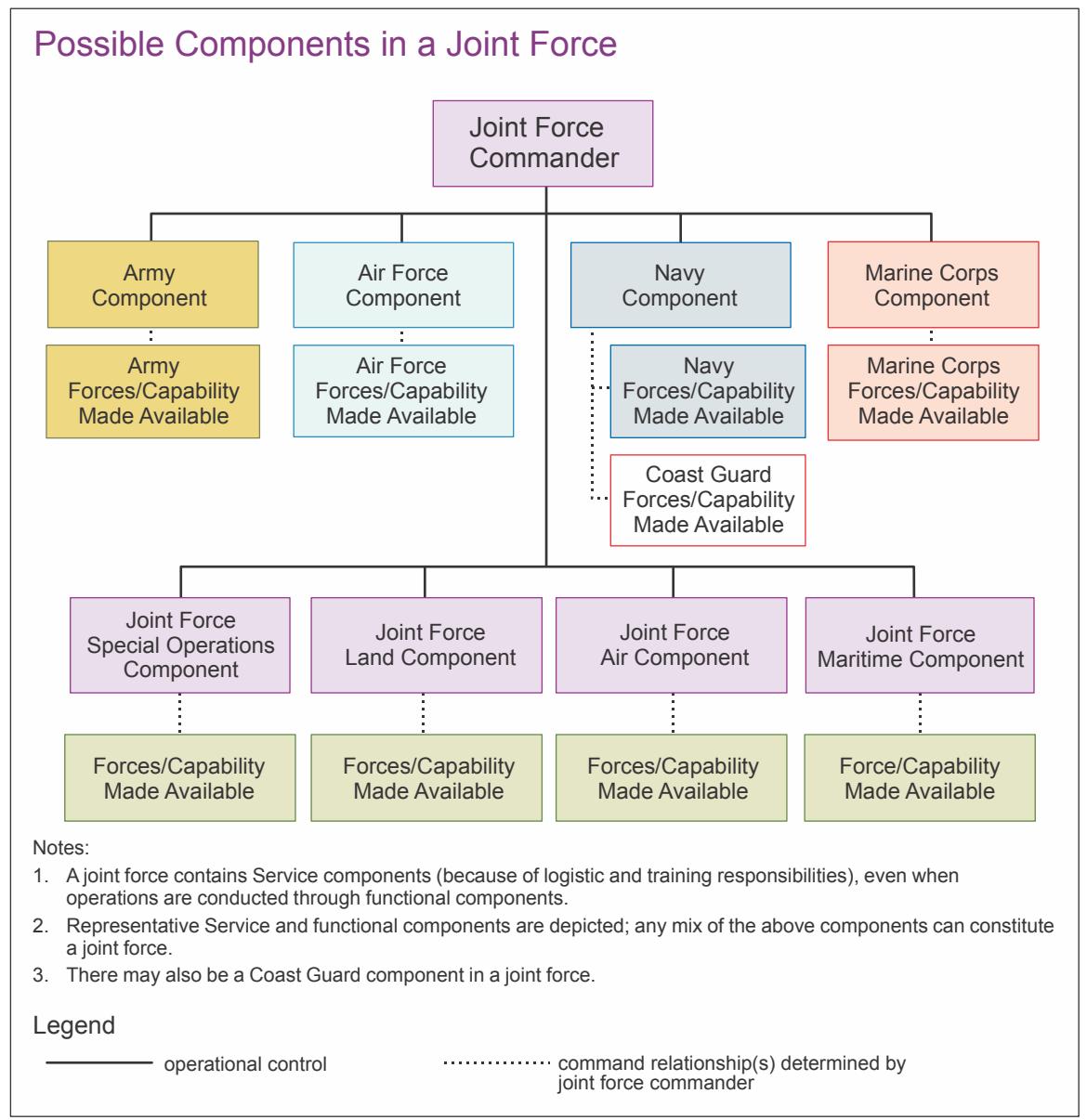
Organizational form is itself treated as a delegated design variable. The JFC "has the authority to organize assigned or attached forces … to best accomplish the assigned mission based on his intent" — choosing among six standard options (subunified command, JTF, Service component, functional component, single-Service force, specific operational force) under four stated principles: simplicity, span of control, unit integrity, and interoperability. Span of control is explicitly multi-causal — "the number of subordinates, number of activities, range of weapon systems, force capabilities, size and complexity of the operational area, and method used to control operations (centralized or decentralized)" — a contingency statement Graicunas and Urwick would recognize. And the doctrine flags the delegation-eroding temptation directly: JFCs may establish functional components precisely to "integrate planning; reduce their span of control; and/or significantly improve combat efficiency, information flow, unity of effort", and "may elect to centralize selected functions within the joint force, but should strive to avoid reducing the versatility, responsiveness, and initiative of subordinate forces." Centralization is available, priced, and warned against in the same sentence.
Four command relationships (COCOM, OPCON, TACON, support) and three non-command authorities (ADCON, coordinating authority, DIRLAUTH), each with stated delegation rules.
JP 1, Chapter V lists twenty-four specific authorities inside combatant command — from prescribing the chain of command to convening general courts-martial. Formal authority, itemized.
A unified CCMD exercises authority through subunified commands, JTFs, Service components, functional components, single-Service forces, or specific operational forces — a fixed menu of forms, composable per mission.
COCOM cannot be delegated or transferred. Whatever else moves, ultimate formal authority and its accountability stay anchored at the combatant commander.
Mission command: intent as incomplete contract, initiative as real authority
JP 1 names mission command "the preferred method of exercising C2." Its mechanics — mission-type orders, commander's intent, disciplined initiative, mutual trust — map one-to-one onto the machinery of delegation theory.
The doctrinal placement matters: mission command appears in Chapter I as a property of the C2 joint function ("Mission command is the preferred method of exercising C2") and again in Chapter V as the second of ten C2 tenets — after "clearly defined authorities, roles, and relationships" and before information management, communication, timely decision making, coordination mechanisms, battle rhythm discipline, dependable support systems, situational awareness, and mutual trust. The ordering is an argument: decision rights must be clear before they can be pushed down, and everything after mission command in the list is infrastructure for making the push-down survivable. The same passage is candid about contingency — "The level of control used will depend on the nature of the operation or task, the risk or priority of its success, and the associated comfort level of the commander." Doctrine admits that the delegation dial is set partly by task risk (a contingency variable) and partly by commander psychology (which is not).
Mission command is the conduct of military operations through decentralized execution based upon mission-type orders. It empowers individuals to exercise judgment in how they carry out their assigned tasks and it exploits the human element in joint operations, emphasizing trust, force of will, initiative, judgment, and creativity. Successful mission command demands that subordinate leaders at all echelons exercise disciplined initiative and act aggressively and independently to accomplish the mission.
The instrument that makes this delegation safe is the mission-type order, and JP 1's definition is a textbook incomplete contract: it "direct[s] a subordinate to perform a certain task without specifying how to accomplish it," containing a mission statement of essential task and purpose — the what and the why — while "the senior leaves the details of execution to the subordinate, allowing the freedom and the obligation to take whatever steps are necessary to deal with the changing situation." Freedom and obligation: residual decision rights over method are not permission, they are assigned work. A JP 1 mission statement always carries five parts — who, what, when, where, and why — with how conspicuously absent. Commander's intent is the clause that governs the states of the world the order cannot enumerate.
Commander's intent represents a unifying idea that allows decentralized execution within centralized, overarching guidance. It is a clear and concise expression of the purpose of the operation and the military end state. It provides focus to the staff and helps subordinate and supporting commanders take actions to achieve the military end state without further orders, even when operations do not unfold as planned.
Formal authority
Retained, enumerated, anchored at the top.
COCOM is non-delegable; responsibility cannot be shed by delegation; doctrine, ROE, and establishing directives bound every grant. The right to decide — and to intervene — never leaves the hierarchy. Aghion–Tirole: the principal keeps formal authority.
Real authority
Deliberately transferred to the on-scene actor.
Mission-type orders assign method choice to the subordinate; intent pre-loads purpose so action continues "without further orders"; disciplined initiative makes independent action a duty. The subordinate holds the information — mission command ensures the subordinate may act on it. Aghion–Tirole: real authority follows information, and here it is granted rather than merely conceded.
Read through Aghion and Tirole, mission command is the deliberate version of what happens to overloaded principals accidentally. Their model predicts that when the principal cannot evaluate every proposal, informed agents acquire real authority whether or not it is granted — and that a principal who can credibly commit not to intervene buys more agent initiative and information-gathering. JP 1's design keeps formal authority concentrated (accountability, courts-martial jurisdiction, the non-delegable COCOM anchor) while committing, in doctrine, to non-intervention in method. The empirical warrant for that bet is the Bavelas–Leavitt lineage from Session 04: centralized networks win on simple tasks, decentralized structures on complex and changing ones — and JP 1 classifies its own environment in Chapter I as "uncertainty, complexity, rapid change, and persistent conflict." The doctrine even installs a judgment override on itself: joint doctrine "will be followed except when, in the judgment of the commander, exceptional circumstances dictate otherwise. … The judgment of the commander based upon the situation is always paramount." The rulebook's final rule allocates the residual decision right against the rulebook.
Tension
The tenth tenet is the load-bearing one — and the least designable.
JP 1's mutual-trust tenet states the dependency plainly: decentralized execution and mission-type orders "capitalize on the initiative of subordinate commanders," and "for these methods to work within a joint force and for the joint force to function at all, there must be a high degree of mutual trust" — trust that "results from honest efforts to learn about and understand the capabilities that each member brings to the joint force, demonstrated competence, and planning and training together." Nine tenets can be engineered by directive. The tenth is accumulated relational capital, and it is the collateral securing the whole delegation contract. Where it is absent, the formal design still stands — and goes unused.
The doctrine the session was built without: ADP 6-0's seven principles
ADP 6-0 is the Army's own mission-command doctrine — and reading it back against the JP 1 derivation of Section 05 corrects the record in two ways: it names a canonical seven principles, and it documents the Army reversing itself on the very words.
Sections 04–05 derived mission command's mechanics from JP 1's ten C2 tenets. That derivation is sound but incomplete, because the canonical list is not JP 1's. ADP 6-0 — the capstone Army publication, absent from this session's first construction — enumerates seven named principles of mission command, and three of them are things the JP 1 tenet treatment underweighted: competence (the tactical and technical proficiency without which delegation is reckless), shared understanding (promoted from a downstream requirement to a first-class precondition), and risk acceptance (named as a duty of the delegating commander, not merely a property of the situation). Where JP 1 lists mission command as the second of ten tenets and calls it "the preferred method of exercising C2" — one setting on a dial — ADP 6-0 states it categorically: "Mission command is the Army's approach to command and control" — not a method to select per task, but the standing posture from which control is relaxed or tightened. The difference is one of emphasis and evolution rather than flat contradiction (both still scale the level of control to the situation), but the emphasis matters: ADP 6-0 makes mission command the default and detailed control the exception.
Mission command requires competent forces and an environment of mutual trust and shared understanding among commanders, staffs, and subordinates. It requires effective teams and a command climate in which subordinates are required to seize opportunities and counter threats within the commander’s intent. Commanders issue mission orders that focus on the purpose of an operation and essential coordination measures rather than on the details of how to perform assigned tasks, giving subordinates the latitude to accomplish those tasks in a manner that best fits the situation. This minimizes the number of decisions a single commander makes and allows subordinates the greatest possible freedom of action to accomplish tasks. Finally, when delegating authority to subordinates, commanders set the necessary conditions for success by allocating appropriate resources to subordinates based on assigned tasks.
| ADP 6-0 principle (2019) | What it adds beyond the JP 1 tenet treatment | Where JP 1 (2013) carries it |
|---|---|---|
| Competence | The proficiency that the level of delegated trust "relates directly to"; assessed continually and drives how much authority a commander will delegate. | Implicit in the mutual-trust tenet ("demonstrated competence"); not a named tenet. |
| Mutual trust | "Shared confidence… built over time based on common shared experiences." The collateral securing delegation. | The tenth tenet — the one Section 05 flagged as load-bearing and least designable. |
| Shared understanding | Promoted to a precondition: "Effective decentralized execution is not possible without shared understanding." Starts with doctrine and professional education. | Distributed across the situational-awareness and information-management tenets, not consolidated. |
| Commander's intent | "Establishes the limits within which a subordinate may exercise initiative." Nests two echelons up. | Carried under the communication tenet — the passage quoted in Section 05. |
| Mission orders | "A technique for writing orders" that emphasizes results, not methods — "the province of the subordinate." | Defined as mission-type orders under the mission-command tenet. |
| Disciplined initiative | Reframed as a duty: subordinates are "required, not just permitted" to act in the absence of orders within intent. | Named inside the mission-command tenet as "disciplined initiative." |
| Risk acceptance | An affirmative command function: "Reasonably estimating and intentionally accepting risk is not gambling." Risk is mitigated by the higher commander. (ADP 6-0 renames its own 2012 "prudent risk" principle to "risk acceptance.") | Not a named tenet; risk enters only as a determinant of the level of control — "the risk or priority of its success, and the associated comfort level of the commander." |
The second correction is sharper and is primary evidence for this seminar's doctrine-as-memory thesis. ADP 6-0's Introduction is an admission of a doctrinal round trip. From 2012, the Army had replaced the term command and control with "mission command," using the one label for a warfighting function, a system, and a philosophy at once. By 2019 it had reversed course, rescinding "mission command warfighting function" and "mission command system," reintroducing command and control, and adopting the joint (JP 1) definition — explicitly to "align the Army with joint and multinational partners." The institution changed the names of its own decision-rights vocabulary twice in seven years, and wrote down why.
The use of the term mission command to describe multiple things—the warfighting function, the system, and a philosophy—created unforeseen ambiguity. Mission command replaced command and control, but in practical application it often meant the same thing. This led to differing expectations among leadership cohorts regarding the appropriate application of mission command during operations and garrison activities. Labeling multiple things mission command unintentionally eroded the importance of mission command, which is critical to the command and control of Army forces across the range of military operations. Differentiating mission command from command and control provides clarity… and aligns the Army with joint and multinational partners, all of whom use the term command and control.
The logic map ADP 6-0 places at its front encodes the settled relationship the terminology fight was about: mission command is the approach nested inside command and control, which the command-and-control warfighting function then supports with people, processes, networks, and command posts. Mission command is neither identical to C2 nor a subordinate box — it is the philosophy that governs how C2 is exercised.
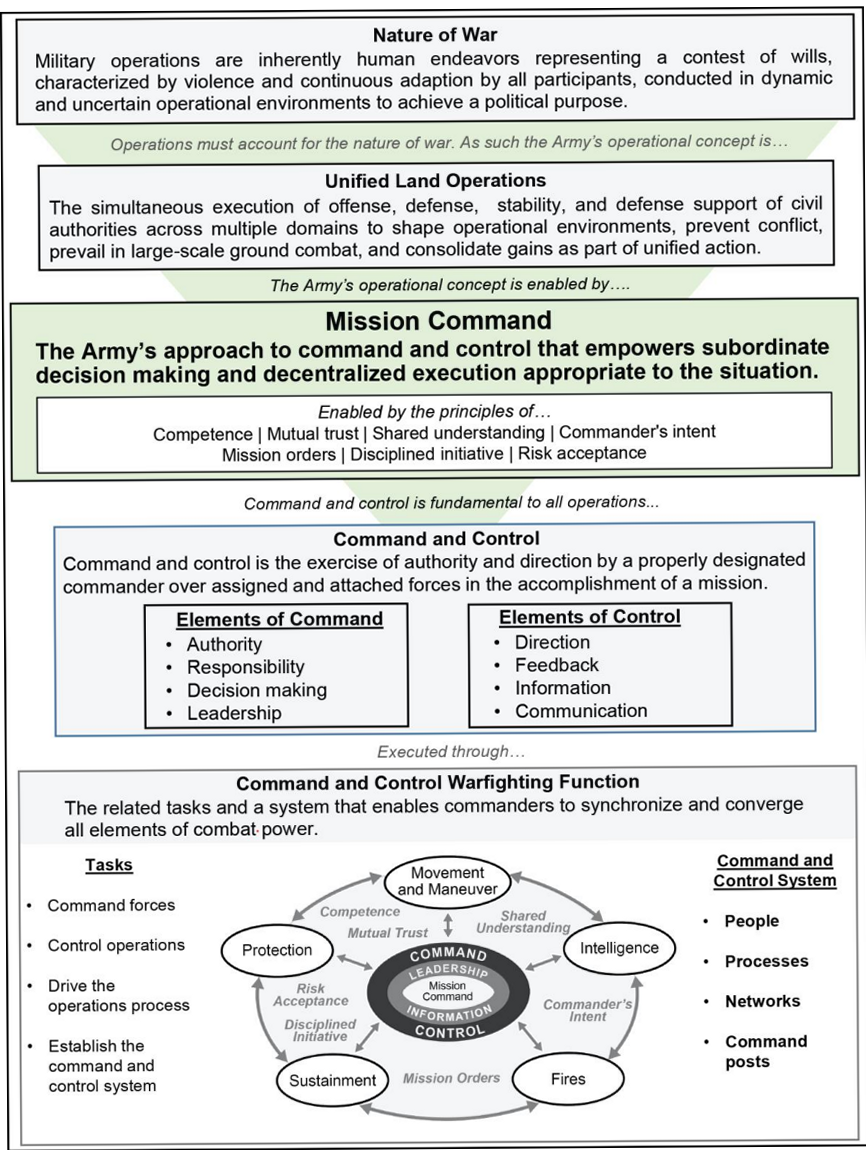
The Marine Corps states the same design as a warfighting philosophy rather than a set of principles, and in doing so supplies the incomplete-contract framing this session has used throughout. MCDP 1, Warfighting derives mission command not from a taxonomy of authorities but from the nature of maneuver warfare: because war is disorderly and the subordinate at the point of decision "will naturally better appreciate the true situation," command and control "must be decentralized." Its instrument is "mission tactics" — assigning a mission "without specifying how the mission must be accomplished" — and it names the arrangement in exactly the terms Simon and Aghion–Tirole would use.
Mission tactics serves as a contract between senior and subordinate. The senior agrees to provide subordinates with the support necessary to help them accomplish their missions but without unnecessarily prescribing their actions. The senior is obligated to provide the guidance that allows subordinates to exercise proper judgment and initiative. The subordinate is obligated to act in conformity with the intent of the senior.
MCDP 1 is the philosophy's purest statement precisely because it refuses to make initiative a procedure. It demands boldness and initiative "down to the lowest levels," insists that "errors by junior leaders stemming from overboldness are a necessary part of learning," and rules that the force "will not accept lack of orders as justification for inaction." That last clause is the mirror image of the whole delegation contract: where JP 1 prices deviation as a reporting obligation, MCDP 1 prices inaction as a fault. What sustains such a philosophy is not doctrine but people who can be trusted to exercise judgment — which is why the Marine Corps issues a companion learning doctrine, MCDP 7, Learning, that treats continuous learning as the institutional means of manufacturing ADP 6-0's competence principle and, through it, the trust the whole design rests on.
What delegation demands: the informational preconditions of mission command
The Army's 18-02 primer is the institution auditing its own delegation design — and finding that decentralized decision rights fail in practice exactly where shared understanding fails. Real authority runs on information; the primer says so in Army prose.
Recent trends from the Combat Training Centers (CTCs) and Mission Command Training Program (MCTP) indicate that units often fail in three main areas: developing and maintaining an effective common operational picture (COP), understanding critical paths and battle rhythm, and ability to reliably access information across the Army. Specifying knowledge management (KM) tasks for the commander imparts a direct responsibility on the part of the commander and all senior leaders to establish and execute a KM program. Mission command doctrine and KM doctrine have become a single operational concept, inseparably linked.
The primer's doctrine chain runs: ADRP 6-0 gives commanders three tasks — drive the operations process, develop teams, inform and influence audiences — and the first is "directly enabled" by knowledge management, whose Army definition is "the process of enabling knowledge flow to enhance shared understanding, learning, and decision making." Its objective sentence is a delegation-theoretic claim in logistics clothing: "Getting the right information, to the right people, in the right format, at the right time, in order to arrive at the right decision." The three observed failure modes are all failures of the shared-understanding substrate, not of the authority design: units at the training centers hold the same decision rights as everyone else, but their common operational picture "was not effective in contributing to shared understanding during movement or when troops were in contact with the enemy," their battle rhythms "do not follow a critical path" to commander decisions, and their information is not reliably accessible. Where Session 04's cognitive hierarchy was a design for individual understanding, the primer's version is explicitly collective — and it prices the failure: decision behavior degrades from anticipatory (low risk) to reactionary (high risk) as an organization slides down the ladder from shared understanding toward raw data.
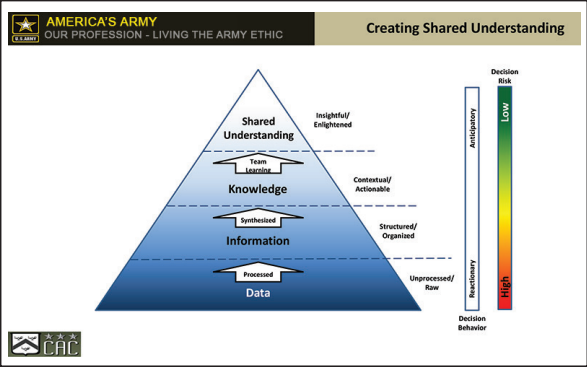
The primer's positive prescription is that the commander must be the "knowledge leader": "Mission command strives to establish the mindset that situational understanding comes from a balance of bottom-up and top-down knowledge processes," and leaders "must drive KM as much as they drive the operations process" — beginning with the most essential guidance a senior leader can give, "to clearly identify the knowledge they require for decision making." In Aghion–Tirole terms the argument is exact: formal delegation without information transfer produces no real authority anywhere. A subordinate who cannot see the situation cannot exercise disciplined initiative; a commander who cannot see the force cannot supervise by exception; and so the delegation contract of Sections 04–05 has an unstated schedule attached — the common operational picture, the battle rhythm, the accessible record — without which both parties default. That schedule, and the machinery the Army built to maintain it (the KM officer, the working group, the five-step process, the maturity model), is Session 06's subject.
Failure mode 1
The common operational picture
"Not as common nor as useful as desired": ineffective at creating shared understanding during movement or in contact — exactly when mission command must carry the load.
Failure mode 2
Battle rhythm and critical path
Meeting cycles "not nested to facilitate a critical path" toward commander decisions; divisions "quickly reduced to combat-ineffective ground forces" when synchronization fails.
Failure mode 3
Access to information
Units cannot reliably reach the Army's own knowledge. "In most cases, the information needed … has been captured within the organization; it just is not being shared."
Seminar discussion
Questions to structure the session's second hour. Each turns on a live tension in the sources or a transfer to non-military organizations.
- Is the non-delegable anchor a feature or a bug? COCOM cannot be delegated, and responsibility survives every delegation of authority. Aghion–Tirole suggest retained formal authority can chill agent initiative — the principal can always overrule. Does the military's combination (formal authority anchored, non-intervention promised by doctrine) capture the best of both, or does an always-available override invite exactly the selective micro-intervention that destroys the initiative delegation was meant to buy?
- "The associated comfort level of the commander." JP 1 lists commander comfort alongside task nature and risk as a determinant of the level of control. Is this honest contingency design — trust is real capital, and its stock varies — or a doctrinal loophole that lets leaders practice detailed control while preaching mission command? Recall the failure mode from Session 01's frame: permission-seeking subordinates produced by leaders with constant digital visibility. Which reading does the NDP 1 centralization history support?
- Deliberate vagueness as contract design. The support relationship is "by design, a somewhat vague but very flexible arrangement," disciplined only by an establishing directive. When is vagueness in an authority contract efficient — preserving adaptation under uncertainty — and when does it merely relocate conflict to the establishing authority who must adjudicate it? Compare dotted-line reporting in corporate matrices, which is usually vague by neglect rather than by design. Does writing the vagueness down change its behavior?
- Can trust capital survive personnel turnover? JP 1 says mutual trust results from "demonstrated competence, and planning and training together"; NDP 1 derives initiative from "trust established through interaction with commanders." Military rotation cycles move people every two to three years. Is mission command's real trust interpersonal at all — or is it institutional, resting on the standardization and doctrine codebook of Session 03, so that any two strangers who share the codebook can transact on "trust" they never personally built? What would that imply for firms that want mission command without a doctrine system?
- Does the digital COP re-centralize real authority? NDP 1 documents that every advance in communications technology precipitates a centralizing trend; the primer demands a live common operational picture as mission command's precondition. But if headquarters can see everything the subordinate sees, the information asymmetry that grounded the subordinate's real authority (Aghion–Tirole) evaporates. Is the shared picture a delegation-enabler, a delegation-destroyer, or both depending on who controls the interruption channel?
- Does mission command go far enough? The edge debate. Alberts and Hayes (2003) argue that in a robustly networked force, command and control should be unbundled and pushed to "the edge," where nearly autonomous units self-synchronize on shared awareness and intent — dissolving the middle management that mission command still preserves. Mission command keeps delegation bounded (commander's intent as a limit), responsibility non-delegable, and the hierarchy anchored; power-to-the-edge would call that a failure of nerve, and mission command would call self-synchronization a recipe for desynchronized action without accountable command. Who is right, and does the answer turn on network reliability — Alberts and Hayes assume a robust network, while NDP 1 grounds the same heritage in commanders who had to operate "for months at a time with minimal communication"?
- The error-forgiveness asymmetry. "An error in judgment is not to be faulted to the same degree as [a failure] to act entirely." Read as Edmondson: a codified psychological-safety guarantee, without which delegated rights go unused. Read as an economist: a moral-hazard subsidy for action over restraint, in a domain where action can be irreversible. Where should a hospital, a nuclear plant, or an SRE team set this asymmetry — and does the military's own answer (nuclear release is command-by-planning territory) concede the point?
- Unity of effort — mechanism or euphemism? Where unity of command is politically impossible, JP 1 substitutes unity of effort, and coordinating authority can "require consultation … but does not have the authority to compel agreement." Is this a genuine coordination mechanism (Mintzberg's mutual adjustment, formalized) or an admission that no one decides? Test against the multinational case: JP 1 itself warns that parallel command structures without a single commander "should be avoided if possible."
- The transfer question. Commander's intent works because Sessions 03–04 built its interpretive substrate: shared doctrine, common terms, pre-loaded common ground. Firms adopting "commander's intent" via OKRs or strategy memos typically copy the artifact without the substrate — no common professional education, no shared planning ritual, no error-forgiveness norm. Predict, from this session's theory, exactly how that fails. Is "empowerment theater" (rights formally delegated, never really exercisable) the modal outcome — and what is the minimum viable substrate?
Synthesis and bridge
What this session establishes and what it sets up.
What we established
The military's decision-rights architecture is legible end to end: formal authority enumerated and anchored, real authority deliberately delegated through intent, the gap closed by trust and shared understanding.
JP 1's taxonomy is a standardized menu of formal-authority contracts, each defined by its exclusions and delegation rules, layered over a dual-chain matrix with explicit conflict rules. On top of it, mission command runs Aghion and Tirole's playbook on purpose: keep formal authority (and its accountability) concentrated, commit by doctrine to non-intervention in method, and transfer real authority downward via mission-type orders and commander's intent — an incomplete contract that specifies purpose and end state so subordinates can act "without further orders, even when operations do not unfold as planned." ADP 6-0 supplies the doctrine the session was first built without — the canonical seven principles (competence, mutual trust, shared understanding, commander's intent, mission orders, disciplined initiative, risk acceptance) and the institutional record of the Army renaming this vocabulary twice in seven years; MCDP 1 states the same design as a warfighting philosophy, "a contract between senior and subordinate," rather than a procedure. NDP 1 shows the design's cultural collateral — the error-forgiveness norm, the standing resistance to technology-driven recentralization — and the 18-02 primer shows its informational bill: without shared understanding, delegated rights exist on paper and reactionary decision-making takes over in fact.
Next session
Session 06: Knowledge Management in the Field — the machinery behind shared understanding.
This session kept invoking shared understanding as the thing that makes delegation real, and the primer told us units measurably fail at producing it. Session 06 opens the machinery: the Army's knowledge-management doctrine in practice — the five-step KM process, the KM officer and working group, content management, battle rhythm design, and the maturity model — read through Hansen's codification-versus-personalization strategy and the organizational-memory literature. Decision rights were this session's contract; knowledge management is how the organization performs it.
Sources and evidence
Every material claim in this lecture traces to these documents.
Primary and context sources
Figures (extracted alongside the converted sources)
Theory cited inline (author-year)