Assigned readings
One research monograph read in full — background, method, results, model, and limitations — read now against its lineage (the strategic-thinking study it grew from) and its institutional twin (the doctrinal method the Army built around the same cognition), plus three canonical theory works that name the capability the monograph is trying to specify.
Wisecarver, M., Byrd, C., Loer, A., Engelsted, L., Adis, C., Kaplan, M., & Weyhrauch, W. S. (2022). A Conceptual Model of Army Leader Systems Thinking (Technical Report 1420). U.S. Army Research Institute for the Behavioral and Social Sciences.
Read the whole report: the Background (competing definitions; the military and management literatures; the honest section on how sparse the empirical work is), the Requirements Review (58 respondents, the qualitative method, the formal/informal-systems finding, the novice-to-expert descriptions), the Model Development (five dimensions, 42 draft behaviors cut to 25, the two renames), and the Limitations. The appendices contain the full instruments — worth skimming to see what the researchers actually asked.
../sources/army/army_leader_systems_thinking/army_leader_systems_thinking.mdSackett, A. G., Karrasch, A. I., Weyhrauch, W. S., & Goldman, E. F. (2016). Enhancing the Strategic Capability of the Army: An Investigation of Strategic Thinking Tasks, Skills, and Development (Research Report 1995). U.S. Army Research Institute for the Behavioral and Social Sciences.
The lineage origin. Read the Results section on Strategic Thinking Competencies and Enablers: the interview method (critical-incident recall), the finding that officers lacked a shared lexicon for their own cognition, and the six competencies distilled from 58 KSAs — of which systems thinking is the sixth. TR 1420 is that one competency taken apart and rebuilt into a behavioral model. Read for the parent construct and for a striking rhyme: Sackett's officers, like TR 1420's, could not say what they did.
../sources/km_cognition/ari_rr_1995_enhancing_strategic_capability_of_the_army_2016/ari_rr_1995_enhancing_strategic_capability_of_the_army_2016.mdDepartment of the Army. (2015). Army Design Methodology (ATP 5-0.1). Read Chapter 1 (Systems Thinking, Framing) and Chapter 6 (Assessment and Reframing).
The session's "so what." TR 1420 specifies the cognition; ATP 5-0.1 is the doctrinal method the institution built around it — framing an operational environment as a system, framing a system of problems, and reframing when the mental model no longer fits. Read Chapter 6's reframing and double-loop-learning passages as the institutional twin of TR 1420's fifth dimension. Note where the two documents do not agree: ADM makes systems thinking a group activity and calls it a "process," where TR 1420 makes it an individual "cognitive approach."
../sources/km_cognition/atp_5_0_1_army_design_methodology_2015/atp_5_0_1_army_design_methodology_2015.mdSorrells, W. T., Downing, G. R., Blakesley, P. J., Pendall, D. W., Walk, J. K., & Wallwork, R. D. (2005). Systemic Operational Design: An Introduction. School of Advanced Military Studies, U.S. Army CGSC.
The intellectual root of ADM. This 2005 SAMS monograph carried Shimon Naveh's systems-theory-based Systemic Operational Design (SOD) into U.S. operational art the same year the Army began the design effort that became ADM. Skim the abstract and Chapter 2 to see systems thinking arriving as problem-setting, not problem-solving — and note that SOD names the adversary directly ("rival as rationale"), the very element TR 1420 defers.
../sources/km_cognition/sams_monograph_systemic_operational_design_introduction_2005/sams_monograph_systemic_operational_design_introduction_2005.mdARI (2020). Managing Complex Problems: A Synthesis of Research on Army Design Methodology and Strategic Thinking (Research Report 2029).
A synthesis of ten ARI reports that ties Army Design Methodology to the strategic- and systems-thinking research program TR 1420 belongs to. Skim the executive summary for the through-line linking the doctrine (ADM) and the research (the six competencies) this session now reads side by side.
../sources/km_cognition/ari_rr_2029_managing_complex_problems_adm_synthesis_2020/ari_rr_2029_managing_complex_problems_adm_synthesis_2020.mdWolters, H. M. K., Grome, A. P., & Hinds, R. M. (Eds.). (2013). Exploring Strategic Thinking: Insights to Assess, Develop, and Retain Army Strategic Thinkers (Research Product 2013-01).
Cite only — a 769 KB compendium of thirteen expert concept papers from the 2011–2012 ARI workshop that founded the strategic-thinking program. Skim the front matter for scope; it is the multi-voice predecessor whose convergences and divergences Sackett's team later distilled into six competencies.
../sources/km_cognition/ari_rp_2013_01_exploring_strategic_thinking_2013/ari_rp_2013_01_exploring_strategic_thinking_2013.mdSimon, H. A. (1947/1997). Administrative Behavior; and Simon (1971), "Designing Organizations for an Information-Rich World."
Bounded rationality is the capability ceiling the whole seminar has been designing around: limited attention, satisficing, simplification as a condition of action. TR 1420 is an attempt to raise that ceiling by training — and its academic SMEs restate Simon exactly when they note that leaders "must reduce and linearize complexity to enable them to act." Read for the argument that organizations exist to economize on cognition, then ask what is left for the individual to carry.
archive.org/details/administrativebe0000simoAshby, W. R. (1956). An Introduction to Cybernetics, Ch. 11 ("Requisite Variety").
"Only variety can destroy variety": a regulator can only control what its internal model can distinguish. Read the law as a claim about commanders — the leader's mental model must carry at least as much variety as the situation it must regulate. The five dimensions of TR 1420 are, on this reading, a specification of where a leader's model must hold variety: elements, relationships, perspectives, patterns, and boundary revisions.
pespmc1.vub.ac.be/books/IntroCyb.pdfWeick, K. E. (1995). Sensemaking in Organizations, Chs. 1–2.
Weick's sensemaking is retrospective, social, and enacted — people discover what they think by articulating it to others. Read for the recipe "how can I know what I think until I see what I say?": it is the theoretical warrant for TR 1420's most consequential methodological move, scoring systems thinking by what leaders describe or discuss, and also the source of the sharpest objection to it.
Sensemaking in Organizations (Sage) — archive.org copyWhy an army studies its own cognition
TR 1420 exists because earlier ARI research made systems thinking one of six strategic thinking competencies — and because the literature the researchers inherited could not agree on what the construct even is. Their first act is definitional triage.
The lineage matters. Sackett et al. (2016), an earlier ARI study, interviewed Army leaders about complex problems that challenged them and distilled 58 knowledge-skill-ability items into six strategic thinking competencies: comprehensive information gathering, learning, critical thinking, innovative thinking, thinking in time, and systems thinking. TR 1420 (research conducted September 2019–March 2021, published December 2022, under contract to Personnel Decisions Research Institutes) takes the last of the six and asks what it would mean, behaviorally, for an Army officer to have it — explicitly so that assessment and training tools can be built on the answer. This is the seminar's structural analysis meeting bounded rationality head-on: sessions 02 through 06 examined designs that assume a certain kind of leader cognition; this document is the institution specifying that cognition as a requirement and preparing to measure it.
Read the parent study and TR 1420's whole method looks less like a fresh start than an inheritance. Sackett's team had already noted that the officers they interviewed could not readily talk about their own cognition — "there simply was not a shared lexicon for them to speak from" — and set out to build one. And its one-sentence definition of the sixth competency is the seed TR 1420 grows into a five-dimension model. The two share a genotype: a holistic perspective, interrelationships, and the integration of parts into a whole. The 2020 ARI synthesis of ten reports across this program, and the earlier thirteen-author compendium from the 2011–2012 workshop that founded it, confirm the through-line: TR 1420 is one late tributary of a decade-long ARI effort to make Army cognition nameable and, eventually, measurable.
A strategic thinker uses a holistic perspective of the dynamic and complex environment to identify interrelationships and integrate disparate factors into a comprehensive whole.
Army leaders must be effective systems thinkers to operate and maintain existing systems and to create plans, make decisions, and solve problems that involve a variety of interrelated elements.
Before it can specify anything, the report must survive the literature. Its Table 1 assembles definitions of systems thinking spanning four decades, and they do not converge — some authors define a skill set, some a perspective, some a process, some an emergent property of applying rules of thought. The report's own summary is blunt: "there is not agreement regarding what constitutes system thinking," and no universally accepted definition exists.
| Source (as cited in TR 1420) | Definition (verbatim, abridged) | What kind of thing is it? |
|---|---|---|
| Arnold & Wade (2015) | "a set of synergistic analytic skills used to improve the capability of identifying and understanding systems, predicting their behaviors, and devising modifications to them" | A skill set — trainable, decomposable. Assessment-friendly |
| Kim (1999) | "A school of thought that focuses on recognizing the interconnections between the parts of a system and synthesizing them into a unified view of the whole" | An intellectual tradition — something one joins, not scores. |
| Senge (1985) | "integrative, synthesizing diverse viewpoints in order to understand the organization as a whole … structural thinking, focusing on the structure of interrelationships" | A synthesis of perspectives — social as much as cognitive. |
| Cabrera et al. (2008) | "systems thinking is not something one does, but something one gets as a result of applying simple rules based on patterns of thinking" | An emergent property of rule-following — the DSRP position. Resists decomposition |
From the wreckage the researchers extract three themes every definition shares — systems thinking is cognitive; it aims at the whole of a situation rather than a facet; it concerns how elements connect and interrelate — and build a deliberately broad working definition on them.
The working definition
"A cognitive approach that applies a holistic perspective to identify and understand interrelationships and emergent properties among elements."
Note what the definition commits to. Cognitive approach locates the capability in the individual mind — this is a person-level construct, not a property of structure or process. Holistic perspective and interrelationships set it against the linear thinking the report blames for solutions that backfire (its example, from Stroh & Zurcher: food aid that undermines local agriculture and increases starvation). And emergent properties smuggles in the hardest claim — that the whole behaves in ways not deducible from the parts, which is precisely what makes the capability difficult to test.
The military literature the report reviews adds one distinction the rest of the session turns on. Allen et al. (2009) and the SAMS theses insist that the systems Army leaders face are open: engineering systems thinking works on closed cycles, but strategic-level military systems are "open, dynamic, and constantly shifting," with porous boundaries that make them illegible in isolation. In Ashby's (1956) terms this is a statement about variety: a closed mechanical system has enumerable states a bounded model can match; an open sociopolitical system generates variety without limit, so the regulator's model must be continuously rebuilt rather than learned once. That is why the report keeps returning to Senge's (2006) learning organization — whose five disciplines (personal mastery, mental models, team learning, shared vision, systems thinking) two War College authors, Gumbert (1998) and Williams (2007), had already urged on the Army — and to an earlier ARI construct, sociocultural systems thinking (Adis et al., 2013): the continuous building and revising of a mental model of the sociocultural relationships in an environment, with six process dimensions cycling from awareness of elements through model revision to application to mission. TR 1420 is that machinery generalized from the cultural terrain to every system a leader touches.
What fifty-eight soldiers and instructors actually said
The requirements review is the report's empirical heart: a qualitative study of how the Army's own officers talk about systems. Its two strongest findings are a vocabulary that outruns understanding, and a two-kinds-of-systems distinction the respondents produced themselves.
Method first, because the numbers below inherit its limits. The team held 26 interview or focus-group sessions with 35 active-duty officers in operational assignments (the "Operational" sample: 1 colonel, 10 lieutenant colonels, 11 majors, 13 captains) and 20 sessions with 23 instructors and administrators (the "Institutional" SMEs, including 9 colonels, several retired). Respondents skewed combat-arms (32 of 58) and educated (66% held a master's or doctorate). Sessions ran 30–60 minutes; two raters with I/O psychology master's degrees coded responses in vivo, with interrater agreement averaging 85% (Operational) and 91% (Institutional). Percentages in the report count sessions in which a theme appeared, not individuals — a coarse instrument, honestly labeled.
Most Operational participants (67%) and Institutional SMEs (82%) knew "systems thinking" as a concept, yet "many did not have an organized understanding of it and were unsure how to define or describe it." The most common Institutional move (31% of sessions) was to define it by pointing at other kinds of thinking — divergent, critical, strategic, nonlinear.
An automated search for 111 systems-related terms found 513 mentions. Top terms: "perspective" (48), "design" (45), "complexity" (20), "social system" (20), "feedback loop" (17). The words of the discipline are in circulation even where the discipline is not.
With a live minority view that lieutenants and captains should "focus on doing their jobs" and that real purview begins at major. The position most often named as demanding it: staff positions (77% of Operational sessions), especially XO (38%) and S-3 (31%).
The vocabulary analysis rewards close reading because it is stratified by rank, and the strata are legible. "Complexity" and "complex adaptive system" cluster at colonel; "strategic thinking" and "strategic leadership" are almost exclusively colonel-and-civilian terms; "social system," "big picture," and "information flow" cluster at captain and major (85% of "social system" mentions came from captain and major sessions); "holistic" belongs mostly to the civilian instructors. Junior officers describe the systems they are embedded in; senior officers describe the properties of systems in general. That is a developmental sequence visible in word choice — and a Weickian point: the vocabularies are sensemaking resources, and each rank makes sense of its work with the vocabulary its position affords. But the report refuses to let the vocabulary stand in for competence.
However, many references to feedback loops were superficial in nature, and it is difficult to determine if respondents were talking about complex, self-stabilizing feedback loops, or simply referring to a simple bipolar feedback loop where actions are taken, and feedback is received.
The respondents' most useful theoretical contribution was unprompted: they kept describing two different kinds of "system," and the researchers elevated the distinction into the report's findings. Formal systems — personnel, communication, and planning systems — are established and documented; they run on their own until they break, at which point the leader must understand elements and relationships well enough to restore them. Informal systems — social systems, informal coordination systems, sociocultural systems in operational environments — are nowhere written down and must be uncovered before they can be reasoned about.
Formal systems · documented
The system is written down
Personnel databases, promotion systems, MDMP, battle rhythms, the targeting cycle. Elements and relationships are enumerated in documents — Session 06's codified layer. Systems thinking here is mostly diagnostic: reactive, triggered when the documented machine fails. One AG officer's example: many databases that must be understood "to get the information needed out of them."
Informal systems · undocumented
The system must be uncovered
Battalion social dynamics, local loyalties and partnerships on deployment, informal coordination networks. Ambiguous, changing, harder to identify — the report says operating in them "requires proactive systems thinking." This is the tacit terrain codification cannot reach (Hansen et al., 1999): no repository holds the model; the leader must build it in place.
The informal or emerging systems such as social systems, informal coordination systems, and sociocultural systems in operational environments, tend to be more ambiguous, changing, and harder to identify. Operating with and within these systems requires proactive systems thinking to identify and understand the systems and understand their impact on decisions and problems.
The job examples officers gave are concrete and worth retaining: working out time and resource factors among a battalion's companies; the artillery targeting process, with its battle-rhythm meetings and Air Force interfaces stretched across time; Mission Command itself, described in one session as "a system of people working together to support their boss in the decision-making process." And when asked what goes wrong without systems thinking, the answers form a Simon-shaped list: poor decision-making and groupthink (23% of sessions), failure to track system status (23%), information overload (15%), tunnel vision (15%), communication breakdown (15%) — with 12% of sessions volunteering that "the Army does not set officers up for systems thinking" and another 12% naming the bureaucracy itself as the obstacle. Overload is the tell: Simon (1971) taught that a wealth of information creates a poverty of attention, and the officers report exactly that pathology from inside the C4I architecture Session 04 admired. One Fires officer's example makes it precise: replacing human scouts with unmanned aerial systems — a single element swapped in the decision system — produced "an enormous increase in the amount of information the officer received and needed to process." The structure amplified throughput; the bounded human at the center had to absorb it.
From "just get it done" to living with ambiguity: the developmental arc
Eleven respondents could articulate what changes between a novice and an expert systems thinker. Their composite is the report's richest description of the capability — and its academic SMEs add the two most theoretically loaded observations in the document.
The descriptions sort into four tracks that develop in parallel: system-specific knowledge (the systems of one's own domain), system-general knowledge (the nature of systems as such — methodologies, theories, the language of system properties), depth of processing, and communicating with and mentoring others. The report makes a point contingency theory would recognize: general and specific knowledge must grow together — abstract systems literacy without domain depth is as limited as domain mastery without the concept of a system. Respondents found the intermediate stage hardest to describe, because leaders develop unevenly across the four tracks and mid-career profiles diverge.
-
Novice
The "just get it done" leader. Deals with issues at surface level; accomplishes narrow tasks "with little consideration for side effects"; sees "the face of the problem, not the whole of the problem"; does not understand "how their cog fits into the larger wheel." In the communicating track, the portrait darkens: "treats people like they are expendable; burns bridges." This is Session 02's doctrine-as-script reader — competent execution of the letter, blind to the system the letter serves.
-
Intermediate
Understands the "why," not yet the reach. Grasps how tasks fit the larger system and questions procedure constructively; accepts new ideas and adapts broken processes; begins joint planning with reduced guidance; "understands the big picture and knows how to apply it but does not have the foresight to predict." Engages in critical thinking "but may not do assessments on impact of solutions" — sees second- and even third-order effects, but slowly and incompletely.
-
Expert
Modifies the system, tolerates the ambiguity, teaches the model. "Uses position power to make or modify the system"; integrates new information quickly; "displays patience to effectively deal with uncertainty and ambiguity"; anticipates problems and prepares all staff sections before they arrive; acts reliably on intuition about the system; recognizes second- and third-order effects quickly. And — the distinctly organizational mark — works with and mentors staff "to build a shared understanding of a system or system of systems," and knows the Army's own social system well enough to work through it. Expertise here is not private insight; it is the ability to install one's model in other people.
A caveat the report itself inserts
"Fifth- or sixth-order effects" is where the folk model outruns reality.
One respondent credited experts with uncovering fifth- and sixth-order effects. The researchers decline the gift: that depth of causal tracing "may be possible with bounded systems such as a machine but would be unrealistic when working with complex adaptive systems." It is a quietly important discipline — the report polices its own construct against heroic overclaiming, in effect conceding Simon's point that no amount of expertise unwinds an open system's combinatorics. Expert judgment satisfices further down the causal chain; it does not exhaust it.
Do leaders get there by seasoning alone? Most sessions (62% Operational, 70% Institutional) said systems thinking develops over time through experience, age, and training — but a substantial minority (38% and 30%) insisted development is conditional: the individual "must be willing and take the time to be introspective," so some leaders will never become expert systems thinkers no matter how long they serve. The report draws the institutional conclusion — guided development beats unguided accumulation — but the minority view has teeth for Session 08: if the capability is partly dispositional, an assessment tool is as much a selection instrument as a development aid. One respondent's observation cuts the same way: "the leaders who made it further in their careers as leaders were the ones who were good at systems thinking" — which is as consistent with the Army selecting for the capability as with the Army producing it.
The four academic SMEs interviewed during model development (PhDs who publish, teach, and consult on systems thinking, including the Cabreras' DSRP school, which emphasizes balancing holism with reductionism) added three refinements. First, the Army's environment is volatile, uncertain, complex, and ambiguous, so most systems officers face are complex adaptive systems. Second, required systems thinking scales with a leader's timespan of responsibility — how far forward they are expected to plan, months to decades, roughly tracking rank. Third, and most important for our purposes:
Additionally, one SME explained that leaders sometimes must reduce and linearize this complexity to enable them to act. Another tendency noted was that some leaders apply systems thinking at the start of their planning processes, when seeking to understand a situation, but then abandon systems thinking once engaged in action.
Hold both halves of that passage together, because they are the session's theoretical crux. The first half is bounded rationality stated as professional necessity: an actionable plan is a linearization, a deliberate collapse of variety into a sequence a staff can execute — Simon's satisficing, and NDP 6's intuitive decision-making from Session 04, wearing systems-theory clothes. The second half is Weick's (1995) warning about frames that stop updating: sensemaking is supposed to be continuous, but action generates commitment to the enacted frame, and the plan built by yesterday's systems thinking becomes today's tunnel vision. Expert systems thinking, on the SMEs' account, is not maximal model complexity — it is controlled variety reduction, with the discipline to reinflate the model when the situation moves. Ashby's law sets the floor; Simon's limits set the ceiling; the expert lives between them, and the model's fifth dimension (Responding to Change) exists precisely to test whether they do.
The model: five dimensions, twenty-five behaviors, one observability problem
The conceptual model is built in three passes — literature plus fieldwork to dimensions, officers to draft behaviors, instructors to a final cut — and its deepest design decision is how to make invisible cognition ratable at all.
-
Literature + 58 respondents → 5 dimensions
Iterative construct definition. Components found in the literature were tested against the working definition and the session notes until five themes stabilized: Identifying Elements, Understanding Dynamic Relationships, Shifting Perspectives, Identifying Holistic Patterns, Responding to Change. Two carried different names at this stage — "Hierarchy" and "Openness" — both later overturned by SME review.
-
29 officers → 42 draft behaviors
Behavior generation from operational experience. Phone interviews and focus groups at three CONUS installations (1 COL, 5 LTC, 10 MAJ, 13 CPT) produced concrete episodes — converting a Stryker brigade to Armor and mapping its stakeholders; whiteboarding a broken deployment mail system from known elements to unknown ones; the UAS information flood; precision-guided munitions deleting weather from the fire-planning system. The team abstracted 42 behaviors, screened for relevance, overlap, wording, and a deliberate altitude: broad enough to apply across jobs, specific enough for a rater to observe.
-
15 institutional SMEs → 25 final behaviors
Expert review and the final cut. Leader-development instructors (10 colonels or retired colonels among them) judged every dimension worth keeping, then cut, merged, and rewrote: 42 behaviors became 25, definitions were simplified, contextual modifiers stripped for generality, and the two renames were forced through. Output: the model now feeding a multirater assessment (Loer et al., in preparation) and a planned scenario-based assessment tool.
| Dimension (final) | Final definition (verbatim) | Representative behavior · theory reading |
|---|---|---|
| Identifying Elements · 5 behaviors | "Identifies people, objects, locations, events, or concepts in an environment or situation that function together as an integrated whole" | Discussing stakeholders relevant to a situation; distinguishing critical elements from less critical ones. The variety inventory: what states can the model represent at all (Ashby). |
| Understanding Dynamic Relationships · 5 behaviors | "Understands complex causal and correlational relationships among a set of elements that form an integrated whole" | Discussing second- and third-order effects on unit or mission; using feedback loops to determine the impact of decisions. Causality vs. correlation and time-delayed effects — added at SME insistence. |
| Shifting Perspectives · 6 behaviors | "Takes perspectives from different subsystems or levels of a system and switches perspectives as needed (e.g., higher level, lower level, lateral levels, different subsystems)" | Discussing how decisions at one level or unit affect other levels or units; roles of joint, coalition, and local-government groups. The echelon structure of Session 01 internalized as a cognitive operation. |
| Identifying Holistic Patterns · 4 behaviors | "Understands the larger picture of a system and common systemic patterns" | Discussing a situation or problem as a whole; building a graphic or model to understand and communicate the problem. The "zoom out" pole — kept separate from Shifting Perspectives over SME objections that the two overlap. |
| Responding to Change · 5 behaviors | "Remains open to emerging information and updates understanding of system as needed; maintains a flexible concept of the system boundaries" | Discussing changes to plans due to changing circumstances; redefining the critical elements as new information emerges. Weick's continuous sensemaking — the anti-fixation dimension. |
The two renames are small case studies in construct hygiene. "Hierarchy" became Shifting Perspectives because SMEs pointed out the original name implied only superior–subordinate movement, excluding lateral perspective-taking between peer units — and lateral coordination is precisely what mission command's horizontal information flow (Session 04) demands. "Openness" became Responding to Change because raters familiar with the Big Five personality trait of the same name would import the wrong construct — the model wants a revisable mental model, not an affable disposition. SMEs also lobbied to merge Shifting Perspectives into Identifying Holistic Patterns; the team refused, on the ground that switching between views and holding the big picture are distinct operations. The model's grain, in other words, was contested to the end.
One is that systems thinking is a cognitive activity, and thus involves numerous thinking behaviors that take place within an individual's mind that are not observable to others. This limitation presents a particular challenge when developing a model and an assessment that are grounded in observable behaviors.
The report's answer to its own limitation is the model's most consequential move. Because verbs like "understands" and "remains open to" name internal states no rater can see, every final behavior was reformatted to what a leader describes or discusses. The stated rationale is practical — Army planning is interactive, so "there would be a low likelihood of leaders not needing to share their thoughts" — but the theoretical warrant is Weick's: sensemaking is social and articulated, and in an organization coordination happens through what is said, not what is silently understood. Session 04 made the same point structurally: mission command runs on shared understanding, and understanding that is never externalized cannot be shared. The move has a cost the report names honestly — a leader could think systemically without discussing it and be scored wrong — and a cost it does not name: an assessment of discourse can be gamed by fluency, rewarding officers who have the vocabulary of Section 03 without the model behind it. The superficial-feedback-loop finding is the report's own evidence that the two come apart.
The doctrine the institution built around the cognition: Army Design Methodology
TR 1420 studies systems thinking as a capability inside one leader's head. Seven years earlier the Army had already turned the same idea into a published method — Army Design Methodology — for a staff to perform together. Reading the two side by side is the session's controlled comparison: the same construct, specified once as an individual competency and once as an institutional procedure, and the two specifications do not fully agree.
The intellectual root runs through Israel. Systems thinking entered U.S. operational art through Systemic Operational Design — Shimon Naveh's application of systems theory to campaign planning, taught to six SAMS students at Fort Leavenworth in early 2005 and pitched as problem-setting, not problem-solving. That is the year, by ATP 5-0.1's own account, the Army and Marine Corps "began a multi-year effort to examine methods to help commanders and staffs understand complex, ill-structured problems"; by 2010 "design" was in doctrine, and in 2012 the Army renamed it Army Design Methodology. Where Session 02 read doctrine as codified judgment, ADM is doctrine codifying a thinking process itself — the institution writing down how to think about systems, and thereby exposing what it believes systems thinking is.
Systems thinking is a process of understanding how parts of a system work and influence each other as part of a greater whole. It is an approach to problem solving that views problems as part of the greater system and that these problems are interrelated.
Set that beside TR 1420's working definition and the first tension is a definitional one — the Army does not speak with one voice about what systems thinking even is. ADM calls it a process; TR 1420 calls it a cognitive approach located "within an individual's mind." This is not a quibble the seminar can smooth over: TR 1420's own Table 1 (Section 02) flagged precisely the process-versus-cognition split as one of the unresolved fault lines in the literature, and here the Army's doctrine and the Army's research land on opposite sides of it. The report is a person-level construct built for a multirater instrument; the doctrine is a procedure built for a planning team. Same words, different ontologies.
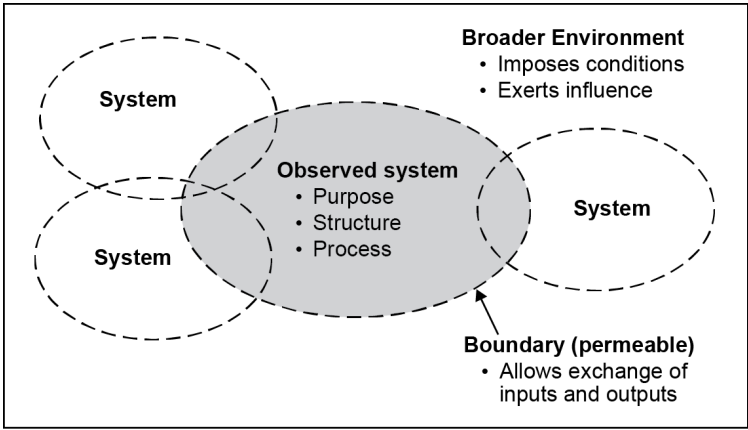
ADM's activities read like the five dimensions performed by a group rather than scored in a person. Framing an operational environment builds models of a system's current and desired future states (Identifying Elements and Dynamic Relationships, done on butcher paper). Framing problems treats the issues as "a system of problems, as opposed to a single problem" (Identifying Holistic Patterns). Its Four Ways of Seeing technique — how does X view itself, how does Y, how does X view Y — is Shifting Perspectives written as a drill. And reframing is Responding to Change with an institutional name: a deliberate return to first assumptions when the mental model stops fitting the world. Here the doctrine is not just parallel to the research; it is sharper than it, because it grounds reframing explicitly in Argyris and Schön's (1978) double-loop learning — its own source note names the book — questioning the values and assumptions behind the plan, not merely correcting execution against it.
This is not an easy task because once an issue is framed and a mental model formed, it is natural for commanders and staffs to not see (or even discard) indicators and events that do not conform to the original understanding and visualization of an operation.
That sentence is Weick's frozen frame stated as doctrine — the enacted commitment that stops updating, the very pathology TR 1420's SMEs described when they said some leaders "apply systems thinking at the start of their planning processes ... but then abandon systems thinking once engaged in action." And it exposes the second, harder tension between the two documents. ADM prescribes the discipline that TR 1420's evidence says leaders lack. The doctrine can order commanders to build reframing indicators, run premortems, and hold periodic design sessions — but ordering the behavior does not produce the cognition, and the next session's evidence (assessed in one-fifth of courses, absent from ROTC commissioning) is the measure of the gap between the prescription and the produced capability. Doctrine writing "reframe" into the operations process is the institution legislating requisite variety; whether any leader can supply it is exactly the question TR 1420 could not answer.
ADM (2015) · doctrine
Systems thinking is a group process
A "process," performed by "the commander and planning team" through "critical and creative thinking by a group." The systems thinker of ADM is a staff: framing, dialogue, and reframing are collective activities, and the enemy sits inside the frame from the start (the environmental frame models "alternative future states of relevant actors," the enemy among them). Distributed cognition by design.
TR 1420 (2022) · research
Systems thinking is one mind's cognitive approach
A "cognitive approach" that takes place "within an individual's mind," scored per leader by a multirater tool. The report scopes itself to individuals, poses but does not answer whether a staff needs one systems thinker or many, and defers the adversary to future research. The instrument measures a person; the doctrine orchestrates a team. The institution's two answers to "who does the systems thinking?" do not match.
Neither document is wrong; they were built for different jobs, and the mismatch is instructive rather than embarrassing. But it sharpens the seminar's thesis. If systems thinking is really the distributed, dialogic activity ADM describes, then TR 1420's individual instrument measures the wrong unit — and Weick would agree, since sensemaking is social. If it is really the individual capability TR 1420 specifies, then ADM's group process is only as good as the minds in the room, and the doctrine's confident procedure rests on a competence the research says is unevenly produced. The 2020 ARI synthesis of ten reports across this program proposes "managing complex problems" as a plainer banner uniting design and strategic thinking, with shared skill-building and assessment. Read from where this seminar sits, the fact that a unifying synthesis was needed a decade in is itself suggestive: the institution had specified the same cognition more than once, in more than one vocabulary, and the strands did not automatically line up.
The evidence question: what the institution knows, teaches, and cannot yet show
Read as an empirical paper, TR 1420 is candid about three uncomfortable facts: the research base for systems thinking is thin, the Army's teaching of it is diffuse and largely unassessed, and the model itself ships unvalidated. The institution is building measurement on a construct it is still satisficing about.
Start with the literature's ledger, as the report itself keeps it. Beyond conceptual frameworks, "there are no predominant empirical measures of systems thinking nor demonstrations regarding its consequences and outcomes." The Cabrera Research Lab's DSRP rules (distinctions, systems, relationships, perspectives) ground a commercial instrument, the Systems Thinking Metacognitive Inventory — for which the report could find no published construct or criterion validity data. The one sustained empirical program, Skaržauskienė and colleagues, measured "systems thinking" with items from an emotional-and-social-competency inventory never designed for the construct, on a single dataset, with leaders self-reporting their own systems thinking, their own leadership, and their own organizations' performance — the textbook common-method-bias trifecta, which the report flags explicitly.
Explained by six ESCI-measured systems thinking competencies (Skaržauskienė, 2010) — but performance was self-reported, most dimension weights were small, and the whole stream rests on one dataset. In a sector split, the figure was 53% in manufacturing vs. 27% in retail (Kvedaravičius et al., 2009), and only 18.4% of sampled leaders came from organizations of 250+ people — weak ground for generalizing to an army.
60% of instructor sessions said students need systems thinking to succeed in their course; 90% said some topics teach it (Army War College 55%, its Strategic Leadership Course 30%, SAMS 35%, CGSC 20%, Red Team 15%) — but only one-fifth said it is needed to pass any specific evaluation, and a few said it is not taught, or not taught effectively, at all.
No ROTC-commissioned participant described any formal systems thinking instruction; West Point graduates who had it got it through the Systems Engineering program (15% of sessions). 31% said they learned it on the job. Half of instructor sessions said students get systems thinking feedback — and whether they do "depended on their particular instructor."
Assemble those numbers and the institutional picture sharpens into the session thesis. The Army's operating concept (Session 05) allocates decision rights downward on the assumption that subordinate leaders can model the system well enough to exercise disciplined initiative inside a commander's intent; its doctrine (Session 02) is written to be read as judgment, which presupposes a reader who can see what the text cannot say. Yet the cognitive capability those designs assume is taught unevenly, assessed almost nowhere, delivered by commissioning source as a matter of luck, and fed back to students at instructor discretion. TR 1420's charitable reading is that the pipeline runs on experience and mentorship — several Operational sessions said exactly that, valuing on-the-job learning over coursework. The uncharitable reading is Ashby's: the institution has specified requisite variety for its leaders without a mechanism that reliably produces it, and the observed correlation between systems thinking and career progression may just be the selection effect washing the problem out of view at the top.
Limitation · scope
What the model deliberately leaves out
Officers only — no NCOs or warrant officers, though senior NCOs "are also likely to engage in systems thinking." Individuals only — yet Army decision-making happens in "a team of teams," and the report poses but does not answer whether a staff needs one systems thinker or many. And no importance-and-frequency validation by job incumbents across the force: COVID-19 shutdowns and cost foreclosed it, so the behaviors' relevance rests on the fifteen reviewing SMEs.
Limitation · honesty
What the report claims for itself
The conclusions are deliberately modest: the model "does not purport to be the only or the single best approach to defining and assessing leader systems thinking" — it is a definition chosen to be useful for building a multirater tool that applies across all Army leaders. That is bounded rationality practiced on the construct itself: not the optimal theory of systems thinking, but a satisficing one, good enough to act on, explicitly open to revision. Grade the report by its own standard and it passes; grade it as validated science and it has not yet sat the exam.
The report's final gesture toward future research is, for this seminar, the most striking sentence in the document — because it concedes that the model so far describes thinking about the Army's own systems, while the course frame's defining condition (Session 01) is an intelligent, adaptive opponent inside every system that matters:
At a broader level, systems thinking in the Army involves decision-making and problem-solving in which the enemy represents one or more elements of the system; that is, the enemy is an integral part of the system, and one that the leader does not control.
An element that models you, learns your patterns, and works to invalidate your mental model is not just another node — it is a variety generator aimed directly at the leader's cognition. Requisite variety against nature is hard; requisite variety against an adversary who studies your model is a moving target by construction. That the report defers "enemy focused" systems thinking to future research does not embarrass the model; it marks precisely where a personnel-psychology construct meets the operational problem the rest of doctrine exists for — and hands Session 08 its question: when the environment's variety outruns the leaders the institution has, the remaining lever is to transform the institution itself.
Seminar discussion
Questions to structure the session's second hour. Each has a live tension or a transfer beyond the military; none has a settled answer.
- Can twenty-five behaviors carry a holism? The model decomposes a capability whose defining claim is that wholes exceed their parts into a checklist of ratable items — the Cabrera school would say systems thinking is what emerges from patterns of thought, not a list one performs. Is behavioral decomposition a legitimate measurement compromise, or does it change the construct into something else the moment it becomes an instrument? What would Goodhart's-law drift look like in a multirater systems thinking score?
- Is expert systems thinking maximal variety or skilled variety reduction? Ashby demands the model match the environment; the academic SMEs say leaders "must reduce and linearize complexity to enable them to act." Reconcile these. Is the expert the leader with the richest model, or the leader who knows which nine-tenths of the model to discard at the decision point — and is the second capability even a systems thinking skill, or a different one (Simon's satisficing) the model never names?
- Does mission command write cognitive checks the personnel system cannot cash? Session 05's design assumes subordinates who see second-order effects and shift perspectives across echelons. TR 1420 finds that capability assessed in one-fifth of courses, absent from ROTC commissioning, and fed back at instructor discretion — while career survivors happen to be good systems thinkers. Argue the two readings: the institution produces the cognition its structure assumes, or it merely selects for it and the structure works only for the survivors.
- Formal versus informal systems is a codification boundary — so can the informal side be taught from documents? Session 06 showed the Army's codification machinery. TR 1420's respondents say the systems that matter most on deployment are the undocumented ones that must be uncovered in place. If informal-systems skill is tacit (Hansen's personalization side; Nonaka's socialization), what is the realistic ceiling of any schoolhouse course or written assessment for it — and is the mentorship the officers praised the only channel that actually transfers it?
- Is "describes or discusses" a measure of thinking or of talking? Weick licenses the move: sensemaking is articulation, and unshared understanding cannot coordinate anyone. But the report's own data show vocabulary detached from understanding (the superficial feedback-loop finding). Does the proxy reward articulate officers over systemic ones — and would the quiet expert whose staff simply runs well score worse than the fluent briefer? Design a check that would catch the divergence.
- Where is the enemy in the model? The report defers adversary-inclusive systems thinking to future research, yet the course frame says the defining feature of military systems is an intelligent opponent inside them. Is a systems thinking model without the enemy a model of the wrong system — garrison cognition rather than combat cognition? Or is that exactly right, because the assessable, trainable foundation must be built on the systems a leader can observe before the adversarial extension is added? Note that ADM's environmental frame puts the adversary in from the start ("alternative future states of relevant actors"), and SOD makes "rival as rationale" a core discourse — so the enemy TR 1420 defers is one the Army's own doctrine already models. Why can the doctrine hold what the personnel instrument cannot?
- Which specification is right — the individual or the staff? TR 1420 makes systems thinking a person-level cognitive approach and builds a multirater instrument to score it per leader; ATP 5-0.1 makes it a group process performed by a planning team, and even defines it with a different word ("process" vs. "cognitive approach"). The Army has specified the same construct twice and not the same way. Is the mismatch a harmless division of labor (a person can be assessed, a team can be trained), or does it mean one of the two is measuring or teaching the wrong unit — and which theorist (Weick on social sensemaking, Simon on the individual satisficer) breaks the tie? What would it cost the Army to pick one?
- Is building assessment tools on an unvalidated model reckless or rational? The empirical base is one self-report dataset with common-method bias; the model's job-relevance check was fifteen SMEs; validation was scoped out by pandemic and cost. Yet waiting for validated science means fielding nothing for a decade. Compare the evidence standard the Army applies to doctrine (Session 03's consensus machinery) with the standard applied here — which institution is being more epistemically honest about what it knows?
- Development or gatekeeping? Most respondents say systems thinking develops with experience and training; a minority says only willing, introspective individuals develop it. The same multirater instrument serves both theories — as pre/post developmental feedback, or as a selection screen for command. What does each use do to the incentive to display systems thinking language, and which use does the "describes or discusses" format quietly favor? Transfer: every competency model in a civilian HR system faces the identical fork.
Synthesis and bridge
What this session establishes and what it sets up.
What we established
The Army treats systems thinking as a specifiable, trainable, testable requirement of command — and TR 1420 shows both the specification and the gap.
The model is real intellectual work: a defensible working definition distilled from a fractured literature; five dimensions (elements, dynamic relationships, shifting perspectives, holistic patterns, responding to change) grounded in 58 practitioners' accounts; 25 behaviors engineered for observability by scoring what leaders describe or discuss. Read through the lens stack, it specifies the internal variety Ashby requires, concedes the linearization Simon compels, and operationalizes the articulation Weick says sensemaking is. And read as institutional evidence, it documents the gap the seminar predicted: the org design assumes leaders who think in systems, while the pipeline that should produce them is diffuse, largely unassessed, and — by the report's own admission — not yet validated.
Next session
Session 08: Transformation — when the institution, not the leader, must change.
This session ended at the limit of individual cognition: an adversary who generates variety faster than any leader's mental model can absorb it, and a personnel system that may select for capability rather than create it. Session 08 moves the unit of analysis up one level — military transformation, the deliberate redesign of the organization itself — and asks the symmetric question: if leaders are bounded, is the institution any better at modeling and remaking itself? The same five dimensions will reappear at organizational scale: identifying what the force is made of, tracing what a change to one element does to the rest, and staying open to evidence that the transformation is not working.
Sources and evidence
Every material claim in this lecture traces to these documents.
Primary source
Theory cited inline (author-year)
Theory named in this lecture without a public link
Sources added in revision — read directly for this session
Works cited within TR 1420 and discussed in this lecture