### **Naval Doctrine Publication 6**
# Naval Command and Control.
19960220 072
DISTRIBUTION STATEMENT A
Approved for public release;
# NAVAL COMMAND AND CONTROL
"I have been concerned for many years over the increasing tendency-now grown almost to 'standard practice'--of flag officers and other group commanders to issue orders and instructions in which their subordinates are told 'how' as well as 'what' to do to such an extent and in such detail that the 'Custom of the service' has virtually become the antithesis of that essential element of command—'initiative of the subordinate.'"
— Admiral Ernest J. King, U.S. Navy
# DISCLAIMER NOTICE

THIS DOCUMENT IS BEST QUALITY AVAILABLE. THE COPY FURNISHED TO DTIC CONTAINED A SIGNIFICANT NUMBER OF COLOR PAGES WHICH DO NOT REPRODUCE LEGIBLY ON BLACK AND WHITE MICROFICHE.

#### DEPARTMENT OF THE NAVY
OFFICE OF THE CHIEF OF NAVAL OPERATIONS WASHINGTON, DC 20350-2000 AND
HEADQUARTERS UNITED STATES MARINE CORPS WASHINGTON, DC 20380-0001
19 May 1995
### **FOREWORD**
Command and control is the foundation upon which the planning and execution of naval operations are built—from peacetime forward presence, to operations other than war, to crisis response, to regional or global war. It is the tool the naval commander uses to cope with the uncertainty of combat and to direct his forces to accomplish the assigned mission. Naval command and control reflects the way we organize, train, and fight.
Naval Doctrine Publication (NDP) 6, Naval Command and Control, is the sixth in a series of capstone documents that articulate naval doctrine and provide the basis for the development of tactics, techniques, and procedures. It explains how naval commanders exercise command and control over assigned forces and outlines broad guidance for the command and control of Navy and Marine Corps operations. Every naval professional must understand its contents.
Į. M. BOORDA
Admiral, U.S. Navy
Chief of Naval Operations
C.E. MUNDY, Jr.
General, U.S. Marine Corps
Commandant of the Marine Corps
DIEC QUALITY INSPECTED 1
DISTRIBUTION STATEMENT A
Approved for public release;
Distribution Unlimited
### INTRODUCTION
Command and control is an essential element of the art and science of naval warfare. Command is the authoritative act of making decisions and ordering action; control is the act of monitoring and influencing this action. These acts—supported by a system of people, information, and technology—enable the naval commander to cope with the uncertainty of combat and to employ military force more efficiently. Modern technology has broadened the scope and increased the complexity of command and control, but its foundations remain constant: professional leadership, competence born of a high level of training, flexibility in organization and equipment, and cohesive doctrine. These elements establish a framework for effective command and control that must be mastered by all who exercise command in the naval Services.
Command and control governs all areas of naval warfare. To be effective, it requires the commander to have a thorough understanding of the nature and conduct of war, naval leadership, the command and control process, and the supporting information systems. It requires an appreciation of the vulnerabilities and weaknesses in our own command and control process and systems—as well as insight into the nature of adversary command and control. The requirement to exercise effective command and control in today's environment extends to all levels of warfare, across the full range of military operations.
This publication discusses the philosophical foundation of command and control, how commanders monitor and influence operations, the command and control process, the systems through which command and control is executed, and the various ways that commanders establish effective command and control.
ii
### **Table of Contents**
| CHAPTER ONE | |
|-----------------------------------------------------------|----|
| The Nature of Naval Command and Control | 3 |
| What is Command and Control? | |
| The Environment of Command and Control: Uncertainty and T | |
| CHAPTERTWO | |
| The Process of Command and Control | 17 |
| The Decision and Execution Cycle | 17 |
| The Cognitive Hierarchy | |
| Decision Making Theory | 23 |
| Methods of Control | 26 |
| CHAPTER THREE | |
| The Naval Command and Control System | 31 |
| Organizing for Command and Control | |
| The Role of Information | |
| Command and Control Support | |
| CHAPTER FOUR | |
| Building Effective Command and Control | 51 |
| Fundamentals of Effective Command and Control | |
| Relative Tempo in Command and Control | |
| Command and Control and the Information Revolution | |
| CONCLUSION | 66 |
| GLOSSARY | 67 |

### **CHAPTER ONE**
## The Nature of Naval Command and Control
"By command, I mean the general's qualities of wisdom, sincerity, humanity, courage, and strictness."
- Sun Tzu
"War is the realm of uncertainty: three quarters of the factors on which action in war is based are wrapped in a fog of greater or lesser uncertainty. A sensitive and discriminating judgment is called for; a skilled intelligence to scent out the truth."
- Carl von Clausewitz
Since the age of fighting sail, command and control has been a central element of naval operations. Across the full range of operations—from peace, to operations other than war, to war—it is our means of influencing the actions of our forces and imposing our will on the enemy. Command and control enables the naval commander to understand the situation in his battlespace, select a course of action, issue intent and orders, monitor the execution of operations, and evaluate the results. It is the primary tool he uses to cope with the disorder and uncertainty of warfare. Without it, organized military operations are impossible. In itself, command and control is no substitute for superior mobility and firepower—but it is the key to exploiting these capabilities at critical times and places, to ensure success in military operations.
3
From the flag or general officer to the individual Sailor or Marine, people are the key to effective command and control. Each naval commander organizes his people to facilitate the planning and execution of missions assigned. He uses a command and control system to collect, process, disseminate, and protect the information needed to gain knowledge of the situation, make decisions, and coordinate forces in pursuit of a common objective. Information fuels the entire command and control process. To use his command and control process at peak effectiveness, the naval commander must gather and use information better and faster than his adversary. A commander who makes and implements sound decisions faster than his adversary—operating within his opponent's decision and execution cycle—increases the relative tempo of operations and leverages his capabilities in maneuver and firepower. In time, this ever increasing advantage in relative combat power can prove decisive.
Revolutionary advances in the technologies of surveillance, communications, information processing, and weapon systems are increasing the pace and reach of warfare exponentially. Future warfare will take place in an expanded battlespace, characterized by rapid, simultaneous, and violent actions across all dimensions—air, land, sea, undersea, space, time, and the electromagnetic spectrum. Naval forces will operate with increased speed, lethality, and effectiveness, massing firepower against the adversary's critical vulnerabilities. The complexity of warfare will increase dramatically, placing greater demands on our ability to command and control forces. During the Battle of Trafalgar in 1805, for example, Admiral Horatio Nelson used only three general tactical flag-hoist signals to maneuver the British fleet. In contrast, at the height of Operation Desert Storm, General H. Norman Schwarzkopf's U.S. Central Command used more than 700,000 telephone calls and 152,000 radio messages per day to coordinate the actions of U.S. and Coalition forces over much of Southwest Asia. Nevertheless, despite the magnitude of change in the technology of command and control, the principles of command used by Nelson to attain the Royal Navy's dominance on the world's oceans continue to guide naval commanders today.
### ADMIRAL HORATIO NELSON
#### Personal Leadership and Doctrine
Effective command and control relies on the shared understanding of separated commanders, an understanding that itself is based on doctrine, teamwork, and trust. No better example of this relationship is found than the Royal Navy's Admiral Horatio Nelson. In battle Nelson relied on his personal leadership and doctrine, a style of command that ultimately came to be called the "Nelson touch." Nelson's great victories at the Nile, Copenhagen, and Trafalgar often are attributed to his superior tactics and to the readiness of his ships and men. Nelson's command style also contributed to these victories, and that style is probably of more enduring interest to later generations of naval officers. The key to the "Nelson touch" was neither his tactics nor his understanding of his enemies, but his belief that the best way to achieve a decisive victory was to give his subordinates a thorough indoctrination before the engagement and near-absolute initiative once it had begun. Nelson's style of command included his personal leadership, his use of mission control, his encouragement of initiative in his subordinates, and his sharing of his intentions and concept of operations with his subordinate commanders.

### What is Command and Control?
As defined in Joint Publication 1-02, command and control is "the exercise of authority and direction by a properly designated commander over assigned and attached forces in the accomplishment of the mission. Command and control functions are performed through an arrangement of personnel, equipment, communications, facilities, and procedures employed by a commander in planning, directing, coordinating, and controlling forces and operations in the accomplishment of the mission." Command and control, therefore, refers both to the process and to the system by which the commander decides what must be done and sees that his decisions are carried out. As defined, the process of command and control includes the "planning, directing, coordinating, and controlling of forces and operations," whereas the system of command and control includes the "personnel, equipment, communications, facilities, and procedures employed by a commander." The commander himself is thus part of both the process and the system.
To illustrate its function in naval operations, command and control can be compared to the functioning of the central nervous system in the human body. Sensory nerves detect what is happening, inside the body and out, and send that information to the brain. The brain interprets the sensations, compares the existing situation to the desired situation, decides on a course of action, and sends the appropriate instructions to the muscles via the motor nerves. In this analogy, the commander is the conscious brain of the military body and command and control is the system of nerves that carry information to him from the senses (the information-gathering units and sensors) and relay instructions from him to the muscles (the military units that will execute the plan). In the human body there is also a subconscious part of the brain that controls routine functions and involuntary responses, such as respiration and reflexes. According to our analogy, this subconscious brain equates to the network of subordinate commanders who carry out a broad range of tasks on their own initiative without having to consult the commander for detailed instructions. While the conscious brain (the commander) sets overall goals and direction, it is the subconscious brain (subordinate commanders and forces) that monitors and regulates most actions.
6
As both a process and a system, command and control provides insight into the nature of the military problem facing us. It promotes understanding of enemy capabilities, intentions, and vulnerabilities. It also seeks to convey understanding of our own situation—to include recognizing our own vulnerabilities. Next, it provides a vision of what needs to be done, identifying suitable and meaningful goals, and adapting those goals as the situation changes. Still more important, it helps the commander devise appropriate actions to attain those goals, and to focus and adapt efforts that create vigorous and harmonious action among the various elements of the force. It also provides security to deny the enemy knowledge of our true intentions. Above all, since we recognize that speed is a weapon, it enables us to generate a rapid tempo of operations. In summary, effective command and control allows a commander to make effective decisions and direct the successful execution of military operations.
The principal element of command and control is *command*. Command is a function of authority, responsibility, and accountability. Formally defined, it is "the authority that a commander in the Armed Forces lawfully exercises over subordinates by virtue of rank or assignment. Command includes the authority and responsibility for effectively using available resources and for planning the employment of, organizing, directing, coordinating, and controlling military forces for the accomplishment of assigned missions. It also includes responsibility for health, welfare, morale, and discipline of assigned personnel." Command in the naval Services also implies *leadership*—the art of motivating people toward a common objective. Leadership is the foremost quality of command, instilling unit cohesion and sense of purpose. It is the catalyst that inspires effort, courage, and commitment. Leadership is the cornerstone of effective command.
The focus of naval command and control is the *commander*. The commander drives the command and control process and has final responsibility and accountability for success of the mission. The
<sup>1 Unless otherwise specified, all definitions contained in this publication are drawn from Joint Publication 1-02, Department of Defense Dictionary of Military and Associated Terms, 23 March 1994.
commander exercises authority through an organization of subordinate commanders, who use information to make decisions and coordinate people and resources toward the accomplishment of a common mission objective. A commander is connected to his subordinate commanders by a command and control system that collects, processes, disseminates, and protects information. Commanders use information to support decision making and, through subordinate commanders, to extend their dominance over the forces of the adversary. Despite today's complex infrastructure of systems and technology, command is inherently an intensely human activity. The element of personal leadership in naval command never should be discounted.

The naval commander derives his authority from two sources—official and personal. Official authority is a function of rank or position and is accorded by law. Personal authority is a function of influence and charisma, stemming from experience, reputation, character, and personal example. Responsibility and accountability for results are natural corollaries of authority; where there is authority, there must also be responsibility and accountability. Conversely, where an individual has responsibility for results, he must also have authority to initiate the actions needed to attain those results. To be most effective, the commander's authority must be both personal and official. While authority can be delegated, responsibility and accountability cannot.
Throughout American history, the hallmark of command at sea has been the broad, undisputed authority of the ship's captain. Similarly, commanders of Marine expeditions have exercised broad authority as soldier-statesmen, as in the Caribbean during the early 1900's. Because naval forces have traditionally operated independently and at great distances from U.S.-based support, command of naval operations has been-by necessity-decentralized. Before the advent of radio communications, a naval commander was relatively autonomous, unable either to receive direction from higher authority ashore or to exert control over any other ships or forces beyond his own line of sight. These characteristics of naval operations demanded that a senior commander state his intent clearly, to ensure that his ships' captains and landing force commanders operated according to the larger plan. Armed with an understanding of their senior's intent, the subordinate commanders were expected to conduct a wide range of operations on their own initiative. This style of command has been an enduring characteristic of naval operations and continues to distinguish the way naval commanders exercise command and control today.
The second element of command and control is control. Control is the means by which a commander guides the conduct of operations. A commander commands by deciding what must be done and exercising leadership to inspire subordinates toward a common goal; he controls by monitoring and influencing the action required to accomplish what must be done. Feedback is a vital element of control; it gives the commander a way to monitor events, adapt to changing circumstances, adjust the allocation of resources, and harmonize the efforts of the force. Control can range from the broad control of military operations—such as the policies issued by a theater commander—to the specific, procedural control of individual weapon systems. We usually think of control as being exercised concurrently with the action undertaken, but it also may occur beforehand. For example, a well-conceived plan based on an accurate assessment of the situation, which clearly indicates what needs to be accomplished and why, provides a certain amount of control. Similarly, effective training, education, and doctrine, which make it more likely that subordinates will take the proper action in combat, pro-
vide control before the fact. The commander's intent—expressed clearly before the operation begins—also exerts control throughout the operation.
Control must sometimes be directive, but naval commanders normally strive to use less restrictive forms of control—seeking willing cooperation rather than coercion—to avoid stifling the initiative of subordinates. Initiative is crucial to the success of a maneuver warfare strategy, which is characterized by the high operational tempo generated when commanders at the lowest level are free to recognize and exploit enemy vulnerabilities as they present themselves during combat. Naval forces use initiative to shape and, where possible, exploit rapid changes within the battlespace. Given the disorderly and chaotic nature of war, each naval commander must balance his desire to orchestrate events with an understanding that success in combat demands freedom of action for subordinates.
"I think of command and control as two different things...I believe that the more control a senior places on a subordinate the less command capability he has. And the more a commander is capable of commanding, the less control he requires."
- LtGen Ernest C. Cheatham, U.S. Marine Corps (Ret.), 1994
The naval commander monitors and guides the actions of his forces through a command and control system that extends his influence through the chain of command. A command and control system encompasses the facilities, equipment, communications, procedures, and personnel essential to a commander for planning, directing, and controlling operations of assigned forces pursuant to the missions assigned. Such an integration of people, doctrine, technology, and information allows a commander to gain situational awareness, reach decisions about courses of action, and implement those decisions by means of plans and orders. Here we use "system" in its broadest sense. That is, the naval command and control system encompasses not only the equipment and technology that support command and control, but also the leadership, training, organiza-
tion, and doctrine that *guide* it. Thus, the commander is an integral part of the command and control system, not just a user of it.
Command and control systems have evolved through history, yet the fundamental nature of the command and control process is timeless. The key to achieving effective command and control will always come down to finding a way to cope with the effects of uncertainty and time—both in modulating the effects of combat's *friction* on us, and creating unmanageable disorder for our opponent.2 The essence of the commander's art is the ability to exploit the effects of uncertainty and time.
### The Environment of Command and Control: Uncertainty and Time
"I can speak from first hand experience. We were engaged in low-level attack. We were right down on the targets, bombing and strafing them at treetop level. There were certain things we saw and reported, and yet it turned out, when we got the photographs back, that we were wrong. And if you think that's changed today, you're wrong, because it hasn't. What is reported about the battlefield or the airspace, and the actual fact of the case, may be two entirely different things."
— General Richard H. Ellis, U.S. Air Force (Ret.), as quoted in Frank M. Snyder, Command and Control: The Literature and Commentaries, 1993.
Our efforts to establish effective command and control are shaped by two fundamental factors that define the environment of command and control in every military operation—uncertainty and time. Regardless of the level of conflict or the type of operation, the commander always will have to deal with these two factors as inherent—and unavoidable—characteristics of command and control.
11
<sup>3 Clausewitz describes friction as "the force that makes the apparently easy so difficult." Friction may result from the actions of the enemy, terrain or weather, ineffective doctrine or equipment, weak leadership, or mere chance. Regardless of its source, friction always has a psychological as well as a physical impact.
War is shaped by human nature. Because the essence of war is a clash of human wills, we must recognize that military operations reflect the dynamics of human interaction—with all its potential for creativity and bold action on one hand, disorder and uncertainty on the other. Our battlespace is the stage for a violent struggle of hostile, independent, and irreconcilable human wills, each trying to impose itself on the other. This struggle is colored by all the complexities, passions, and unpredictability of human behavior. We must expect our enemy to appear enigmatic and to act unpredictably; to seek, just as we do, the advantages that surprise and deception bring. We recognize, therefore, that all military action will take place in an environment of *uncertainty*—the "fog of war." Simply put, uncertainity is the difference between what we actually know and what we want to know about any situation.
Uncertainty pervades all military operations. We encounter uncertainty in the form of unknowns about our adversary and his intentions, about the environment, and even about our own forces. We try to reduce uncertainty to a reasonable point by gathering information, which we can transform into knowledge and understanding. Nevertheless, the nature of combat always will make absolute certainty impossible to attain. Gathering information can increase the commander's understanding of the situation by lessening the number and degree of unknowns he must face, but it will never remove all of them. In fact, the pursuit of more information can, in some cases, lead the commander to have less knowledge about the situation. As Clausewitz said, "a great part of the information obtained in war is contradictory, a still greater part is false, and by far the greatest part is uncertain."3 If not managed properly, sensors and information systems can overwhelm the commander with more information than he can process and understand in time to make decisions.
At the outset, it is important to understand that certainty is a function of knowledge, not of information. The two are clearly related, but the distinction is important—information is the raw
<sup>3 Carl von Clausewitz, On War, trans., and ed., M. Howard and P. Paret (Princeton, NJ: Princeton University Press, 1984), p. 75.
material from which knowledge is generated. Knowledge results from people adding meaning to information through the process of cognition. In other words, knowledge is derived not only from information, but also from experience, intuition, and judgment. Therefore decreasing uncertainty is not simply a matter of increasing the amount of information available to the commander. The value of information and the abilities of the person using it—not simply the quantity of information—are what is most important.
In addition to the problem of uncertainty, a commander will always have to deal with the problem of time. Gathering and processing information takes time. In military operations, time is a precious commodity for three reasons. First, the information we gather, and the knowledge we derive from it, is perishable; as we take the time to collect new information, previously collected information may become obsolete. Second, since war is a contest between opposing wills, time itself is a resource shared by both sides. While we are trying to gather information about a particular situation, the enemy already may be taking new actions—and changing the situation in the process. Third, the rapid tempo of modern operations limits the amount of information that the commander can gather and process before having to make another decision. Command and control thus becomes a race against time. The more time a commander spends processing information trying to reduce uncertainty, the slower his tempo of operations becomes. If taken to extreme, the pursuit of more and more information can lead to operational paralysis. A naval commander, therefore, must ensure that his decision making and execution are swift—at least swifter than those of his adversary.
Command is most meaningful in the context of uncertainty and time because a commander's leadership is best demonstrated in coping with the friction they bring to combat. Naval commanders attempt to mitigate the effects of uncertainty and time through professional leadership and teamwork, realistic training, flexibility in organization and equipment, and cohesive doctrine.
### NAVAL LEADERSHIP AT THE BATTLE OF EMPRESS AUGUSTA BAY
The combat leadership of Rear Admiral Aaron Stanton Merrill at the Battle of Empress Augusta Bay in November 1943 exemplifies successful naval command and control. Merrill's leadership was fully tested in the bloody fight for Bougainville Island in the northern Solomons. The mission of his Task Force 39, composed of one cruiser division and two destroyer divisions, was to prevent Japanese naval forces from entering Empress Augusta Bay and attacking the American beachhead at Torokina.
Merrill, the consummate cruiser-destroyer sailor, had forged his units into a well-honed team that could outfight the enemy in head-to-head night surface engagements. He also selected as his chief subordinates men who possessed good judgment under fire and the desire to close with and destroy the enemy. One such officer was Captain Arleigh "31-Knot" Burke, destined to become Chief of Naval Operations. Merrill made sure that his subordinate officers understood their central role in the operation and let them know that he expected them to exercise initiative, based on the tactical situation.

Merrill learned from intelligence that a Japanese naval force would attack Torokina in the early morning hours of 2 November 1943. To meet this attack, Merrill placed the destroyer division led by Burke in the van of his task force. Merrill decided to launch torpedo attacks against the Japanese before having his cruisers close within gun range. Despite its failure to hit any of Admiral Sentaro Omori's capital ships, the torpedo attack threw the Japanese into disarray. During the ensuing night action, the three American naval divisions fought essentially separate battles, but their leaders understood Merrill's intent and concept of operations so well that their independent actions served the overall objective. Without losing a single ship, the American task force sank the Japanese light cruiser Sendai and destroyer Hatsukaze, causing the rest to flee.
The naval historian Samuel Eliot Morison summarized Merrill's performance in command: "He was bold when boldness was needed and cautious when caution was required; in the face of a constantly changing tactical situation he kept his poise, confidence and power of quick decision."


### **CHAPTER TWO**
## The Process of Command and Control
"To be a successful commander, one must combine qualities of leadership with a knowledge of his profession. Either without the other is not of much avail."
- Admiral Raymond A. Spruance, U.S. Navy
In learning to deal with the unavoidable friction and disorder of military operations, a naval leader must under stand the process of command and control. It is this process that translates *idea* into *action*, enabling the naval commander to coordinate the actions of his forces throughout the battlespace. Understanding this process entails understanding the cyclic nature of command and control, the role of information, the strategies people use in making decisions, and the various ways commanders control the actions of their subordinates. This understanding, in turn, will serve as the basis for creating an effective system for command and control.
### The Decision and Execution Cycle
Command and control is a continuous, cyclical process by which a commander makes decisions and exercises authority over subordinate commanders in accomplishing an assigned mission. Each
naval commander's decision and execution cycle—or "OODA Loop"—can be seen as having four sequential phases, as illustrated by the model in Figure 2-1.4 This model applies to any two-sided conflict, whether the antagonists are two individuals locked in hand-to-hand combat or two large naval formations in combat on the open ocean. Although it vastly simplifies an extremely complex process, the model is useful in showing how command and control works. First, the model recognizes the decision maker as the crucial element in the entire process of command and control. Accordingly, a commander first *observes* the environment (using sensors, information systems, and situation reports from his subordinates) to collect data about his surroundings and the status of enemy and friendly forces. These data are typically correlated, fused, and displayed in a common tactical picture—a representation or image of the battlespace that is shared
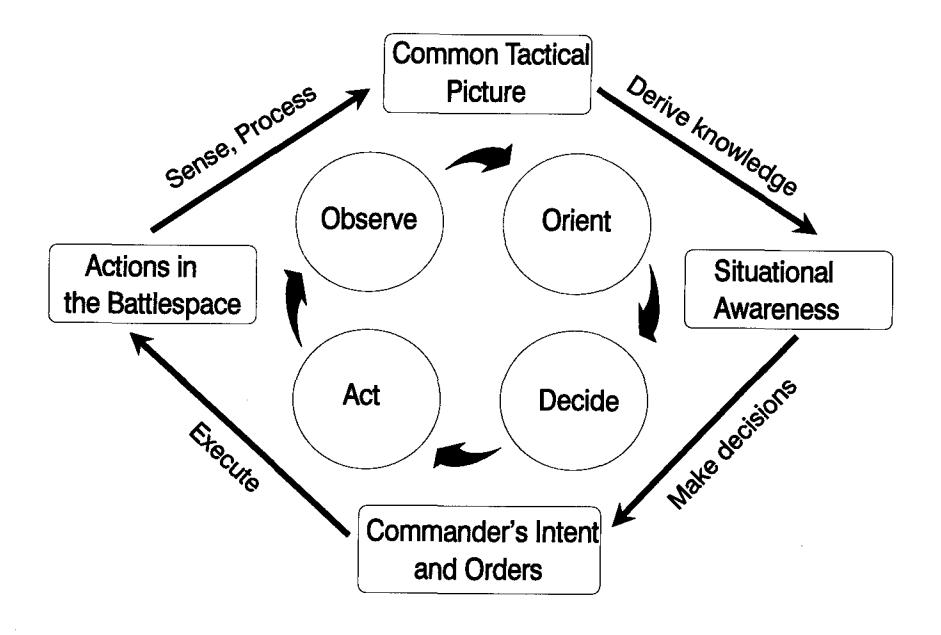
Figure 2-1. The Decision and Execution Cycle
18
<sup>4 The OODA Loop was developed by Col John R. Boyd, USAF (Ret), "An Organic Design for Command and Control," *A Discourse on Winning and Losing*. Unpublished lecture notes, August 1987. OODA is an acronym for Observe-Orient-Decide-Act.
among commanders at various levels. Next, a commander orients himself to the environment—that is, he forms a mental picture of the situation—by converting sensor data and other information into estimates, assumptions, and judgments about what is happening. The intelligence process plays a key role in supporting the commander's ability to orient. From his orientation the commander derives his understanding of the battlespace, or situational awareness. Based on this understanding, he then decides on a course of action and comes up with a plan. Finally, he sets forth his intent and issues orders to put that plan into action. During the action, the commander monitors the execution of operations and gauges their results, bringing him full circle to the observation phase, from which he begins the cycle again. Throughout the entire cycle, the friction and fog of war continually hinder the commander's ability to observe, orient, decide, and act.
In general, we base our decision making on our orientation to the situation. Orientation is the result of a cognitive process that turns data gathered from the environment into knowledge and understanding. It is the key to the entire decision and execution cycle, because it influences the way we observe, decide, and act. The orientation process shapes the character of the current decision and execution cycle; in turn, present cycles shape the character of future cycles. Our experience, expectations, culture, and the unfolding circumstances of war all influence our ability to orient. The commander's orientation, however, is rooted in what he believes to be the current "reality" of the battlespace. This image of reality is derived from his direct observation, sensors, intelligence systems, and situation reports from subordinate commanders. Since these sources of information are imperfect and may be manipulated by the opposing side, his perception of "reality" will inevitably be something other than absolute reality. Accordingly, a commander should constantly strive to build, validate, update, and disseminate his image of the battlespace. At the same time he should recognize the unavoidable uncertainty inherent in this image. He also should recognize the advantages to be gained by increasing the level of uncertainty existing in his opponent's image of the battlespace.
Since the decision and execution cycle is a continuous process, all phases of the cycle are active at each echelon of command. Each commander will gather information, develop situational awareness, and plan for future operations at the same time he is conducting current operations. Meanwhile, senior and subordinate commanders are gathering information and working through decision and execution cycles at their respective levels. However, the essential lesson of the decision and execution cycle is the absolute importance of generating tempo. Maintaining rapid decision and execution cycles-and thus a rapid tempo of operations-requires that seniors and subordinates alike have an accurate image of the battlespace and a shared vision of what needs to be done. With this common perspective, commanders are able to experience superior situational awareness and make more effective decisions, enabling them to exercise initiative during combat. To exercise initiative successfully, a subordinate must understand his senior's intent. Thus, a key tenet of naval warfare is that commanders at every level must understand their seniors' intent, so they can exploit rapid decision and execution cycles in harmony with the broader, more general efforts at higher levels.
### The Cognitive Hierarchy
To this point, we have used the term "information" generically to refer to all forms of description or representation, from raw data to knowledge and understanding. We will continue to use the term generically when we are discussing information as one of the three components of the command and control system (as discussed in the next chapter), or information management in general. However, we will use the term more precisely when we discuss information as one of four steps in generating understanding, or situational awareness, as illustrated in Figure 2-2.5 Understanding is the desired end state of the orientation phase of the decision and execution cycle.
<sup>5 Based on Jeffrey R. Cooper, "The Coherent Battlefield–Removing the 'Fog of War': A Framework for Understanding an MTR of the 'Information Age." Unpublished paper. SRS Technologies, 9 June 1993.
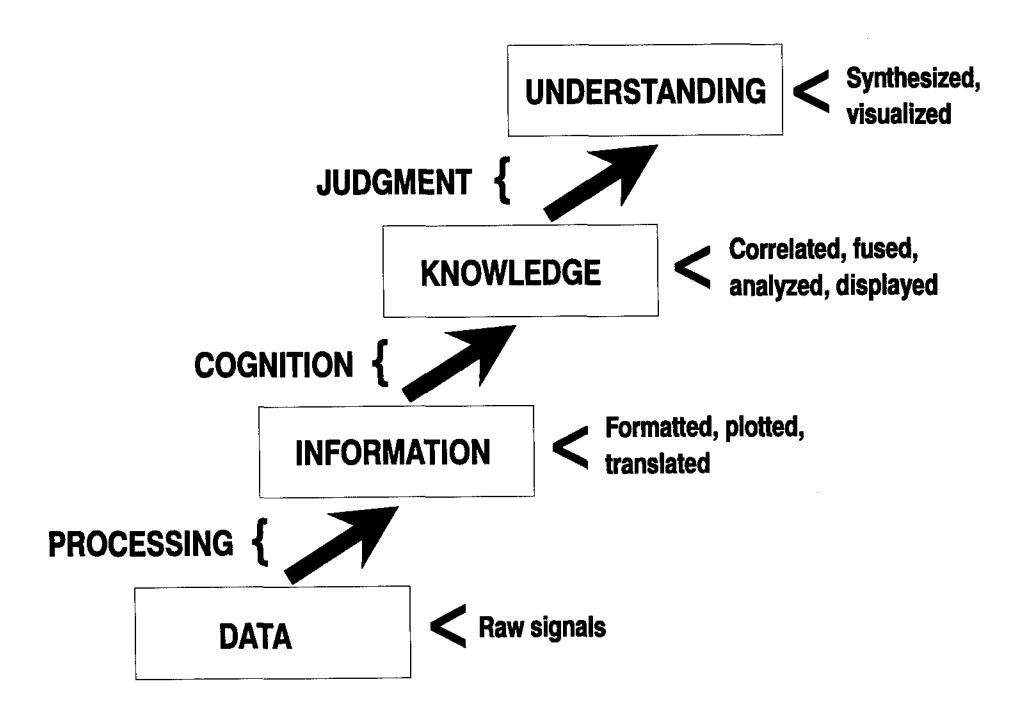
Figure 2-2. The Cognitive Hierarchy
The first step toward understanding is gathering data—the building blocks of understanding. Data are bits and bytes transferred between computers; transmissions sent by telephone, radio, or facsimile; rolls of undeveloped film. We gather data primarily from our sensors in the form of raw signals. These signals may take the form of a Sailor or Marine's direct observation of the battlespace, radar returns from a target, or radio signals intercepted from enemy communications. To be meaningful, however, these raw signals must be processed so that they can be understood by the people who must use them.
Processing involves organizing, formatting, collating, filtering, plotting, and all other functions that turn data into information. Within this context, "information" is the name we assign to data once it is collected from the environment and processed into usable form. In this sense, information may refer to a report called in by a reconnaissance team, radar returns that have been processed and
identified as a particular class of air track, or enemy radio transmissions that have been detected, classified, and geolocated by radio direction finding. Processing gives the data a limited amount of value. Although not yet fully analyzed and correlated, processed data clearly has immediate use for people in avoiding threats, acquiring targets, and building situational awareness. *Combat information* is one form of information that a commander relies on to make decisions while conducting operations.

Information—i.e., processed data—allows us to generate knowledge through cognition: the act of learning, of integrating various pieces of processed data. Knowledge results from analyzing, correlating, and fusing data that have been processed and evaluated as to their reliability, relevance, and importance. For the naval commander, naval intelligence is a form of knowledge that helps build a picture of the situation—as it exists now and may exist in the future. As we gain knowledge we begin to see the relationships between events in the battlespace, to fathom the way an enemy thinks, and to project what he might do. More importantly, at this level we begin to recognize some of the things that will forever remain unknown—and thus identify the uncertainty we must deal with.
Finally, by applying judgment, we transform knowledge into understanding. Judgment is a purely human skill, based on experience, expertise, and intuition. Automated information systems can play a crucial role in collecting and processing data, but they play a very limited role at present in generating understanding. Understanding is distilled from knowledge that has been synthesized and applied to a specific situation to gain a deeper level of awareness—a knowledge of the situation's inner workings. We may know what is going on; we understand why. Understanding equates to situational awareness, through which we can see patterns emerging from events in the battlespace and anticipate the consequences both of our actions and those of the enemy. True understanding should be the basis for our decisions. At the same time, however, we must recognize that the inevitable constraints of uncertainty and time in combat, may preclude full situational awareness prior to deciding and acting.
### **Decision Making Theory**
Making sound and timely decisions is a key objective of the command and control process. In military operations, several general principles of decision making apply. First, because war is a clash of opposing wills, we realize that we cannot make decisions in a vacuum. We must take our enemy into account—recognizing that, while we are trying to impose our will on him, he is trying to do the same thing to us. Second, whoever can make and implement sound decisions faster gains a telling-often decisive-advantage. Third, a military decision is much more than a mathematical computation—it requires intuition and analysis to recognize the essence of the problem and creativity to devise a practical solution. Such ability is the product of experience, education, intelligence, boldness, perception, and character. Fourth, because all decisions must be made in the face of uncertainty and every situation is unique, there is no perfect solution to any problem in military operations—so we should not agonize over finding one. Instead, we should adopt a promising course of action with an acceptable degree of risk, and execute it before an adversary can get oriented and take action. Finally-in general-the lower the echelon
of command, the faster and more direct decision making can be. An individual unit commander can normally base decisions on factors that he observes firsthand. At successively higher echelons of command, commanders are further removed from events by time and distance. As a consequence, in a well-trained force, imbued with initiative, the lower we can push the decision-making threshold, the swifter our decision and execution cycle will become.
The defining features of the command and control problem uncertainty and time-exert a significant influence on decision making. As knowledge about a situation increases, our ability to make an appropriate decision also increases. Knowledge is a function of information so, as the quantity of information increases, the effectiveness of the decision also should increase. At some point in the process, however, when basic knowledge has been gained and the quest for information focuses more on filling in details, we reach a point of diminishing returns. At this point, the potential value of the decision does not increase in proportion to the information gained or the time and effort expended to obtain it. As the amount of information increases to this certain point, knowledge is increasing and the time needed to make an effective decision is decreasing. Beyond this point, additional information may have the opposite effect—it may only serve to cloud the situation, impede understanding, and cause the commander to take more time to reach the same decision he could have reached with less information. Therefore it is not the quantity of information that matters; it is the right information made available to the commander at the right time.
"A good plan violently executed now is better than a perfect plan next week."
— General George S. Patton, Jr., U.S. Army
One theory of decision making sees it as an analytical process. The commander generates several options, then identifies criteria for evaluating these options, assigns values to the evaluation criteria, and
rates each option according to these criteria. The basic idea is to compare multiple options concurrently to arrive at an optimal solution. Analytical decision making tends to be thorough, but time-consuming. Theoretically, experience is not necessary for effective analytical decision making—reasoning power is enough.
A second approach to decision making is based on intuition. This approach relies on an experienced commander's ability to recognize the key elements of a problem, rapidly integrate them, and make a proper decision. Intuitive decision making thus replaces analysis with experience and judgment. The intuitive model credits an experienced commander with the ability to grasp the situation in its entirety, an ability sometimes called coup d'oeil.6 Intuitive decision making strives to find the first solution that solves the problem, rather than waiting for the "best" solution. The speedier intuitive model is consistent with the view that war is ultimately an art rather than a science—there is no absolutely correct answer to any problem. The intuitive model works on the assumption that, by drawing upon personal experience, the commander will generate a workable first solution, and therefore does not need to develop numerous options. If time permits, the commander may evaluate his decision; if he finds it defective, he moves on to the next reasonable solution.
Each model of decision making has its strengths and weaknesses; which is better depends on the nature of the situation, particularly on the time and information available. Typically, the analytical approach is more appropriate for deliberate planning prior to military action, when the time is measured in hours or days and extensive information can be gathered and processed. In this situation, modeling, simulation, and exercises may be useful in allowing the commander to evaluate his potential courses of action. The intuitive approach is clearly more appropriate for the fluid, rapidly changing environment of combat, when time and uncertainty are critical factors. In practice, the commander usually will incorporate certain analytical methods and decision aids into an essentially intuitive process whenever the situation warrants and time permits.
<sup>6 Literally, "stroke of eye"—a quick view or survey.
### **Methods of Control**
Historically, in striking a balance between orchestrating operations and granting freedom of action to subordinates, commanders have used two methods of control—detailed control and mission control. When using detailed control, a commander controls with a "tight-rein." Command and control is centralized. Orders and plans are explicit, as when a formation of ships is conducting tactical maneuvering. Such control emphasizes vertical information flow, with information flowing up the chain of command and orders flowing down. Detailed control is often the preferred method when time is not a critical factor, when procedures must be closely adhered to for safety reasons, or when restrictive rules of engagement demand close monitoring and extensive reporting of events. Detailed control, however, does not normally work well in a rapidly changing situation; nor does it function well when the vertical flow of information is disrupted. Therefore, it is not the preferred method of control under conditions of great uncertainty and time constraints.

In contrast, mission control seeks to cope with the effects of uncertainty and time by creating a system that can respond quickly in combat. Rather than seeking certainty prior to making decisions. we lower the degree of certainty needed before we decide and act. When using mission control, a commander controls with a "loose rein." Command and control is decentralized and flexible. Orders and plans are succinct. In addition to keeping the commander informed, mission control emphasizes horizontal information flow among subordinate commands. The commander guides the actions of subordinates by imparting an understanding of mission requirements, then allows them freedom of action. Unity of effort is not attained by conformity imposed from above, but grows instead from spontaneous cooperation among all elements of the force. By decentralizing decision making authority, we seek to heighten the tempo of operations and improve the force's ability to deal with rapidly changing situations. Moreover, because it relies on implicit understanding of mission requirements, mission control is much less vulnerable to disruption than detailed control.
In practice, no commander will rely solely on either detailed or mission control. The type of control he uses will depend on the nature of the operation or task, the environment, the nature and capabilities of the enemy, and—perhaps most of all—the qualities of his own people. Detailed control may be more appropriate in performing specific, precise tasks of a procedural or technical nature—such as controlling airspace—but it is less effective in the conduct of high-tempo operations where judgment, creativity, and initiative are required. As being the more ambitious form of control, however, mission control demands more of leaders at all levels.
- § - § - § -
### COMMAND AND CONTROL IN THE BATTLE OF BRITAIN, 1940
"Never in the field of human conflict was so much owed by so many to so few."
- Winston S. Churchill, 20 August 1940
The classic modern command and control success story is that of Air Marshal Hugh Dowding's Fighter Command in the Battle of Britain. Although the German Luftwaffe had superiority in numbers, Fighter Command had superior command and control, which it used to defeat the German campaign to bomb Great Britain into submission.

Early in the war, the British developed a series of air defense radars, but it wasn't British radar technology that made their command and control superior to the Luftwaffe's. In fact, the German radars—the Freya and the Würzburg—were more capable than those of the British. Rather, it was the British organization for information processing and dissemination—the system that linked radars, observers, and pilots to the Operations Rooms—that gave them the upper hand. In fighter pilot Peter Townsend's words, "The Germans knew about British radar, but never dreamed that what the radar 'saw' was being passed on to the fighter pilot in the air through such a highly elaborate communications system."
Information gleaned from radars and observers came together in the "big picture" assembled in the Operations Room. Initial radar reports were passed through a filter room, where conflicts were resolved. In Operations, the filtered information from the radars was combined with reports from observers and data on friendly forces. At this point, the "bogies" (unidentified aircraft) or "bandits" (enemy aircraft) were assigned to sector controllers who would then guide assigned aircraft to meet the enemy. The "big picture"—in other words, the common tactical picture—became the basis for deciding which fighters to send where. Fighter Command used the unprecedented capabilities of its command and control system to anticipate the Luftwaffe's attacks and move all available fighters to critical points where its pilots surprised and attacked the enemy. In so doing, Fighter Command defeated the German attempt to gain control of the skies over Britain.

-- Adapted from Thomas P. Coakley, Command and Control for War and Peace, Washington, D.C.: National Defense University Press, 1992
29

### **CHAPTER THREE**
## The Naval Command and Control System
'The effectiveness of American Seapower depends directly on the effectiveness of the exercise of command, control and coordination of our Naval Forces by Naval Commanders, and the means through which this exercise is accomplished. . . . "
- Admiral Arleigh A. Burke, U.S. Navy
hether in routine peacetime forward-presence operations, in humanitarian relief and peacekeeping operations, in crisis response, or in regional or global combat, the naval commander monitors and influences the actions of his forces through a system for command and control. This system provides the key link in the chain that connects forward-deployed naval forces with each other, the supporting shore establishment, forces of other Services and other nations, and government and non-government agencies. It is built upon our understanding of the nature of war and the command and control process.
As a system, naval command and control has three components—our command and control organization, information, and command and control support. The command and control organization encompasses the commander and the chain of command that connects superior commanders with subordinate commanders. Information is the lifeblood of the entire command and control system. Command and control support is the structure by which the naval com-
mander exercises command and control. It includes the people, equipment, and facilities that provide information to commanders and subordinates.
### **Organizing for Command and Control**
Naval forces prepare for combat as task-organized, Navy-Marine Corps teams. Tailored for joint operations and scaled to the mission, they can act as an enabling force for follow-on joint operations, serve as the core element of a joint task force, or fully integrate their actions with standing joint forces. Naval forces are organized in a way that clearly defines the structure of authority and responsibility. In great measure, the way we organize our forces determines the way we fight. In fact, every organizational decision is a command and control decision, because it establishes the network of relationships among commanders. The way we organize gives us a framework for building task forces and task groups, defining command relationships, organizing and controlling the battlespace, and managing information. By task-organizing our force into capable subordinate elements and assigning each its own task, we in effect organize the overall mission into manageable parts.
Organization establishes the *chain of command* and the command and support relationships within the force. The chain of command establishes authority and responsibility in an unbroken succession. Commanders at each echelon respond to intent and orders from higher commanders and, in turn, issue intent and orders to their subordinates; each commander has full authority and responsibility within his given sphere. Command and support relationships specify the type and degree of authority one commander has over another and the type and degree of support that one commander must provide another.
Command authority for naval forces, as with all U.S. military forces, originates with the President and extends through the Secretary of Defense—with advice from the Chairman of the Joint Chiefs of Staff—to the combatant commanders. A combatant command is a
command with a broad, continuing mission under a single commander. It may be either a *unified command*, composed of forces of two or more Services, or a *specified command*, normally composed of forces from a single Service. A combatant command may have a geographic area of responsibility, referred to as a theater, or functional responsibilities, such as for special operations or space. Naval forces can be assigned to any of the combatant commanders for operations. The organization of combatant commands today is depicted in Figure 3-1. Each combatant command has Service components. The combatant commander will determine whether the Service component commander or a functional component commander will command and control forces.7
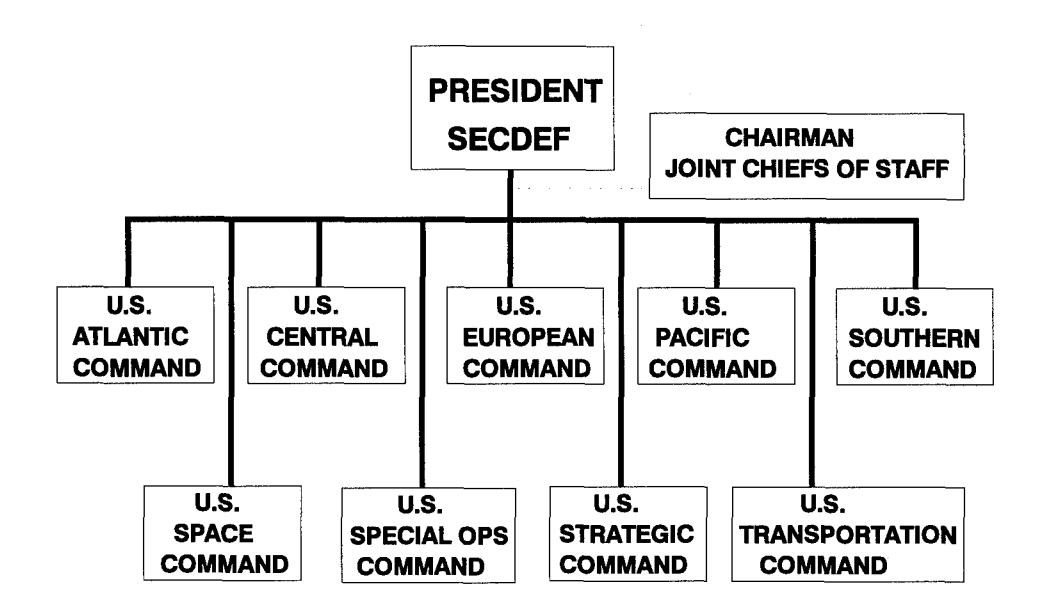
Figure 3-1. Combatant Command Organization
<sup>7 Joint Pub 3-0, "Doctrine for Joint Operations," contains a more complete description of component commander duties and responsibilities, both Service and functional.
Combatant commanders typically organize their forces for specific warfighting tasks by forming a joint task force. Joint task forces are appropriately constituted and designated, task-organized forces composed of forces from two or more Services. Commanders of joint task forces normally conduct operations to achieve objectives at the operational level of warfare. The Services provide forces to the joint task force, whose commander organizes these forces into Service or functional components as the mission demands. A joint task force commander may also organize functional components when two or more Services operate in the same medium. A Special Operations component, typically called a Joint Special Operations Task Force, and a Joint Force Air Component Commander are two examples of functional components. For combat and operations other than war, combatant commanders normally employ assigned naval forces as part of a joint task force.
There are four basic forms of command relationships—combatant command, operational control, tactical control, and support. Only combatant commanders exercise combatant command (COCOM) authority-COCOM cannot be delegated. COCOM authority includes broad responsibility for organizing and employing forces, assigning tasks, designating objectives, and directing all aspects of joint operations, training, and logistics necessary to accomplish the mission. Combatant commanders-either unified or specified commanders-normally exercise COCOM through designated Service or functional component commanders, commanders of a subordinate unified command (such as Commander, U.S. Forces Korea), or a subordinate joint task force commander. Combatant commanders may provide forces, including naval forces, for multinational peacekeeping efforts. In these operations, Presidential Decision Directive PDD-25 of May 1994 states that the President retains and will never relinquish command authority over U.S. forces.
Inherent in combatant command, operational control (OPCON) is the authority to direct all aspects of military operations and joint training to accomplish assigned missions. It allows the commander to perform those functions of command over subordi-
nate forces involving organizing and employing commands and forces, assigning tasks, designating objectives, and giving authoritative direction to execute the mission. OPCON is normally delegated to and exercised by joint task force commanders, Service or functional component commanders of a joint task force, or naval expeditionary force commanders. On a case by case basis, naval forces may be placed under the OPCON of a United Nations (U.N.) commander for specific U.N. operations authorized by the Security Council.

Tactical control (TACON) may be exercised by commanders at any echelon at or below the level of the combatant commander. It is the detailed and usually local direction and control of movements or maneuvers necessary to accomplish warfighting duties and responsibilities. It includes sufficient authority for controlling and directing the application of force or tactical use of supporting forces. Naval commanders typically exercise TACON over forces assigned or attached, including forces from other Services, nations, or functional components. Unless otherwise specified, TACON involves no responsibilities for organization, logistics, or training.
A commander may establish various support relationships—mutual, general, direct, or close support—between subordinate commanders when one unit or organization can aid, protect, complement, or sustain another force. Support may be exercised by commanders at any echelon of command. A commander normally establishes a support relationship by directing one force (the "supporting force") to provide support to another force (the "supported force"). The superior commander specifies the degree of authority granted to the supported commander in the initiating directive. In addition to these command relationships, a commander also has several other forms of authority available: coordinating authority, administrative control, and direct liaison authorization.8
In addition to specifying the command relationships, our command and control organization also gives the commander a *staff* appropriate to his level of command. The staff at any given level assists the commander in executing his duties by providing specialized expertise and allowing a division of labor. The staff is not part of the chain of command and thus has no authority in its own right, although the commander may delegate authority to a staff officer if he so chooses. In such cases, the staff officer exercises that authority "by direction" of the commander.
Our organization should ensure a reasonable *span of control*. Span of control refers to the number of subordinates or activities under the control of a single commander. There is a limit to the number of subordinates an individual can control effectively; the ideal span of control will vary. For example, the more fluid the situation, the fewer subordinate elements a commander can track. Similarly, a commander who must pay close attention to the operations of each of his subordinate elements generally has a narrower span of control than a commander who exercises mission control and lets his subordinates work out the details of execution.
<sup>8 See Joint Publication 0-2, "Unified Action Armed Forces (UNAAF)" and Joint Publication 3-0, "Doctrine for Joint Operations," for more information on command relationships.
In general, narrowing the span of control means deepening the organization by adding layers of command. The more layers of command an organization has, the longer it takes for information to move from top to bottom and vice versa, the less responsive it is in processing information. Deciding to flatten the organization by eliminating echelons of command increases the speed at which information can be disseminated, thereby increasing tempo; but it also requires widening the span of control and puts a premium on lateral coordination between subordinate units. A tradeoff thus exists between organizational width and depth. Consequently, the commander must have the ability to organize his forces in whatever manner the situation demands.
Naval command and control organizations must be able to handle and disseminate information efficiently. We generally favor more decentralized organizations, which can process information more quickly, to maintain a high tempo of operations. This gives the local commander authority to take action on his own initiative. To be most effective, decentralized execution requires the local commander to have the information required to form a real-time, comprehensive picture of the situation in his battlespace.
### The Role of Information
As the second component of the command and control system, information is the raw material of decision making and execution. There are two basic uses for information. The first is to help create an understanding of the situation as the basis for making a decision. Information serving this purpose can be described as *image-building information*. This type of information primarily supports the orientation and decision phases of the decision and execution cycle. Image-building information consists of information about the enemy, the surrounding environment, and the status and disposition of our own forces. The second basic use for information, equally important, is to make it a means of coordinating actions in the execution of the plan after the decision has been made. Such information can be described as *execution information*, and primarily supports the action phase of the
decision and execution cycle. Execution information may take several forms: e.g., orders or guidance issued to subordinates, execution coordination, or requests of one unit for support by another. Execution information refers not only to instructions or plans; it also means disseminating the commander's vision and intent.

Information is essential to effective command and control, yet any given piece of information may be meaningless in itself. Correlating and fusing pieces of information help us gain knowledge and understanding by allowing us to form a mental image of the battlespace to heighten and convey our understanding of the situation. People not only think in terms of images, they also understand things best as images and are inspired the most by images. Images also can describe the military challenges we face, as well as their solutions. A carefully drafted concept of operations and commander's intent should convey a clearly understood mental image of the operation and the desired outcome. We disseminate this image throughout the force, allowing our subordinates to seize the initiative with a clear understanding of their commander's intent and the local situation.
Our image of a situation is based not only on our empirical observations of the situation, but on our interpretation of those observations as well. Consequently, our image also is based on our intuition and judgment, which in turn are the product of our expe-
riences, preconceptions, education, and training. New information that conflicts with our existing image requires us either to validate the image or revise it. If we are going to exercise command and control effectively, the image that we create and communicate to others must be realistic. Conversely, if we want to deceive our adversary, we try to implant in his mind an image of the situation that does not match reality, thereby leading him toward bad decisions.
We generate images from our own observations as well as from information we receive from others. In general, the higher the level of command, the more we must receive our information from other people, instead of direct observation. This situation causes three problems. First, as we have recognized, uncertainty is inherent in any situation. When we observe something firsthand we have an intuitive appreciation for the level of uncertainty—a sense of how reliable the information is-and we can act accordingly. But, when we receive our information secondhand, we sometimes lose that sense. This can be especially dangerous in a high-technology command center, where elaborate displays and decision aids tend to take on an appearance of infallibility. Second, as human beings we can sense more about a situation from firsthand observation than we can communicate accurately to others. Finally, since each of us interprets events and information differently, the information we do communicate is inevitably distorted to some degree as it passes from one node to the next.
In dealing with the unavoidable problems of distortion and delay, a commander may choose to view critical events directly to the greatest extent possible, while concurrently attempting to stay abreast of the overall situation; in this way he avoids the distortions and delays that occur when information filters through successive echelons. However, military operations have become so complex and dispersed over such wide areas that commanders have found it increasingly difficult to observe all, or even most, of the critical events directly. One historical solution to this problem uses a technique known as the *directed telescope*. A directed telescope involves the commander's use of trusted and like-minded officers to act as his eyes and ears to observe selected events and report directly back to him. A commander may direct this "telescope" at the enemy, at the environment, or at his own forces.
Improperly used, however, directed telescopes can damage the crucial bonds of trust that a commander seeks to build with his subordinates. Directed telescopes should not replace regular reporting chains, but should augment them—either to avoid burdening lower echelons with additional information-gathering or to check the validity of information generated through regular channels.
Because our sources of information are imperfect and susceptible to distortion and deception, we must assess the quality of our information carefully. Although by no means all-inclusive, the following six criteria, listed in order of relative importance, help us characterize this quality:
- Relevance. Information that applies to the mission, task, or situation at hand.
- Accuracy. Information that conveys the true situation.
- *Timeliness*. Information that is available in time to make decisions.
- *Usability*. Information that is in common, easily understood formats and displays.
- Completeness. All necessary information required by the decision maker.
- *Precision*. Information that has the required level of detail or granularity.
First, our information should be relevant and accurate. As a second priority, we should ensure that information is both timely and presented in a usable form. Finally, information should be as complete and precise as possible. The following rules of thumb apply: incomplete or imprecise information is better than no information at all; untimely or unusable information is the same as no information at all; irrelevant or inaccurate information is worse than no information at all.
Because information is the lifeblood of any command and control system, we must have an effective way of managing information flow. Information management facilitates a rapid, distributed, and unconstrained flow of information, while providing users the ability to judge its quality. It also provides a means of focusing the flow and preventing information overload. It must support the flow of both image-building and execution information, giving the commander the ability to communicate his vision clearly. To the greatest extent possible, it should supply information, in the form of meaningful images rather than raw data, which requires that we have sophisticated means of filtering, fusing, and prioritizing information. Most of all, it means that the decision maker should have the continuous ability to find out what information is available and to retrieve that information when required. All information management should focus on critical information requirements, which demands vision on the part of the commander and understanding on the part of subordinates to identify and recognize the most critical needs.
To ensure the commander gets the information he needs, we need to manage carefully the way we position information and databases. Current information must reside with every unit of the naval force and be updated automatically as required. Based on planned information requirements and dissemination criteria, naval, joint, and national information sources should "push" relevant, time-sensitive information to naval forces. However, rather than "push" vast quantities of irrelevant information to the user, we require a command and control architecture that also allows the user to "pull" information he needs to plan and execute his mission. Of critical importance, information systems must be designed to ensure that information flows not just vertically through this "push-pull" architecture, but laterally as well. Lateral information flow allows subordinate commanders to maintain situational awareness of events in adjacent sectors, where they may be able to lend or receive support.
Modern technology is revolutionizing our ability to gather, disseminate, and use information—with this technology, we seek to leverage the combat advantages of timely, accurate information. Harnessing the power of modern information technology, however,
implies more than simply collecting and processing more and more data. We must also ensure that information technology contributes to the commander's knowledge and understanding. To minimize the time and effort that commanders must spend assimilating information-and generating understanding-our common tactical picture should help convey information in a form that directly imparts knowledge and understanding. We also must constantly assess the impact of technology on command and control, and ensure that technology serves the commander's warfighting needs. For example, even though new technologies now allow senior leadership to direct operations from afar, we still must give the on-scene commander the freedom of action to exercise initiative based on his knowledge of the local situation. This is an essential element of our command and control philosophy. Furthermore, as we rely increasingly on information from interactive global information sources, we must take steps to protect the integrity and security of our own information infrastructure, to ensure that we have access to the information we need when we need it. Improvements in correlating, filtering, interpreting, and displaying information are also required to reap the benefits of the increased quantity and fidelity of information.
### **Command and Control Support**
Command and control support, the third component of the naval command and control system, provides the framework but does not constitute the system itself. It encompasses all personnel, systems, and resources throughout the naval force that support the flow and processing of information, to include the following functions: surveillance, reconnaissance, and target acquisition; information processing; intelligence; decision and display; communications; electronic warfare; cryptology; command and control warfare and information warfare.
The principal objective of command and control support is to enhance the abilities of commanders to make and execute decisions, as well as to assist operations to counter enemy command and control capabilities. Support personnel plan, coordinate, and sustain all com-
mand and control support activities, based on the commander's information requirements and the required flow and processing of information. Support planners advise commanders and operations planners on the status, capabilities, and limitations of support personnel and their associated command, control, communications, computers, and intelligence (C4I) systems supporting naval forces—the tools with which command and control support personnel ensure that information supports their commanders' needs.

Multinational operations represent a unique challenge to naval forces in establishing effective command and control support. Whether the multinational operations include close allies who operate together regularly or coalition members who seldom—if ever—operate together, the key is to keep things simple. If possible, multinational communications agreements should be made in advance of war. These agreements should cover communications principles, procedures, and overall requirements. In the absence of such agreements, the procedures of one ally should be adopted on the direction of a duly established multinational authority. As in any other multinational situation, liaison officers can play a key role in overcoming language and cultural differences and building teamwork and trust.
Naval C4I Systems. As an important element of command and control support, naval C4I systems are the information systems, equipment, software, and infrastructure that enable the commander to exercise authority and direction over assigned forces. C4I systems also help the commander monitor and influence the actions of his forces through the chain of command. These systems support the following four basic functions:
- Collecting. Gathering and formatting data for processing.
- *Processing*. Filtering, correlating, fusing, evaluating, and displaying data to produce image-building information required for commanders to take appropriate action.
- Disseminating. Distributing image-building or execution information to appropriate locations for further processing or use.
- *Protecting*. Guarding our information from an adversary's attempts to exploit, corrupt, or destroy it.
C4I systems encompass the tangible structure supporting the command and control process. Although highly automated, this structure should be designed foremost with people in mind, giving them access to information and helping them make effective use of it. In modern naval warfare, advanced technology is essential for automating the collection, processing, dissemination, and protection of information. The objective of technology, however, is not to eliminate people from the command and control process; instead it is to enhance their performance. Technology automates routine functions that machines can accomplish more efficiently than people, freeing commanders to focus on the aspects of command and control that require their experience, judgment, and intuition. Enhancements to C4I systems should upgrade the quality of the commander's information. We must remember, however, that more information is not always better information.
Naval C4I systems should exploit the potential of human reasoning and intuition, and leverage U.S. advantages in information
technology to attain peak human effectiveness. C4I systems should support all aspects of the commander's decision and execution cycle, and enable naval forces to integrate their efforts with those of other Services, government and non-government agencies, and multinational partners. They should monitor and exploit all dimensions of the battlespace, using all available sensors. They also should facilitate information flow throughout the force: not just up and down the chain of command, but laterally as well. They should be designed as part of an architecture that can integrate with other operational systems, software, and databases quickly. They should also provide a coherent, accurate, and timely picture of the situation, scaled to the needs of the user. Finally, these systems also support the commander's efforts to exploit or attack the adversary's information systems and disrupt his ability to coordinate his forces.
C4I systems are vital for planning, executing, and sustaining a successful naval, joint, or multinational operation. All aspects of naval warfare—operations, logistics, planning, and intelligence—depend on responsive command and control. Integrating command and control requirements and plans with those for operations, logistics, and intelligence is essential. Experience has repeatedly demonstrated that command and control support planners should be brought in at the beginning of the planning process, and they must interact continuously with those who will execute the operation.
Common Characteristics of Naval C4I Systems. Although this section discusses these characteristics of C4I systems separately, close relationships exist among all of them. Depending on the situation, naval commanders may have to deemphasize some in favor of others. The order in which these characteristics are discussed is not intended to indicate their relative importance. C4I systems should be:
• Reliable. C4I systems should be available when needed and perform as intended, with low failure rates and few errors. Reliability is also attained by standardizing equipment and procedures, building necessary redundancy, establishing effective logistics support, and protecting against computer viruses, electronic jamming, and decep-
- tion. Systems should perform reliably aboard ships and aircraft, in garrison, and in austere field environments.
- Secure. C4I systems should provide security commensurate with the user's requirements and the vulnerability of the transmission media to interception and exploitation. Security is achieved by employing appropriate multilevel security protection and cryptographic systems, using transmission security techniques, and educating and training personnel in security procedures.
- Timely. C4I systems should process and transfer information between decision makers rapidly enough to maintain a high tempo of operations and ensure that our decision and execution cycle remains ahead of any potential adversary's.
- *Flexible*. C4I systems should be capable of being reconfigured quickly, to respond to a rapidly changing environment. Flexibility can be obtained through system design, using commercial facilities, mobile or transportable C4I systems, or prepositioned facilities.
- Interoperable. C4I systems should ensure that information can be exchanged among all the commanders and forces involved in an operation. Naval C4I systems also should possess the interoperability required to ensure information exchange in joint and multinational operations and in operations with other government agencies.
- *Survivable*. C4I systems' survivability can be attained by dispersal and protection of key nodes, physical and electromagnetic hardening, and redundancy of communications paths and information processing nodes.
The Role of Space Systems in Command and Control Support. Because they are inherently mobile and relatively unconstrained by overseas basing or infrastructure requirements, naval forces give U.S. decision makers great flexibility in employing the instruments of national power. These characteristics of naval forces, however, also

present unique challenges in orchestrating their actions. Space systems play a key role in linking widely dispersed, forward deployed naval forces with each other, the supporting shore establishment, forces of other Services and other nations, and government and nongovernment agencies. In fact, the nature of naval operations makes space systems indispensable tools in the command and control of naval forces. Naval commanders rely on them to provide surveillance and intelligence that is an important part of compiling the common battlespace picture. Today, naval forces are one of DoD's largest users of space systems, relying on space support for most ship-to-shore communications, precision navigation, combat information and intelligence, and weather and environmental data. This information allows naval commanders to gain situational awareness, communicate their intent and orders, and then monitor the actions of friendly and enemy forces. Without space systems, modern high-tempo naval operations as we know them would be inconceivable.
Space systems provide a unique capability to collect and disseminate large volumes of information. Such information plays a key role in expanding the commander's situational awareness of friendly and enemy activity. Space systems can provide sustained, covert surveillance of the battlespace to allow timely indications and warning of hostile actions. They can detect, classify, and identify high-interest targets and can help in assessing battle damage. They can provide highly accurate positional data to aid navigation, mapping and charting, and search and rescue. Finally, they can tie together naval, joint, and multinational forces across large areas of the globe by means of high-capacity, secure communications.
"A key element of our military technological superiority is our capability to command the high ground of space for early warning, intelligence, weather, surveillance, navigation, and command, control and communications."
— General Colin L. Powell, U.S. Army Chairman, Joint Chiefs of Staff, 1991
Because of their extended line of sight, space systems have unique operating characteristics that make them especially valuable to naval forces. They provide global coverage of areas of interest, including areas not normally accessible by terrestrial means. Depending on the geometry of their orbits, satellites can provide either periodic, short-duration coverage of specific points on the earth's surface, or continuous, long-dwell coverage of larger areas. They are extremely effective at certain tasks—such as global weather monitoring—that require the collection and processing of large volumes of information. Communications satellites are the primary means of providing immediate worldwide connectivity to all naval forces at sea, regardless of the location, weather, or type of operation. During multinational Operation Restore Hope in Somalia, for example, military and commercial satellite communications were the backbone of long distance and intratheater connectivity. Ashore, in regions with limited com-
munications infrastructure, satellite communications are the primary means available for reliable, high-capacity, long-haul service. On the other hand, a commander must understand that space systems cannot meet all his requirements. Because of the physical characteristics of their orbit, for example, space systems cannot provide continuous high resolution imagery of point targets. In addition, space systems are susceptible to disruption from jamming, interference, and electromagnetic pulse. For these reasons, naval warfighters must understand space support: how it helps U.S. and friendly forces—and conversely, how it may assist our adversaries—and how it can best be used to our advantage in the command and control of naval forces.
As technology advances, the conduct of warfare will continue to change. Each advance in command and control technology will help us form a more complete picture of the battlespace, generate faster decision cycles, maneuver rapidly in time and space, and be increasingly flexible in the application of combat power. Nevertheless, we must take care not to be captivated by a purely technological view of command and control that reflects only the quantity of information. Sound judgment must be used in planning and operating this increasingly complex command and control system to ensure that the commander can rapidly make and implement sound decisions throughout the battlespace.


### **CHAPTER FOUR**
## **Building Effective Command** and Control
"The art of command is not that of thinking and deciding for one's subordinates as though one stood in their shoes."
Marshal of France Ferdinand Foch
o be effective, our command and control—both the process and the system—must be able to cope with the effects of uncertainty and time. In doing so, we use a philosophy of command and control that serves as a shared understanding of the commander's art, which supports the way we employ naval forces under the inevitable conditions of uncertainty and limited time.
### Fundamentals of Effective Command and Control
As a basis for this philosophy, we recognize that war is inherently disorderly, unpredictable, and replete with friction. Effective command and control helps the naval commander unify the force in the face of combat's disorder and shape the course of events to meet his needs. It helps him function effectively across the full range of conflict, in any environment. It helps him generate a rapid tempo of operations, while coping effectively with disruptions created by the enemy—or self-induced ones. Moreover, although our philosophy of command and control is based on our warfighting needs, it applies equally to successful mission accomplishment during operations other
than war. The following paragraphs outline the major tenets of the philosophy we use to build effective command and control.
### People are the key to command and control.
The first principle of naval command and control is that people are the key. People make things happen—the command and control system exists only to serve them. Strong, effective leadership is required at all levels to unleash the potential of subordinates to perform to the utmost. Throughout the command and control process we seek to capitalize on the unique human abilities of initiative, boldness, creativity, judgment, and strength of character to overcome the uncertainty and disorder of combat. These qualities are essential to seize and exploit opportunities for combat advantage as they arise during battle. Since the essence of war is a clash of human wills, any concept of command and control that first does not account for this human dimension is inherently flawed. No amount of technology or equipment can supplant human effort in command and control.

### Mission control.
While we realize that the particular form of command and control we use depends on the unique requirements of the situation, we seek to use mission control as the best way to deal with the effects of
uncertainty and time. In using mission control a senior commander assigns missions and explains his intent, but leaves his subordinates free to choose the means and manner of accomplishing the task. In this way, every commander in his own sphere can exercise his authority fully and apply his imagination and judgment freely. Since we recognize that precision and certainty are impossible in war, we trade them in using mission control for enhanced speed, agility, and adaptability. Moreover, mission control is central to the art of maneuver warfare. It provides the flexibility to deal with rapidly changing situations and to exploit fleeting windows of opportunity. It provides the degree of cooperation necessary to ensure harmony of effort, yet gives commanders at all levels the latitude to act with initiative and boldness. Mission control thus seeks to capitalize on the initiative of subordinates to speed up the pace of our decision and execution cycle to achieve and maintain unity of effort and a rapid tempo of operations.
### Unity of effort.
To ensure unity of effort a naval force should operate under the insight, vision, and direction of a single commander. In this way one commander sets objectives for his forces, has the authority to plan and direct operations, organizes his forces to fit the mission, exercises command through a chain of command, and ensures that there are clear procedures in place for succession of command. As Joint Publication 1, Joint Warfare of the U.S. Armed Forces, states, "Unity of command is the guiding principle of war in military command relationships." In many situations, however, unity of command may not be achievable, especially in multinational or multi-agency operations, where cooperating forces and coalition partners may have divergent goals and agenda. In a broader sense, unity of effort implies that a commander coordinates his efforts with all participants in the operation, striving to shape their efforts toward a common goal. Unity of effort does not, however, imply rigid, centralized control, but rather cooperation, coordination, and mission control. After the commander articulates his intent and designates one unit or group as the main effort, he delegates authority to subordinates to make decisions and execute operations in pursuit of the main objective. Unity of effort ensures harmonious, coordinated action by all elements of the force.
Unity of effort demands that the commander impart a common vision of how he foresees the operation unfolding. In fact, when using mission control, one of the commander's primary responsibilities is to provide this shared vision. A common vision is the means by which a commander influences action. It establishes purpose and focus. It motivates subordinates and energizes the entire organization. It provides an understanding of the situation as it exists, as well as an image of the desired end state. In this vision, the commander should establish the underlying intent of operations. Because situations change, the commander must continuously adapt his vision to changing circumstances, and continuously impart this evolving, adapting vision to the entire organization. Common vision is the basis for decentralized decision making and execution.
### Decentralized decision making and execution.
The pace, complexity, and dispersed nature of modern naval warfare demand that command be decentralized during execution. The on-scene commander must be free to exercise initiative based on his understanding of the situation and his knowledge of the commander's intent. Delegating authority commensurate with responsibility builds trust and teamwork. Decentralized execution does not, however, lessen the responsibility or accountability of the commander. Each naval commander maintains unity of effort in decentralized operations by stating his intent clearly, issuing mission-type orders, and monitoring events.
Commander's intent represents a unifying idea that allows decentralization of command within centralized, overarching guidance. The commander's intent represents his vision of an operation. It describes the outcome he desires, while allowing subordinates to exercise initiative in consonance with his overall goals. During execution the situation may change, possibly making some assigned tasks obsolete, but the commander's intent is overarching and usually remains unchanged. The commander's intent is the primary way we decentralize execution while maintaining unity of effort. In fact, the concept of the commander's intent is so important that it has been formally implemented in the joint planning process; every joint mission planning order is required to start with a carefully crafted statement of the commander's intent.
A commander reaches a full understanding of his senior's intent through the process of mission analysis, which may be either explicit or implicit depending on the circumstances. Mission analysis is essential in ensuring that commanders at all levels of the chain of command have a shared vision of what needs to be done and why. In analyzing his mission, the commander must first understand his senior's mission so that he can see how his actions will contribute to the overall effort. Next, he derives his mission by identifying the task, whether assigned or implied, and its purpose. A task is a specific action directed by a superior; its purpose is normally the accomplishment or partial accomplishment of a larger task assigned to that superior. Where the mission contains multiple tasks, the commander must determine their relative priorities. After deriving his mission, the commander formulates a mission statement. The mission statement should be clear, concise, and proportional to the scope and capability of the command. Next, a commander should identify constraints imposed on his ability to accomplish the mission, including rules of engagement. Armed with this understanding of the thrust and scope of his mission, a commander next identifies specific, realistic, and clearly defined objectives. Objectives will include both physical objectives (e.g., destroying certain enemy units or strongholds) and functional objectives (e.g., degrading the enemy's ability to command and control his forces).
"Auftragstaktik [mission-type orders] is the leadership action...by which the higher leader does not give his subordinate a binding order, but more an excerpt from his own thought process, through which he demands from [the subordinate] the intellectual cooperation for the accomplishment of the mission."
— A German Army manual, 1912
As a form of mission control, the commander uses *mission-type* orders as a tool to decentralize execution. Mission-type orders specify the objective to be obtained or the end state desired, and the purpose for attaining it. In this way, mission-type orders direct a subordinate
to perform a certain task without specifying how to accomplish it. The senior leaves the details of execution to the subordinate, allowing him the freedom—and the obligation—to take whatever steps are necessary to deal with the changing situation. This freedom of action encourages the initiative needed to exploit the volatile, disorderly nature of combat.
"The basic requirement of decentralized operations in general war is preplanned response in accordance with commonly understood doctrine. Lord Nelson did not win at Trafalgar because he had a great plan, although his plan was great. He won because his subordinate commanders thoroughly understood that plan and their place in it well in advance of planned execution. You must be prepared to take action. . . when certain conditions are met; you cannot anticipate minute-by-minute guidance. . . ."
Vice Admiral Henry C. Mustin III, U.S. Navy Commander, Second Fleet Fighting Instructions, 1986
### Initiative of subordinates.
Seizing and maintaining the initiative lie at the heart of naval warfighting. Because the threat may be unpredictable and multidimensional, initiative is an indispensable element in the way we fight. Retaining the initiative in combat demands that leaders at all levels think for themselves, share information, and execute orders intelligently. Competent subordinate commanders at the scene of action will naturally have a better appreciation for the true situation than a senior who is some distance removed. Armed with an understanding of their senior's intent, subordinate commanders can recognize and react to enemy actions and vulnerabilities without waiting for direction from the chain of command. To ensure boldness and initiative during war and operations other than war, naval commanders should encourage initiative in their subordinates during peacetime operations and training.
### Implicit communication and understanding.
Cooperation is essential in any military operation. Because we seek to minimize restrictive control measures and detailed instructions, we must find effective ways to create cooperation. In-high tempo warfare, the commander does this by fostering implicit communication and understanding with his subordinates. This common understanding builds teamwork and mutual trust, allowing us to harmonize our actions intuitively with others. These abilities, however, do not come automatically. They are the product of a common ethos and repeated training and exercise. Much like the members of a basketball team who move the ball on a fast break without a scripted play or apparent effort, an effective military organization most often results from a shared understanding built through experience, competence, and demanding yet realistic training and exercises.
### Relative Tempo in Command and Control
"The battlefield is a scene of constant chaos. The winner will be the one that best controls that chaos, both his own and that of his enemy."
- Napoleon Bonaparte
Since war is an interaction of hostile, independent wills—and hostile, independent decision and execution cycles—we seek to generate tempo as a weapon. Tempo allows us to take action that sets in motion a series of actions and reactions, each of which may expose—if only for a moment—a critical vulnerability of the enemy. Catching the enemy in this vulnerable position, we are able to deliver a decisive blow. Our command and control philosophy of decentralization and mission control enables us to operate at a rapid tempo, giving us a tremendous advantage over an enemy who needs more time to process information, make decisions, and take action. Directed against an enemy with a slower decision and execution cycle, rapid and unexpected attacks on critical vulnerabilities can be overwhelming.
#### LEE AT GETTYSBURG: AN OPPORTUNITY LOST
Two weeks after his "masterpiece at Chancellorsville," which cost the life of Lieutenant General Thomas "Stonewall" Jackson, General Robert E. Lee reorganized his Army of Northern Virginia from two corps of four divisions each, into three corps of three divisions each. As with all reorganizations, there were drawbacks and shortcomings. Two of his three corps commanders were new to their assignments, as were five of nine division commanders, and six of his thirty-seven brigade commanders. After Jackson's death, one of Lee's concerns was his personal unfamiliarity with his new commanders, and thus his lack of implicit communication and understanding. As Lee said of his close relationship with Jackson, "I never troubled myself to give him detailed instructions. The most general suggestions were all that he needed."

Reorganized and rested, Lee marched his army north into Pennsylvania, seeking combat, victory, and an end to a war that had gone on far too long. At the end of the first day of fighting at Gettysburg, after the Confederate troops had pushed the Federal soldiers through the town of Gettysburg and onto the heights south of the town, Lee issued a verbal order to Lieutenant General Richard S. Ewell, commander of his second corps, "to carry the hill occupied by the enemy, if he found it practicable." Lee used the term "practicable" in his order because he was not personally
in a position to judge for himself the condition of Ewell's troops or the difficulties the objective itself might present. Ewell, however, interpreted "practicable" as meaning that he must be certain of success. Ewell reasoned that in war few things were certain, least of all success; as a result, he refrained from taking any risk whatsoever.

Because of this miscommunication between Ewell and Lee, Ewell did not attack, thereby giving the Federal troops enough time to fortify both Cemetery Hill and Culp's Hill. Those two fortified hills became the hook and the barb of the Federals' unbreakable fishhook defense at the decisive Battle of Gettysburg.

Adapted from Shelby Foote, The Civil War: A Narrative, New York: Random House, 1963.
59
As depicted in Figure 4-1, command and control involves a complex interaction of friendly forces, enemy forces, and environmental factors. This model is useful in understanding how the tempo of friendly and enemy command and control interact—and how command and control warfare affects the decision and execution cycle. Rather than operating in isolation, decision and execution cycles take place simultaneously—but not in synchronization—for both sides in combat. The friction and fog of war will always mean that commanders cannot step through their decision and execution cycles free from external influences-enemy actions and the environment will continually affect the actions of friendly forces. As we have seen, however, the essential lesson of the decision and execution cycle is the absolute importance of generating tempo. We should always attempt to be ahead of the enemy in our decision and execution cycle-that is, we want to be deciding on our next move and executing it while the enemy is still trying to orient himself to our last action. Since war is competitive, it is not the absolute speed of decision and execution that matters, but our speed relative to the enemy. Our goal is to be faster than the enemy, which means interfering with his command and control as well as streamlining our own. With this ability, we generate a dominant tempo that allows us to control the enemy's ability to transition between the different phases of the decision and execution cycle.
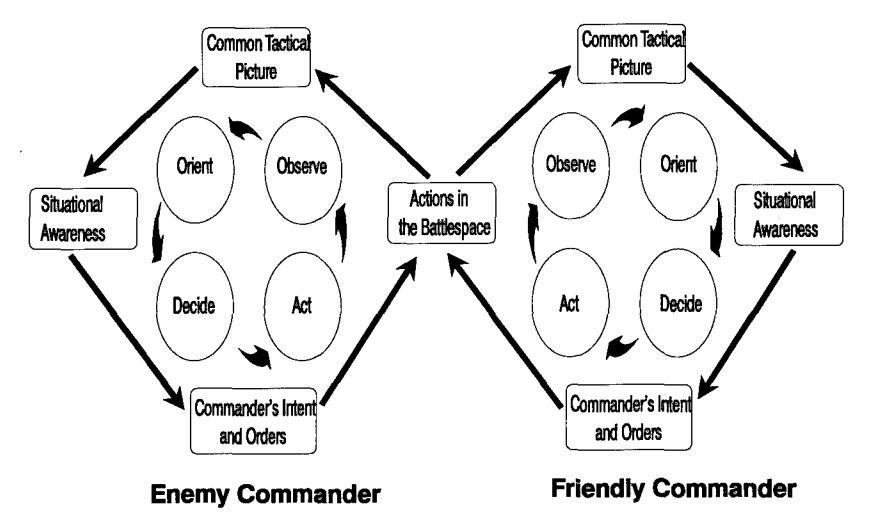
Figure 4-1. Interaction of Friendly and Enemy Decision and Execution Cycles
The commander's leadership, creativity, courage, and stamina all influence how effectively he makes and implements decisions. Such human factors are crucial in maintaining and accelerating the tempo of operations. By making quick and sound decisions, thereby turning observations into actions more efficiently than our opponent, we can get inside the opponent's decision and execution cycle. In doing so, we generate confusion and disorder in the adversary's mind, and slow his decision making. Since time is the crucial variable in the decision and execution cycle, the commander who can gather information and make decisions faster and better than his opponent will generate a quicker tempo of operations and gain a decided military advantage. In such a situation, the opponent will find his actions lagging farther and farther behind the true situation. With each cycle his decisions become less and less relevant, and he is ultimately unable to cope with a rapidly deteriorating situation. High operational tempo, which sows disorder and paralyzes enemy decision making, is at the heart of maneuver warfare.9
"De l'audace, et encore de l'audace, et toujours de l'audace!" (Audacity, and again audacity, and always audacity!)
— Georges Jacques Danton French Revolutionary Leader, 1792
In maneuver warfare, we seek not only to moderate the friction and uncertainty of combat for us, but to maximize disorder and uncertainty for our adversary as well. Disorder presents an adversary with ambiguous, deceptive, and novel situations that confuse and paralyze his decision making. It degrades our opponent's ability to orient himself to the situation. Because orientation is largely based on information received from observations of the battlespace, we can influence our adversary's orientation—and thus increase his sense of disorder—by disrupting his ability to the observe the battlespace. We
<sup>9 Of course, the ability to generate a rapid tempo of operations does not negate the need to bide time when the situation calls for patience. Our goal is not merely rapid action, but also meaningful action.
do this by deceiving, degrading, or destroying his sensors, communication links, and decision support systems. When we combine these attacks on his orientation process with unpredictability and fast-paced maneuver in time and space, we increase the differential in our relative tempos and magnify our adversary's disorder, shatter his cohesion, and ultimately destroy his will to fight. Recognizing that uncertainty is inherent in military operations, for us and our enemy, we strive to exploit this uncertainty to our advantage. In essence, effective command and control reflects our ability to thrive in an atmosphere of disorder and uncertainty.
### Command and Control and the Information Revolution
The naval Services are now witness to the birth of dramatic and far-reaching changes in doctrine, organization, and technology that are altering the conduct of warfare fundamentally. This sea change in the methods and tools of war is evident in rapid improvements in the technology of war—sensors, information systems, decision aids, and weapons—along with the evolving joint doctrine and joint organizational structures that will allow us to seize the opportunities offered by new technology. Together, these changes are revolutionizing the amount of information a commander has available to maintain situational awareness, make decisions, and coordinate the application of force. These advances will not, of course, change certain enduring aspects of warfare—the nature of war and of human beings and the problems of uncertainty and time, for example—but they do have profound implications for the ways naval forces will help deter and, if required, fight our nation's wars.
As foreshadowed during Operations Desert Shield and Desert Storm, one of the key features of these changes in the conduct of warfare is the enormous power of burgeoning information-processing and cognition technologies. Advanced sensors collect greater volumes of higher fidelity information. More powerful information processors filter and correlate this information to facilitate rapid understanding and decision making. Modeling, simulation, and other
decision support aids allow the commander to plan operations rapidly, test the outcomes of decisions and actions, and react to unexpected contingencies during execution. New communications systems and technologies allow a commander to coordinate multiple, simultaneous operations across vast distances. This is not to say that equipment will not fail or that people will not make mistakes—friction in military operations will persist. Yet, more than ever before, naval commanders at all levels will be able to build a more complete picture of the battlespace, along with the supporting command and control architecture to act on that information.

This information revolution has elevated the role of information in military operations to center stage. Today, the side that is able to manipulate or corrupt the information an adversary relies on to command and control his forces—and thus to influence his perceptions and, ultimately, his behavior—can employ information as a powerful weapon in peace, crisis, or war. Conversely, the side that is vulnerable to attempts to distort or deny its sources of information faces huge obstacles in effectively employing its military power. By
leveraging our advantages in the field of information, we can begin to shape the information available to an opponent while protecting our own, often unique information sources and systems. In so doing, U.S. forces may be able to better modulate the escalation of hostilities, or even to deter combat altogether, by staying one step ahead of our potential adversaries in the decision and execution cycle.
In response to the challenges posed by the increasing power of global information and interactive information systems, information warfare is emerging as a major new area of conflict. The Office of the Assistant Secretary of Defense (C3I) views information warfare as "actions taken to achieve information superiority in support of national military strategy by affecting adversary information and information systems while leveraging and protecting our information and information systems." Information warfare thus encompasses efforts at exploiting, manipulating, and destroying an adversary's sources of information, protecting our own information, and using information to gain a competitive advantage across the full range of military operations. In essence, information warfare seeks to seize and maintain a decisive advantage rapidly before shots are fired, missiles are released, or Marines are landed on hostile shore.
Since the time of Sun Tzu, military commanders have employed strategies to degrade their opponents' ability to command and control their forces. As a subset of information warfare, command and control warfare is an element of military strategy that employs the full range of naval, joint, and national means—both lethal and nonlethal—to attack an adversary's ability to command and control his forces, while simultaneously protecting our own command and control. Command and control warfare supports military operations at all levels of conflict, including pre-hostilities. By degrading or destroying an adversary's command and control—or deceiving him about friendly force capabilities and intentions—we can achieve surprise, maintain a rapid tempo of operations, and employ our own military forces more effectively. By protecting friendly command and control, moreover, we can ensure that an adversary never attains a similar advantage.
While command and control warfare has both offensive and defensive applications, in building effective command and control a commander must focus on protecting his own command and control. The defensive application of command and control warfare seeks to limit the adversary's efforts to deceive, degrade, or destroy our command and control, as well as to protect it from friendly interference. Our susceptibility to an adversary's attacks on our command and control does not depend on his technological sophistication or relative combat power. In fact, when we have a distinct edge in combat power, attempting to disrupt our command and control may be one of our adversary's leading war aims. Because of our heavy dependence on information systems and technology, his efforts need not be sophisticated to be successful. We guard against these efforts in two ways: by attacking the adversary's ability to counter our command and control and by reducing our vulnerability to attack through security, deception, and other force protection measures. In addition, because of our dependence on automated information systems, we are vulnerable to self-inflicted problems that degrade our command and control. The commander should ensure that his command and control protection efforts include steps to educate command and control support personnel in minimizing friendly interference.
Effective command and control provides a framework for exploiting the effects of combat's uncertainty. Inspirational leadership, mission control, unity of effort, decentralized decision making and execution, initiative at all levels, and implicit communication build confidence, morale, and the will to fight. They allow us to operate at a rapid tempo of operations and are essential elements of the successful command and control of naval forces.
- § - § - § -
65
### **CONCLUSION**
As war has evolved through the ages, so have the challenges of maintaining effective command and control. Some conclusions can be drawn about the environment in which command and control must function today and in the near future. If there is one thing that history shows us, it is that every military operation is different and that none of them is exactly what the commander—or those who try to forecast the nature of future military operations—expects. Thus, naval command and control, both the process and the system, must be flexible and adaptive to function effectively in support of the commander.
We must make an important distinction between the process of command and control and the system that supports it—the process is more important than the system. The commander is clearly a part of the process; but he is also part of the command and control system, not separate from it. More importantly, the entire command and control process depends on the shared understanding of separated commanders, an understanding that can be greatly facilitated by an efficient command and control system. Today, there is no denying the increasing importance of technology to command and control. A relevant example is real-time media coverage of events, a feature of modern life that tends to accelerate the speed at which events develop and to cause them to acquire an aura of immediacy and crisis. In many ways, technology has helped U.S. forces keep pace with the increasing complexity of war. Nevertheless, technology is not without its dangers. We always must strike a balance between overrelying on technology on one hand and failing to make proper use of technology on the other.
Helping the commander cope with uncertainty is a primary objective of command and control. However, uncertainty is inherent in any military operation and will never be eliminated altogether. The complex nature of conflict, where the outcome depends on decisions and actions by many commanders on both sides, demands that naval commanders be able to adapt to and thrive in an environment of uncertainty. Professional leadership, realistic training, flexibility, and cohesive doctrine will all help the commander cope with uncertainty.
### **GLOSSARY**
**Battlespace**: All aspects of air, surface, and subsurface, land, space, and the electromagnetic spectrum that encompass the area of influence and area of interest. (NWP 1-02)
Chain of command: The succession of commanding officers from a superior to a subordinate through which command is exercised. (Joint Pub 1-02)
Combatant command: One of the unified or specified combatant commands established by the President. (Joint Pub 1-02)
Combatant command (command authority): Non-transferable command authority established by title 10, United States Code, section 164, exercised only by commanders of unified or specified combatant commands unless otherwise directed by the President or the Secretary of Defense. Combatant command (command authority) is the authority of a combatant commander to perform those functions of command over assigned forces involving organizing and employing commands and forces, assigning tasks, designating objectives, and giving authoritative direction over all aspects of military operations, joint training, and logistics necessary to accomplish the missions assigned to the command. Also called COCOM. (Joint Pub 1-02)
Combatant commander: A commander in chief of one of the unified or specified combatant commands established by the President. (Joint Pub 1-02)
Combat information: Unevaluated data, gathered by or provided directly to the tactical commander which, due to its highly perishable nature or the criticality of the situation, cannot be processed into tactical intelligence in time to satisfy the user's tactical intelligence requirements. (Joint Pub 1-02)
**Command:** 1. The authority that a commander in the Armed Forces lawfully exercises over subordinates by virtue of rank or assignment. Command includes the authority and responsibility for effectively using available resources and for planning the employment of,
organizing, directing, coordinating, and controlling military forces for the accomplishment of assigned missions. It also includes responsibility for health, welfare, morale, and discipline of assigned personnel. 2. An order given by a commander; that is, the will of the commander expressed for the purpose of bringing about a particular action. 3. A unit or units, an organization, or an area under the command of one individual. (Joint Pub 1-02)
Command and control: The exercise of authority and direction by a properly designated commander over assigned and attached forces in the accomplishment of the mission. Command and control functions are performed through an arrangement of personnel, equipment, communications, facilities, and procedures employed by a commander in planning, directing, coordinating, and controlling forces and operations in the accomplishment of the mission. (JCS/J7/Joint Doctrine Division memo dtd 20 Oct 94)
Command and control system: The facilities, equipment, communications, procedures, and personnel essential to a commander for planning, directing, and controlling operations of assigned forces pursuant to the missions assigned. (Joint Pub 1-02)
Command and control warfare: The integrated use of operations security (OPSEC), military deception, psychological operations (PSYOP), electronic warfare (EW), and physical destruction, mutually supported by intelligence, to deny information to, influence, degrade, or destroy adversary command and control capabilities, while protecting friendly command and control capabilities against such actions. Command and control warfare applies across the operational continuum and at all levels of conflict. Also called C2W. C2W is both offensive and defensive: a. counter-C2—To prevent effective C2 of adversary forces by denying information to, influencing, degrading, or destroying the adversary C2 system. b. C2-protection—To maintain effective command and control of own forces by turning to friendly advantage or negating adversary efforts to deny information to, influence, degrade, or destroy the friendly C2 system. (Joint Pub 1-02)
Control: Authority which may be less than full command exercised by a commander over part of the activities of subordinate or other organizations. (Joint Pub 1-02)
**Information**: The meaning that a human assigns to data by means of the known conventions used in their representation. (Joint Pub 1-02)
Intelligence: The product resulting from the collection, processing, integration, analysis, evaluation, and interpretation of available information concerning foreign countries or areas. (Joint Pub 1-02)
Joint force: A general term applied to a force composed of significant elements, assigned or attached, of two or more Military Departments, operating under a single joint force commander. (JCS/J7/Joint Doctrine Division memo dtd 20 Oct 94)
Joint task force: A joint force that is constituted and so designated by the Secretary of Defense, a combatant commander, a subunified commander, or an existing joint task force commander. (JCS/J7/Joint Doctrine Division memo dtd 20 Oct 94)
Mission: The task, together with the purpose, that clearly indicates the action to be taken and the reason therefor. (Joint Pub 1-02)
Mission type order: Order to a unit to perform a mission without specifying how it is to be accomplished. (Joint Pub 1-02)
Operational control: Transferable command authority that may be exercised by commanders at any echelon at or below the level of combatant command. Operational control is inherent in Combatant Command (command authority) and is the authority to perform those functions of command over subordinate forces involving organizing and employing commands and forces, assigning tasks, designating objectives, and giving authoritative direction necessary to accomplish the mission. Also called OPCON. (Joint Pub 1-02)
Specified command: A command that has broad continuing missions and that is established by the President through the Secretary of Defense with the advice and assistance of the Chairman of the Joint Chiefs of Staff. It normally is composed of forces from a single Military Department. Also called specified combatant command. (Joint Pub 1-02)
Tactical control: The detailed and, usually, local direction and control of movements or maneuvers necessary to accomplish missions or tasks assigned. Also called TACON. (Joint Pub 1-02)
Unified command: A command with broad continuing missions under a single commander and composed of forces from two or more Military Departments, and which is established by the President, through the Secretary of Defense with the advice and assistance of the Chairman of the Joint Chiefs of Staff. Also called unified combatant command. (Joint Pub 1-02)
### SUGGESTED FOLLOW-ON READINGS
Joint Publication 1, "Joint Warfare of the U.S. Armed Forces," 11 November 1991.
Joint Publication 3-0, "Doctrine for Joint Operations," 9 September 1993.
Joint Publication 6-0, "Doctrine for Command, Control, Communications, and Computer (C4) Systems Support to Joint Operations," 3 June 1992.
"C4I for the Warrior," The Joint Staff, 12 June 1992.
Naval Doctrine Publication 1, "Naval Warfare," 28 March 1994.
Naval Doctrine Publication 2, "Naval Intelligence," 30 September 1994.
Fleet Marine Force Manual 1, "Warfighting," 6 March 1989.
Fleet Marine Force Manual 3, "Command and Control," 16 June 1993.
Allard, Kenneth C. Command, Control and the Common Defense. (New Haven, CT: Yale University Press, 1990).
Coakley, Thomas P. Command and Control for War and Peace. (Washington, D.C.: National Defense University Press, 1992).
Druzhinin, V.V. and Kontorov, D.S. Concept, Algorithm, Decision: Decision Making and Automation. (USAF translation) (Moscow: Voennizdat, 1972).
- Marshall, S.L.A. Men Against Fire: The Problem of Battle Command in Future War. (Gloucester, MA: Peter Smith, 1978).
- Orr, George E., Maj, USAF. Combat Operations C3I: Fundamentals and Interactions. (Maxwell Air Force Base, AL: Air University Press, 1983).
- Schmitt, John F., Capt, USMC. "Observations on Decisionmaking in Battle." *Marine Corps Gazette*, March 1988, pp. 18-20.
- Snyder, Frank M. Command and Control: The Literature and Commentaries. (Washington, D.C.: National Defense University Press, 1993).
- Sun Tzu. The Art of War. Ed. and trans. by Samuel B. Griffith. (New York, NY: Oxford University Press, 1988).
- Toffler, Alvin and Heidi. War and Anti-War. (Boston, MA: Little, Brown and Company, 1993).
- van Creveld, Martin L. Command in War. (Cambridge, MA: Harvard University Press, 1985).
- von Clausewitz, Carl. On War. Ed. and trans. by Michael Howard and Peter Paret. (Princeton, NJ: Princeton University Press, 1984).
- Wohlstetter, Roberta. Pearl Harbor: Warning and Decision. (Stanford, CA: Stanford University Press, 1962).
Naval Doctrine Command was established by the Department of the Navy in 1993. Its primary missions are to develop naval concepts and integrated naval doctrine; provide a coordinated Navy-Marine Corps voice in joint and multinational doctrine development; and address naval and joint doctrine with respect to training, education, operations, exercises, simulations, and war games. To ensure doctrine remains relevant we encourage your feedback on this publication and other doctrinal issues. Address your comments to:
> Commander, Naval Doctrine Command 1540 Gilbert Street Norfolk, VA 23511-2785
Additional copies of this publication may be obtained through the following distribution center:
> Defense Distribution Depot Susquehana, Pennsylvania Building 5 5450 Carlisle Pike Mechanicsburg, Pennsylvania 17055-0789 re: SN 0700LP0000600
This publication may be purchased by non-government personnel by writing to: ASO/NPFD Attn: Cash Sales Code 1013, 5801 Tabor Avenue, Philadelphia PA 19120-5099 or National Technical Information Services, 5285 Port Royal Rd. Springfield, VA 22161, Attn: Military Publications.