Assigned readings
Two primary documents that show the factory from inside — its process specification and an insider's critique — the joint factory's own governing set (its charter, its current process manual, and their supporting instruments), one flagship product read selectively, and three theory works that make the process legible as organizational design.
TRADOC Pamphlet 71-20-3, The U.S. Army Training and Doctrine Command Concept Development Guide (6 December 2011)
Read in full — it is short and every administrative detail is a design decision. Chapter 2 defines the doctrine/concept distinction and the Army Concept Framework; Chapter 3 gives the nine development steps and the capability-statement grammar; Chapter 4 specifies the staffing ladder, version numbers, comment typology, and the critical-comment veto. Appendix B is the format specification, down to tense and font.
../sources/army/tradoc_concept_development_guide.mdCol Charles Q. Brown Jr., Developing Doctrine for the Future Joint Force: Creating Synergy and Minimizing Seams, Walker Paper No. 3 (Air University Press; Air Force Fellows research, 2003–04)
Read the executive summary, Chapters 1–2 (the JOpsC framework and command-and-control tenets), and then Chapters 3–7 for the five focus areas, watching the case-study evidence: Desert Storm, Kosovo, Afghanistan, Iraq. Appendices A–E summarize the then-current doctrine each chapter attacks. The author — then a colonel on fellowship, later Chairman of the Joint Chiefs of Staff — is auditing the factory's output against three wars' worth of field experience.
../sources/joint/developing_doctrine_future_joint_force_walker_2003.mdJoint Publication 5-0, Joint Planning (1 December 2020) — selective
Read the executive summary, Chapter I (planning functions and plan products), and Chapter III Sections A–B (the four planning functions, plan-assessment outcomes, and the seven-step joint planning process). We read it not for its planning advice but as the factory's flagship product: doctrine whose content is the organization's own decision process, complete with review gates and approval authorities written into the text.
../sources/joint/jp5_joint_planning_2020.mdJP 5-0, Planeamiento Conjunto (2017, Spanish edition)
Reading-list mention only: the same doctrine issued in translation — evidence that the factory's products are also an export and interoperability good, shipped to allies as a shared coordination standard.
../sources/joint/jp5_planeamiento_conjunto_2017_es.mdCJCS Instruction 5120.02E, Joint Doctrine Development System (6 November 2020)
The factory's charter — 24 KB, read in full. Enclosure A states what joint doctrine is and how it relates to policy, strategy, training, lessons learned, and concepts; Enclosure B assigns responsibilities and names the Joint Doctrine Development Community's voting and non-voting members (Figure B-1). This is the governing document Session 03 previously knew only secondhand, through Walker's critique of the system it charters.
../sources/joint/cjcsi_5120_02e_joint_doctrine_development_system_2020.mdCJCS Manual 5120.01D, Joint Doctrine Development and Revision Process (2025)
The current, step-by-step process manual — the joint counterpart to TRADOC Pam 71-20-3. Read Enclosure A (the Joint Doctrine System, the doctrine hierarchy, and the four review-comment types) and Enclosure B (the nominal 300-day revision, the 100-day / administrative / urgent change tracks, and the joint-working-group consensus-and-vote machinery). Compare its formalized process, station by station, against the seams Walker documented in 2003.
../sources/joint/cjcsm_5120_01d_joint_doctrine_development_revision_process_2025.mdJP 1-01, Joint Doctrine Development System (5 July 2000)
The factory's earlier self-description, back when the process itself was published as a joint publication rather than a Chairman's directive — the "before" side of the CJCSI/CJCSM pair, and the process Walker was critiquing in 2003. Skim the preface and hierarchy sections to see how the same system was framed a generation ago.
../sources/joint/jp1_01_joint_doctrine_development_system_2000.mdTRADOC Regulation 25-36, The U.S. Army Training and Doctrine Command Doctrine Publishing Program (2 January 2023)
The Army's parallel production regulation — how the same institution runs doctrine (not concepts) through its own publishing pipeline. Skim the responsibilities and process chapters to see the Army analogue of the joint 300-day cycle.
../sources/joint/tradoc_reg_25_36_doctrine_publishing_program_2023.mdADP 1-01, Doctrine Primer (31 July 2019)
Army meta-doctrine: a doctrine about what doctrine is, how it is organized, and why its terms are disciplined. Read the introduction and Chapter 2 for the factory's own account of the doctrine/concept relationship and reasons doctrine changes.
../sources/joint/adp1_01_doctrine_primer_2019.mdCJCSI 5705.01G, Standardization of Military and Associated Terminology (2020), and the DOD Dictionary of Military and Associated Terms (2021)
The factory's vocabulary-control arm and its output. The instruction is the policy that appoints a DoD Terminologist and governs which terms enter the standard lexicon; the Dictionary is that lexicon (a reference to consult, not read). Read the instruction's responsibilities section; use the Dictionary only to see what standardized terminology looks like as a product.
../sources/joint/cjcsi_5705_01g_terminology_standardization_2020.md ../sources/joint/dod_dictionary_military_terms_2021.mdJoint Doctrine Note 1-19, Competition Continuum (3 June 2019)
A live specimen of the pre-doctrinal instrument: a Joint Doctrine Note, explicitly "not authoritative," that circulates emerging ideas as a supporting effort of formal doctrine development. Read the preface to see how the Joint Doctrine System quarantines exploration at the joint level — the analogue of the Army's DRAFT-stamped concepts.
../sources/joint/jdn1_19_competition_continuum_2019.mdJoint Doctrine Hierarchy (status chart, 12 December 2024)
The official one-page inventory of the joint doctrine library — capstone, keystone, core publications, notes, and guides — with a legend recording each publication's release status. Read it as the factory's parts catalogue, and note the legend line stating that web access to current JPs requires a common access card.
../sources/joint/joint_doctrine_hierarchy_status_chart_2025.mdMarch, J. G. (1991). Exploration and exploitation in organizational learning. Organization Science, 2(1), 71–87.
The session's spine. March's claim — that organizations must divide scarce attention between exploiting what they already know and exploring what they might know, and that adaptive processes systematically favor exploitation — predicts exactly the two-artifact system the Army built: doctrine for exploitation, concepts for exploration, with separate pipelines and separate burdens of proof.
doi.org/10.1287/orsc.2.1.71Cohen, M. D., March, J. G., & Olsen, J. P. (1972). A garbage can model of organizational choice. Administrative Science Quarterly, 17(1), 1–25.
Read for the model of choice opportunities as cans into which problems, solutions, and participants are dumped. Doctrine revision conferences are choice opportunities; Brown's proposals are solutions in search of one; the TRADOC staffing rules are an attempt to put a lid, a schedule, and a participant roster on the can.
doi.org/10.2307/2392088Galbraith, J. R. (1974). Organization design: An information-processing view. Interfaces, 4(3), 28–36.
Reread from Session 04's vantage will come later; here, apply it to the staffing chain itself. The version ladder, the comment-resolution matrix, and the adjudication board are information-processing capacity purchased at known cost in latency; the page limit and format rules reduce the need for processing downstream.
doi.org/10.1287/inte.4.3.28Two artifact classes: doctrine exploits, concepts explore
The Army does not have one kind of institutional knowledge document — it has two, with different time horizons, different epistemic standing, and different approval authorities. That split is March's exploration–exploitation tradeoff, institutionalized as a filing system.
TRADOC Pam 71-20-3 opens by drawing the line that organizes the whole factory. Doctrine "provides fundamental principles by which the military forces or elements thereof guide actions in support of national objectives. It is authoritative, requiring judgment in application." It describes the current and near-term force, provides a common language, drives how the Army is organized and equipped, and is the basis for all training and education. Concepts describe how future forces may operate: joint concepts cover 8–20 years out, Army concepts 6–18 years. Concepts originate from exactly two sources: "the rise of a new military problem that currently available DOTLMPF capabilities cannot adequately answer," or "the recognition that existing military problems can be addressed more effectively through employment of new technologies, new methods, new organizational approaches, or other forms of change." A concept is warranted only when professional military judgment concludes no viable solution exists and the problem cannot be solved by incremental change to doctrine, organization, training, materiel, leadership, personnel, or facilities (DOTMLPF).
Concepts, in contrast, describe future operational requirements that the Army will likely have to meet. Restated, doctrine guides today's force and influences near term change; concepts stand years in the future and pull today's force forward to anticipate operations in the future OE.
Doctrine · exploitation
Authoritative memory of what works
Current and near-term force. "Authoritative, requiring judgment in application." Common language, basis of training, driver of organization and equipment. It never has to re-argue its own validity; revision requires cause.
Concepts · exploration
Licensed speculation, quarantined from practice
Six to eighteen years out. "A concept warrants no assumption of validity, but recognizes that it is received with skepticism and must make its case through logic and experimentation." Marked DRAFT — NOT FOR IMPLEMENTATION until approved. It must not "simply restate current doctrine."
March (1991) argued that adaptive systems drift toward exploitation because its returns are nearer, surer, and more legible; organizations that want exploration must protect it structurally. The Army Concept Framework (ACF) is that protection made bureaucratic. It comprises a fixed hierarchy: the Army Capstone Concept (TRADOC Pam 525-3-0, approved by the Chief of Staff of the Army), the Army Operating Concept (525-3-1, approved by the Commanding General of TRADOC), six Army Functional Concepts — mission command, intelligence, movement and maneuver, fires, protection, sustainment, each owned by a Center of Excellence and approved by the Director of the Army Capabilities Integration Center (ARCIC) — plus leadership-directed concepts and legacy concept capability plans. Below the framework sit two advisory genres, CONOPS and white papers, which any TRADOC organization may initiate and a general officer may approve. Note the gradient: the more exploratory and informal the artifact, the lower the approval authority and the weaker its claim on the institution. Exploration is licensed, but its license is stamped by rank.
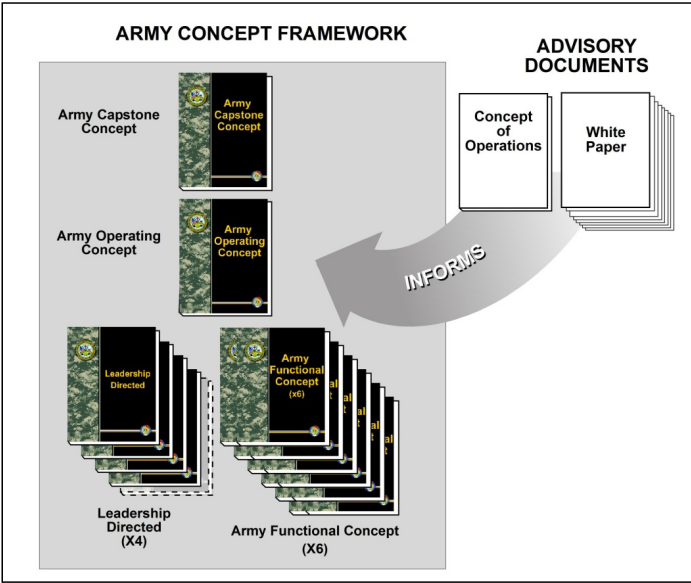
The seam between the two artifact classes is load-bearing because concepts are the intake of the requirements machine. Concepts yield required capabilities, written in a mandated five-part grammar — who, what, where/when, why, plus a back-reference the pamphlet calls "integrity of intent" — and those capability statements feed the capabilities-based assessment (CBA) of the Joint Capabilities Integration and Development System (JCIDS), which identifies gaps and proposes DOTMLPF solutions. The guide is explicit that this provides "traceability of all Army system and non-system solutions back to overarching national strategic guidance." In Walsh and Ungson's (1991) terms from Session 02: the retention bins are wired to the procurement system. What gets written into a concept determines, years later, what the institution buys, how it trains, and eventually what its doctrine can say. Ideas that never clear the concept pipeline never become capabilities; the factory's intake filter is a filter on the possible.
A grammatical tell
Exploration is drafted in the grammar of exploitation.
Appendix B's style rules require concepts to be written in the current tense — "use of current tense allows the author to write as if the concept's solution is available and is being utilized" — while noting that the future tense and "must" are "the language of command." The institution asks its speculations to read like settled practice, and reserves imperative grammar for authority. Formalization (Weber's files; Mintzberg's standardization of work processes) reaches all the way down into verb tense.
The shop floor: version ladders, comment matrices, and the veto
Chapter 4 of the TRADOC guide specifies, station by station, how an idea becomes institutional memory. Every station is an information-processing design choice with a measurable cost in latency — and one of them is a formal veto.
Development begins only on authority: the CG of TRADOC orders a concept, a new assessment identifies the need, or the ARCIC Campaign Plan directs a periodic review — Centers of Excellence "do not initiate concept development without approval from CG, TRADOC." A signed program directive (PD) names the concept, the general-officer guidance, the milestones, and — critically — the writing team's core and supporting members; a terms of reference extends the roster across organizational boundaries. The team runs a design session, often commissions a concept study ("usually longer than the concept" — the argument that lets the product be short), then tests the key ideas in a limited objective experiment or wargame against a red team — "a sanity check to ensure the study's key ideas are worthy of further development," explicitly not a substitute for post-approval experimentation.
-
Writing team
Initial draft. Produced by the chartered core team after the design session, literature review, study, and limited objective experiment. Consensus among core members is required before any version advances — the team lead's version number is a certification of that consensus.
-
Action-officer review
First staffing. An official TRADOC tasking sends the draft plus a blank comment resolution matrix (CRM) to the whole community of practice; at least 30 days for review. Each organization consolidates its comments into one CRM. Optional seminars convene subject-matter experts between versions.
-
Colonel (O-6) review
Second staffing. Same mechanics, but each organization's consolidated CRM now requires O-6 approval before submission; 30 days inside TRADOC, 45 for outside organizations. The adjudicated CRM from 0.3 travels with the draft — reviewers see how their last round of objections was disposed of.
-
General-officer review
Final staffing. CRMs now require general-officer approval. Unresolved critical comments go to an adjudication board whose members' rank matches the version — colonels for 0.5 disputes, general officers for 0.7 — drawn from the PD's core organizations, deciding by majority vote.
-
Approval authority
Approval package. Version 0.9, the adjudicated CRM, a position paper on any unresolved critical comments, and a TRADOC Form 5 staffing sheet go to the approval authority. After signature: formal edit, Freedom of Information Act check, authentication by the G-6 (up to 30 more days), and publication as a 525-series pamphlet. Only web posting makes it official.
The comment typology is a three-level severity scale with real teeth. An administrative comment fixes typography; a substantive comment flags text that is "unnecessary, incorrect, misleading, confusing, or inconsistent" and equates to concur with comment. A critical comment is different in kind:
A critical comment indicates non-concurrence of the entire document until the comment is satisfactorily resolved. A critical comment raises concerns with issues such as, the concept contains content that conflicts with policy, strategy, and other issues of known canon or with a passage that is patently wrong.
Read that as organizational design: any single stakeholder organization can block the entire artifact by filing one comment — but the veto is procedurally channeled. The comment must include specific replacement language ("relook" and "section poorly written" are rejected without action); the writing team must accept, partially accept, or negotiate; failing that, the rank-matched board votes. Galbraith (1974) gives us the vocabulary for what this machine is. The version ladder is a designed escalation path: cheap, low-rank information processing first, expensive senior attention reserved for residual conflict — exactly his rule that exceptions rise until they meet someone with authority to resolve them. The CRM is a formalized lateral relation: it forces horizontal contact between the writing team and every stakeholder, in a lean written medium, before vertical escalation. And the 25-page cap on a concept's main body, the acronym discipline, the mandated five-chapter format — these are strategies for reducing the need for downstream processing, rationing the scarce attention of hundreds of reviewers across the community of practice. The price of all this reliability is stated plainly in the document itself:
Para 4-1a's planning figure — excluding editing, validation, authentication, and publication, and excluding "complex issues or extraordinary coordination," which "could require more time."
Three staffing rounds (0.3, 0.5, 0.7), each with at least 30 days for TRADOC reviewers and 45 for outside organizations — a quarter of the cycle is deliberately allocated to waiting for the community to read.
An explicit attention budget. The unbounded argument goes in the separately staffed study; the institutional artifact is compressed for absorption.
A single critical comment from any staffing member blocks approval until resolved by acceptance, negotiation, or majority vote of a rank-matched adjudication board.
Notice what this process is optimized for: not speed, and not originality — consensus and traceability. Every objection is logged, adjudicated in writing, and archived with the draft; every capability statement carries its provenance reference. The factory produces memory that the whole institution has signed, which is precisely what makes the memory authoritative — and precisely what makes it slow. Hold that tradeoff; Brown is about to show us its cost in the field.
The insider's audit: practice outruns the memory
Brown's Walker Paper documents, war by war, the gap between what the factory had codified and what the force actually did. The field adapts in weeks; the factory revises in years; the difference is paid on the battlefield.
Brown's framing claim is historical: joint doctrine was never manufactured as joint knowledge. The services wrote their doctrine separately, and joint publications were produced by "melding" the service texts — a merge, not a synthesis. His foreword (by Michael Fischerkeller of the Institute for Defense Analyses) states the consequence without euphemism:
Historically, the services have developed and published their doctrine separately, often causing seams in thought and execution. Although joint doctrine exists for today's joint force, its development followed the same historical pattern—taking service doctrines and "melding" into joint doctrine. This construct for developing joint doctrine has its shortcomings, which are most often manifested where we least likely want to see them—on the battlefield.
The paper's method is disciplined: he anchors every proposal in the nine command-and-control tenets of JP 0-2 (clearly defined authorities, information management, implicit communication, timely decision making, robust integration mechanisms, battle-rhythm discipline, responsive interoperable support systems, situational awareness, mutual trust) and the Joint Operations Concept's seven attributes for the 15–20-year force (fully integrated, expeditionary, networked, decentralized, adaptable, decision superior, lethal), then tests current doctrine against recent operations in five focus areas: supported/supporting relationships, establishing directives, synchronization of interdiction and maneuver, joint fires, and fire support coordination measures. The evidence table below compresses his case studies; each row is a place where the codified memory and the operating force diverged.
| Doctrinal assumption | Field evidence | Interpretation |
|---|---|---|
| Interdiction and maneuver are "synchronized" by design |
Desert Storm's "Highway of Death": the FSCL placement dispute never reached the theater commander — Schwarzkopf said afterward he knew little of the debate. In OIF, the sandstorm-week destruction of massing Iraqi forces looked synchronized but "was more a result of circumstance than design." Walker Paper, Ch. 5 |
"Serendipity drives synchronization … more than doctrine." Successful outcomes concealed process failure — the learning signal the factory needs is masked by winning. High confidence |
| Support relationships follow areas of operations and doctrinal missions |
Kosovo had no land component and no land AO. Early Afghanistan had no AO below the combatant commander and unclear support relationships "not resolved until weeks after the operations … were under way"; fleeting leadership targets were missed under a "burdensome approval process." Walker Paper, Chs. 3–4 |
The codified category system (AOs belong to surface commanders) did not match the war that arrived; commanders improvised relationships doctrine could not name. High confidence |
| The FSCL, with its six-hour coordination standard, controls deep fires |
OIF placed the FSCL 100+ km beyond the forward edge versus the 30–40 km doctrinal norm; 3ID(M) covered 350 km in 48 hours, twice nearly overrunning its own FSCL. Anaconda ran on 200+ restrictive measures because permissive doctrine assumed a linear battlefield. Walker Paper, Ch. 7 |
A coordination artifact tuned to one operational tempo becomes a hazard at another. Latency constants are baked into doctrine and age badly. High confidence |
| Joint fires C2 is interoperable across components |
Five service-specific C2 systems "lack commonality, compatibility, and standardized capabilities"; ground commanders monitored up to 12 incompatible information systems; V Corps fired three ATACMS without adequate airspace coordination; headquarters "defaulted to using Microsoft Office applications and chat rooms." Walker Paper, Ch. 6 |
Where codified interfaces fail, the organization coordinates through ad hoc lean media and liaison bodies — mutual adjustment silently substituting for the standardization doctrine promised. High confidence |
| Terminal attack control is a recognized joint qualification |
Before September 2003 there were four different terminal-control qualification standards, "none of them universally recognized across the joint community"; nondoctrinal terminology made close air support "degraded and at times dangerous." The JTAC definition entered JP 3-09.3 only after the wars exposed the gap. Walker Paper, Ch. 6 |
Certification is memory about people (Mintzberg's standardization of skills); the joint layer had never written it down, so trust could not cross service boundaries. High confidence |
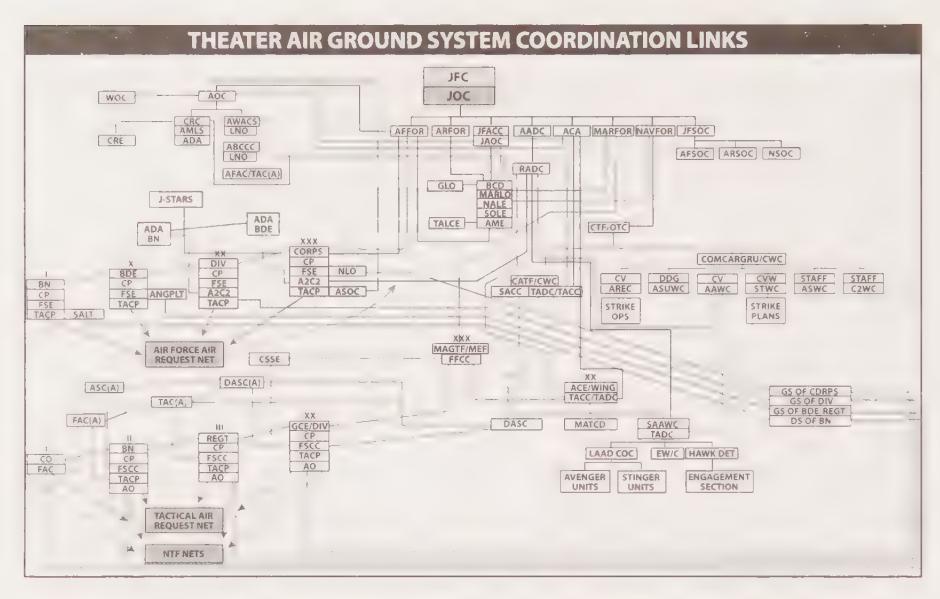
However, recent operations have demonstrated that serendipity drives synchronization of interdiction and maneuver more than doctrine.
Now put the two learning loops side by side. The fast loop is field adaptation: before OIF, joint elements rehearsed time-sensitive targeting on the Nellis ranges for weeks and wrote their own tactics, techniques, and procedures; the air component then relied on those TTPs and "never produced an establishing directive" that doctrine expected. The 484th Air Expeditionary Wing ignored standard formulas and placed tactical air control parties by mission need. Marines put a liaison officer aboard AWACS to manage joint fires in real time — "it took several weeks before this ad hoc arrangement realized its full utility." In Argyris and Schön's (1978) terms this is single-loop learning: correcting action within the existing frame, and storing the correction locally — in TTPs, workarounds, and individual experience, the most volatile of Walsh and Ungson's retention bins. The slow loop is the factory: the ACCE liaison concept improvised in OIF was captured in JP 3-09.3 in September 2003 — but only for the air-to-land case; JP 3-31 gave land operations their first approved joint C2 doctrine in March 2004; the joint "battle handover" Brown wants did not exist in doctrine at all. Double-loop learning — revising the governing frame itself — happens only through the consensus machinery of Section 03, and it runs years behind the fast loop. Brown's foreword phrase for the residue is exact: recent successes "have been more reliant on the innovation and tenacity of our warriors than forward-thinking joint doctrine."
Tension · the cost of the gap
The gap is not free just because the wars were won.
Missed fleeting targets in Afghanistan; fratricide risk from nondoctrinal CAS terminology; a 1,966-person air operations center (grown from 672) that required more than 30 C-17s, 24 C-5s, and 90 C-130s to deploy because reachback doctrine lagged practice; cross-boundary fires cleared over Iridium phones by borrowed liaison officers. Each is a coordination cost paid in real time because the codified memory did not yet contain what parts of the organization already knew. Levitt and March (1988) call this the gap between experience and encoded routine; Brown's paper is 100 pages of it, itemized.
The politics of codification: doctrine as negotiated residue
What finally gets written is not simply what was learned — it is what the assembled stakeholders could agree to sign. The garbage-can model explains both the outcomes Brown documents and the process rules TRADOC imposes.
Cohen, March, and Olsen (1972) modeled organizations as "organized anarchies" in which problems, solutions, and participants flow semi-independently and attach to whatever choice opportunities happen to be open. Doctrine development is a nearly clinical instance. The choice opportunities are scheduled: publication revisions, rewrite conferences (Brown's field data arrives via briefings to an AFDD 2-1.3 Counterland rewrite conference), joint working groups. The solutions often pre-exist the problems: effects-based operations, prioritized effects lists, and effects tasking orders came out of the Millennium Challenge 2002 experiment and circulated for years looking for a doctrinal home. And the participants are the services, each carrying institutional interests into every vote. Consider the episode Brown recounts from inside the drafting of JP 3-30, Command and Control for Joint Air Operations:
Episode · the two-option vote
JP 3-30: who is the supported commander?
Initial drafts kept legacy language designating the air component commander as supported commander for certain doctrinal missions. "The joint community disputed this language, resulting in the presentation of two options to the service operations deputies for resolution." Option two — list the missions as responsibilities and emphasize the JFC's authority to assign relationships — won, and was "designated as the model" for JP 3-31 and JP 3-32. A definitional question about authority was settled the way coalitions settle things: by drafting alternatives and voting.
Episode · competing memories
The FSCL, remembered twice
Army doctrine (FM 6-20-30) places the fire support coordination line beyond the corps deep fight — far out. Air Force doctrine (AFDD 2-1.3) places it "where the capability to produce the preponderance of effects … shifts from the ground component to the air component" — closer in. Two authoritative institutional memories encode two institutional interests about the same line on the map; joint doctrine hosts the dispute rather than resolving it, and the argument re-erupts in every war.
Episode · non-decision as decision
Kill boxes: three theaters, three standards
JP 3-60 "leaves the standardization to each theater, which equates to no standard for an expeditionary joint force." Korea, European Command, and Central Command each use a different grid numbering and subdivision convention, with different kill-box status terminology — "for no apparent operational reason." Where consensus could not be assembled, the factory shipped the disagreement, and deploying units must learn three systems.
Episode · a category with stakes
What counts as "joint"?
Doctrine defined joint fires by the two-service test — fires from two or more components in coordinated action. Brown proposes moving the operative words to "operating under a single joint force commander." The definition is not semantics: it determines which organizations, liaison billets, and C2 systems the joint layer must recognize and resource. Category boundaries in the memory are turf boundaries in the budget.
Brown understands the game he is playing, and says so — his preface defines success not as adoption but as agenda-setting:
My measure of success in this paper is not the reader's agreement with the ideas and thoughts I present. More so, I base the success of this research paper on its ability to generate discussion that forces the changes required to create synergy and minimize seams in air-ground integration.
He is manufacturing a solution and dropping it into the can, hoping a choice opportunity drifts by. (It is worth pausing on the fact that the colonel who wrote this critique of the doctrine factory later ran the institutions that own it — as Air Force Chief of Staff and then Chairman of the Joint Chiefs. The factory's critics are its future managers, which is itself a retention mechanism.) Now reread TRADOC Pam 71-20-3 with garbage-can eyes and its strangest features become legible as anarchy dampers. Fluid participation is the model's chaos engine — so the program directive fixes the participant roster in writing before drafting begins, and CoE representatives "must have the authority to speak on behalf of their organizations." Unclear preferences flood choices with untraceable objections — so the CRM forces every objection into a typed severity class with mandatory replacement language, and vague comments are "rejected without action." Problems latch onto unrelated choices — so the two-source rule (new problem, or new means) and the "is a concept even required?" gate at Step 2 screen the intake. The staffing process is best read not as naive rational planning but as a deliberately engineered constraint on an organized anarchy the institution knows itself to be. The garbage can still operates — the JP 3-30 vote proves it — but it operates on a schedule, with a roster, under a comment typology, leaving an archived adjudication record. Consensus is the price of authority: memory that binds five armed services can only be written by a process every one of them can block, which is why every clause survives only in the form all parties could live with.
The factory's own charter: reading the governing documents against Walker's 2003 audit
Until now this session read the joint factory secondhand — through the Army's concept guide and through Walker's critique of a process he could only describe from outside its drafting rooms. We can now read the factory's own governing documents: the charter that establishes it, the current manual that specifies its process, and the supporting instruments that control its vocabulary and its hierarchy. The question is what two decades changed, and what survived unchanged, in the exact seams Walker named.
The joint doctrine factory is chartered by a single Chairman's instruction, CJCSI 5120.02E, whose Enclosure A is the joint counterpart to TRADOC Pam 71-20-3's opening definitions — but where the Army guide separates doctrine from concepts, the joint charter first fixes what joint doctrine is. It is "official advice and should be followed, unless the commander determines exceptional circumstances dictate otherwise"; it "focuses on how to think, not what to think, about operations"; and it takes precedence over Service and multi-Service doctrine. The charter names the machine that produces this advice — the Joint Doctrine Development Community (JDDC) — and enumerates its membership with the precision of a voting register: the combatant commands, the Services, the National Guard Bureau, and the Joint Staff J-7 are voting members; other Joint Staff directorates, combat support agencies, and National Defense University are non-voting. The definition that matters most for our lens is the charter's own account of what it is establishing:
The system of lead agents, Joint Staff doctrine sponsors, primary review authorities, coordinating review authorities, technical review authorities, assessment agents, Joint Doctrine Planning Conferences, procedures, and the hierarchical framework designed to initiate, develop, approve, and maintain joint publications.
Read that definition as an organizational chart written in the grammar of role-titles: the factory is its assignment of authorities — sponsor, agent, reviewer — and its "hierarchical framework." This is Weber's bureaucracy naming itself, and it makes the same design commitment the Army guide did in Section 03: memory is authoritative because a named ladder of offices signs it. The charter is deliberately thin, though — it establishes roles and delegates the actual process to a companion manual, exactly as the Army guide points past its own text to staffing regulations. That manual is the second document, and it is where Walker's 2003 seams meet the current process.
The current CJCS Manual 5120.01D (2025) specifies the joint process station by station, and its headline parameter is a cycle time — the joint analogue of TRADOC's 8–10 months:
JEDD assesses and updates JPs through the joint doctrine revision process with a nominal 300-day revision process and may change existing publications that fall short of a full revision using one of three change processes: 100-day, administrative, or urgent.
Now run the comparison Walker could not. He wrote in 2003 against the process then published as JP 1-01 (2000) — the factory's self-description back when its own operating manual was itself a joint publication, before that self-description migrated into a Chairman's directive. His central charge was structural: joint doctrine was "melded" from separately written Service texts, and the resulting seams surfaced "on the battlefield," years after the field had already improvised around them. The 2025 manual answers some of that charge directly and leaves the rest untouched.
| Walker's 2003 complaint | What the 2025 manual now does | Interpretation |
|---|---|---|
| The factory is too slow; doctrine trails the war by years, so voids open at the worst moment |
Adds expedited tracks below the nominal 300-day revision: a 100-day change for limited updates, an administrative change for corrections, and an urgent change — "the most expedient means to make time-sensitive changes to critical portions of a publication," qualified by JEDD within 7 business days and coordinated with the community for only 3 working days. CJCSM 5120.01D, Encl. B |
Latency is now tiered, not single-speed. The institution built a fast lane for exactly the friendly-fire-risk case Walker itemized — a partial, structural answer to the gap. Changed |
| No mechanism captures emerging practice before it is doctrine-ready; TTPs written at Nellis have nowhere to go |
The Joint Doctrine Note is now a first-class instrument: "a short-term, bridging solution to address a potential doctrine void," neither authoritative nor approved, that "provides a mechanism to capture emerging doctrine" and may be referenced by a JP. JDN 1-19, Competition Continuum (2019), is a live specimen. CJCSM 5120.01D, Encl. A |
The factory now has a licensed intake for pre-doctrinal ideas — the joint analogue of the Army's DRAFT-stamped concept. Exploration gets a quarantined channel at the joint level too. Changed |
| Joint doctrine is a merge of Service texts, not a synthesis; Service interests survive as seams |
Still assembled through the JDDC by lead agents drawn from the Services and commands; still resolved by a joint working group where "any voting member may call for a formal vote," each member has one vote, and absent voting members "concur with the CRM and the JWG’s decisions unless they communicate their position to JEDD in writing." CJCSM 5120.01D, Encl. A–B |
The consensus-of-services architecture is unchanged. The vote can still ship a Service's interest as ambiguity; Walker's "melding, not synthesis" survives the reform intact. Unchanged |
| The base revision is slow because the community reads slowly |
The nominal full revision is still ~300 days — a 60-day coordination-draft staffing window inside a 120-day coordination phase — and JEDD, not the requester, "will determine the types of revision/change." CJCSM 5120.01D, Encl. B |
The slow loop stayed slow; only the option set around it grew. The default speed of binding memory is roughly what it was. Unchanged |
There is a genuine discrepancy between what Session 03 taught in Section 03 and what the joint manual specifies, and it should be surfaced rather than smoothed. The Army guide's comment typology is a three-level scale — administrative, substantive, critical. The joint manual runs four types: it inserts a "major" comment between substantive and critical, and it calibrates the veto differently. Where the Army's critical comment simply "indicates non-concurrence of the entire document," the joint critical comment is conditional on rank:
A critical comment indicates the submitting organization’s intent to nonconcur with the text of a publication under consideration unless the JSDS/LA resolves the comment. During O-6 planner-level coordination, critical review comments require a GO/FO or civilian equivalent memo from the submitting organization.
The joint manual then adds a rule the Army guide has no equivalent of: a critical comment submitted without a general-officer memo is automatically downgraded to a major comment, and even a properly memo-backed critical comment yields to the working group, because "the final text is determined by consensus of the JWG, as is the case for all comments." Read against Section 03's one-comment veto, this is a subtler valve. The Army guarantees any single organization a blocking objection; the joint system makes the block cost a flag officer's signature and then subordinates even that to a consensus vote. Neither is simply stronger — they are different settlements of the same tradeoff between letting any stakeholder stop the line and preventing lowest-common-denominator memory. Two factories in the same institution, having faced the identical design problem, wrote two different answers into their manuals. The seminar's job is not to reconcile them but to notice that the choice was available and made twice.
Cross-cutting · the vocabulary-control arm
The office that runs the factory also owns the dictionary.
The same Joint Staff J-7 division that manages joint doctrine (JEDD) also runs the DoD Terminology Program under CJCSI 5705.01G, which makes the Chairman "the primary office responsible for the development of the DoD Dictionary" and appoints a standing DoD Terminologist. The DOD Dictionary is the output: roughly 2,500 approved doctrine terms, backed by a separate 25,000-plus-term policy Terminology Repository. In Session 02's vocabulary this is retention-bin governance at the level of individual words — Mintzberg's standardization of the medium itself. The factory does not only decide what the institution remembers; through the same office, it decides the words the memory may be written in. ADP 1-01, the Army's Doctrine Primer, makes the same move at the meta-level: a doctrine whose subject is doctrine, existing so the institution can "discipline the establishment of terms and the categorization of operational knowledge."
Finally, the factory's parts catalogue is itself primary evidence for this seminar's thesis. The official Joint Doctrine Hierarchy chart (status of 12 December 2024) lays out the whole library — capstone JP 1 Volumes 1–2, six keystone publications (1-0 through 6-0), the core publications hung beneath each keystone, the Joint Doctrine Notes, and the joint guides. Where TRADOC Reg 25-36 (2023) governs the Army's parallel publishing program, this chart shows the joint output in one frame. But read its legend closely.
Tension · the archive is closing on its own map
The hierarchy chart records that its own capstone is now behind a card reader.
The chart's legend marks that web access to current joint publications requires a common access card — and the corpus behind this session confirms the drift: JP 1 Volumes 1–2 (2020/2023) and JP 3-0 (2022) are unclassified but no longer publicly posted, available only through the CAC-gated Joint Electronic Library Plus, per Wayback sweeps through mid-2026 documented in this seminar's corpus research. The document we could read here — JP 1-01 (2000) — was itself a public joint publication; its successor process now lives in Chairman's directives, and the capstone it points to has left the open web. For a seminar about doctrine as organizational memory, this is the thesis arriving as evidence: the institution is gating access to its own memory, and the map of the memory records the gate. The "before/after" of the factory's self-description is also a before/after of its public availability.
The JDN specimen closes the loop with Section 02's exploration–exploitation seam. JDN 1-19 describes itself as "a publication intended to facilitate information sharing on problems and potential solutions as a supporting effort of formal joint doctrine development and revision," and states flatly that "The guidance in this JDN is not authoritative." It was the joint force's licensed speculation about competition below armed conflict — and by the 2024 hierarchy chart its number is gone, its content matured forward into a successor note (JDN 1-22, Joint Force in Strategic Competition) and into concepts and doctrine. That is the whole factory in one artifact's life: an idea admitted through the quarantined intake, circulated as explicitly non-binding, and either promoted into authoritative memory or rescinded. March's protected exploration, the garbage can's choice opportunity, and the slow double loop are all visible in a single publication number that appeared and then vanished from the map.
The flagship product: JP 5-0 encodes the organization's own process
What does the factory make at its best? JP 5-0's subject is not the enemy — it is the institution's own decision procedure: who initiates planning, in what sequence, with what review gates, producing plans at four calibrated levels of written detail, under a standing revision loop.
JP 5-0 defines joint planning as "the deliberate process of determining how to implement strategic guidance: how (the ways) to use military capabilities (the means) in time and space to achieve objectives (the ends) within an acceptable level of risk." Everything after that definition is organizational process, codified. Planning consists of four functions — strategic guidance, concept development, plan development, plan assessment — "generally sequential, although often run simultaneously to deepen the dialogue between civilian and military leaders." Inside them runs the seven-step joint planning process (planning initiation; mission analysis; course-of-action development; COA analysis and wargaming; COA comparison; COA approval; plan or order development), explicitly "recursive, assessment-informed … and not linear." The document even specifies the sociology of the work: planning teams are cross-functional groups led by the J-5 or J-3, with named seats for intelligence, logistics, communications, medical, legal, components, and — where authorized — allies. The publication is a communication-design artifact about decision rights and information flow, produced by the very machinery of Sections 03 and 05.
Set direction
NSS; Unified Command Plan and Contingency Planning Guidance, both signed by the President; NDS signed by SecDef.
Review and approve
In-progress reviews (IPRs); SecDef approves plans of record and force assignment/allocation.
Translate
Joint Strategic Planning System; National Military Strategy; Joint Strategic Campaign Plan tasking plans to commands.
Integrate globally
Global integrator role per Title 10; formal plan review governed by CJCSI 3141.01; APEX policy family (CJCS Guide 3130).
Plan
Campaign plans in constant execution; contingency plans via the seven-step JPP; supporting commands prepare supporting plans.
Assess
Continuous operation and plan assessment; briefed to SecDef at plan-update IPRs; outcome: refine, adapt, terminate, or execute.
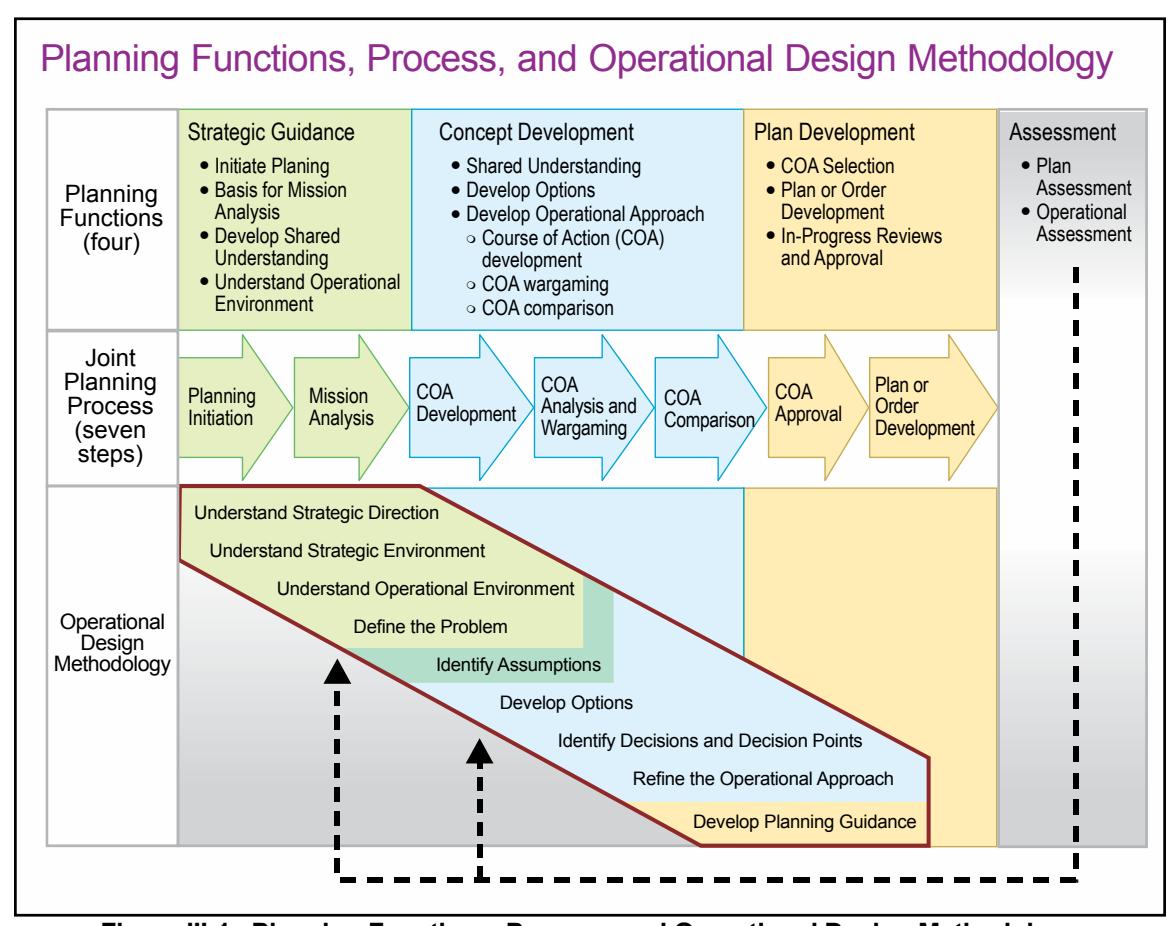
Two features matter most for our lens. First, the four levels of planning detail are a graduated codification scale — an explicit institutional answer to the question "how much shall we write down in advance?" Level 1, the commander's estimate, is little more than ranked courses of action; Level 2, the base plan (BPLAN), adds a concept of operations, major forces, and timelines but "normally does not include annexes"; Level 3, the concept plan (CONPLAN), is "an OPLAN in an abbreviated format" with named annexes, upgraded to 3T if time-phased force and deployment data is directed; Level 4, the operation plan (OPLAN), is "a complete and detailed plan" down to a transportation-feasible deployment database. In Galbraith's terms, pre-planning is pre-computation: each level buys shorter crisis-response latency at the price of authoring and — crucially — maintaining more codified material as the world drifts away from it. Hansen, Nohria, and Tierney's (1999) codification-versus-personalization economics apply line for line: codify what will be reused under time pressure; leave the rest in planners' heads and in the process.
Second, plans are governed as living memory with a standing revision loop. The plan-assessment function requires commanders to keep every plan under continuous evaluation against a changing environment:
Commanders continually review and evaluate the plan to determine one of four possible outcomes—refine, adapt, terminate planning or cancel the plan, or execute—and then act accordingly.
Refinement flows continuously through fragmentary orders; adaptation reopens the operational approach when the problem itself has changed; termination requires permission to archive, staffed through the Joint Staff to SecDef or the CJCS depending on which tasking document created the plan. Even forgetting is a governed, multi-echelon process. This is the doctrine factory's answer to its own Session-04 problem from Brown: having been burned by shelfware plans and lagging publications, the institution wrote a maintenance schedule for its memory into the memory itself. And it flags the deepest caveat in its own epigraph — Eisenhower's "Plans are worthless, but planning is everything." The JPEC's civil-military dialogue, the shared staff estimates, the wargamed assumptions — much of the factory's real product is the shared understanding built in the participants, not the document. Levitt and March (1988) would recognize the design: routines encode lessons, but the encoding process is itself where much of the learning lives. The Spanish-language edition of JP 5-0 on our supplementary list completes the picture: the artifact is also an export good, a coordination standard shipped to allies so that two nations' staffs can mesh their planning processes — memory as interoperability infrastructure.
Settled point
Process properties are knowledge properties.
Across all three sources the same identity holds: the latency of the staffing cycle is the staleness of the memory; the veto points determine whose experience gets encoded; the consensus requirement sets the resolution of what can be said (disputes ship as ambiguity, like the theater-specific kill boxes); the codification levels set what the institution can retrieve under time pressure. To design the doctrine process is to design what the institution can know — the factory's blueprint is an epistemology.
Seminar discussion
Questions to structure the session's second hour.
- Is the latency load-bearing? TRADOC's cycle is 8–10 months plus editing, with a quarter of it spent waiting out 30–45-day review windows. Argue both sides: the delay is waste the institution should engineer away; the delay is the validation — consensus time is what converts an opinion into memory the whole institution will obey. Which properties of the military's environment (Session 01) decide the question, and would your answer survive transfer to a firm?
- The one-comment veto. A single critical comment non-concurs an entire concept, but must carry replacement language and can be overridden by a rank-matched majority vote. Is this closer to a liberum veto that guarantees lowest-common-denominator memory, or to a well-designed andon cord that lets any stakeholder stop the line? What would Cohen, March, and Olsen predict happens to the content of documents written under such a rule?
- Serendipity as evidence. Brown's operations succeeded despite the doctrine gaps — "innovation and tenacity" carried the load, and TTPs written at Nellis substituted for the establishing directive doctrine required. If the fast loop reliably compensates, what exactly is the argument for spending the slow loop's cost at all? Construct the strongest case that an organization should deliberately let TTPs lead and doctrine trail — then identify the failure mode Session 02's memory argument predicts for it (personnel rotation, cross-unit transfer, allied interoperability).
- Quarantined exploration. The ACF gives exploration its own artifact class, pipeline, and "DRAFT — NOT FOR IMPLEMENTATION" stamp, while doctrine "warrants" no re-proof of its own validity. Does this structure protect exploration, as March requires — or contain it, ensuring the exploitative memory is never contaminated by an unapproved idea? Note the asymmetry of burden: concepts must "accept the burden of proof"; doctrine never re-argues its case. Who, in this system, can falsify standing doctrine, and with what evidence?
- Galbraith audit. Map the staffing chain onto Galbraith's four strategies: where has the Army bought information-processing capacity (CRMs, adjudication boards, seminars), and where has it reduced the need for processing (page limits, format templates, capability-statement grammar)? Brown proposes digitizing the establishing directive and coordination measures. Does digitization change the design, or only the medium — and what does Daft and Lengel's richness hierarchy predict about resolving doctrinal disputes through a comment matrix?
- Why keep Level 4 plans? Eisenhower's epigraph says plans are worthless and planning is everything; JP 5-0 nonetheless mandates OPLANs with transportation-feasible deployment databases that are costly to build and age from the moment of approval. Using Hansen's codification economics and the RATE loop, defend the Level 4 investment for some contingencies and Level 1 for others. What is the organizational equivalent in your world — and do you actually maintain your "OPLANs"?
- Reading negotiated text. The JP 3-30 supported-commander language was settled by presenting two options to the service operations deputies; theater kill-box conventions were never settled at all. Given only a finished doctrinal text, how could an analyst detect which passages are validated learning and which are negotiated residue? Propose concrete textual markers (hedged verbs, theater exceptions, dual definitions like interdiction vs. air interdiction) — then ask what this implies about reading any organization's official documents.
- Did the reform touch the seam? The 2025 joint manual answers Walker's 2003 critique by adding a fast lane (100-day, administrative, urgent changes; 7-day qualification) and a formal Joint Doctrine Note to capture emerging practice — yet keeps the nominal 300-day base revision and the one-vote-per-service consensus that produces the "melded" doctrine he attacked. Did the institution fix the seam or only the latency around it? Argue whether an expedited change track and a non-authoritative bridging note actually address "melding, not synthesis," or whether they leave the structural cause untouched while relieving its most visible symptom. What would a reform that touched the seam itself have to change?
- Two factories, two vetoes. The Army guide (Section 03) gives any organization a one-comment veto that blocks the whole document; the joint manual (Section 06) runs a four-type typology in which a critical comment is downgraded to "major" without a general-officer memo and, even memo-backed, yields to joint-working-group consensus. Same institution, same design problem, two settlements. Which better balances letting any stakeholder stop the line against lowest-common-denominator memory — and what does the difference between an Army audience and a five-service joint audience predict about why each chose as it did? Would you expect the content of joint doctrine to be blander or sharper than Service doctrine as a result?
- Transfer. Your organization's doctrine factory is its RFC process, architecture decision records, postmortem repository, style guides. Choose three TRADOC mechanisms — the version-rank ladder, the comment severity typology with mandatory replacement language, the rank-matched adjudication board, the 25-page cap, the PD's fixed participant roster — and argue which would improve your process and which depend on properties (severe environment, obedience norms, mass rotation) your organization lacks.
Synthesis and bridge
What this session establishes and what it sets up.
What we established
The institution's memory has a production function, and its parameters are epistemic.
Session 02 showed doctrine is organizational memory; this session showed the memory is manufactured by a standing industrial process whose measurable properties — 8–10-month Army cycles and nominal 300-day joint revisions, rank-tiered review gates, a channeled veto (three comment types in the Army guide, four in the joint manual), consensus-and-vote adjudication, 25-page attention budgets, four calibrated codification levels — determine what the institution can know and when. We read the factory in its own governing voice for the first time: the joint charter (CJCSI 5120.02E) that establishes the machine, and the current process manual (CJCSM 5120.01D, 2025) that specifies it. The factory deliberately splits exploration (concepts, Joint Doctrine Notes) from exploitation (doctrine); its consensus machinery converts field learning into binding memory slowly and politically, so practice runs ahead on a fast single loop while codification follows on a slow double loop; and where consensus fails, the disagreement itself ships as doctrine. Two decades after Walker's audit, the joint process added expedited change tracks and a bridging note to relieve the latency he attacked — but kept the ~300-day base revision and the consensus-of-services structure that produces "melded" doctrine, so the seam survived the reform. Brown's audit prices the gap; JP 5-0 shows the mature product — an organization codifying its own decision process, revision schedule included; and the hierarchy chart's own legend shows the institution gating public access to that memory.
Next session
Session 04 — Command and Control as Communication Design
We have seen how the memory is written; next we read the factory's most self-referential product line in depth. Naval Doctrine Publication 6 specifies how the organization will move information, form shared understanding, and decide while under attack — an explicit communication-and-decision architecture. The C2 tenets Brown used as his fixed stars in this session become the object of study: doctrine about the coordination machinery itself, read with Galbraith, Daft & Lengel, and the network experiments.
Sources and evidence
Every material claim in this lecture traces to these documents.
Source register