Assigned readings
Two capstone C2 doctrine publications read closely, the CCRP formal model that lets us name the design space precisely, a modern capstone and two supporting sources for contrast, and three canonical theory works that let us read the doctrine as design rather than exhortation.
Naval Doctrine Publication 6, Naval Command and Control (Department of the Navy / U.S. Marine Corps, 1996)
The whole document — it is short and every chapter earns its place. Read Chapter 1 (what C2 is; uncertainty and time), Chapter 2 (the decision-and-execution cycle, the cognitive hierarchy, methods of control), Chapter 3 (the C2 system: organization, information, support), and Chapter 4 (mission control, commander's intent, relative tempo). Treat each definition and figure as a design decision with a stated rationale.
../sources/navy/ndp6_naval_command_and_control_1996.mdMarine Corps Doctrinal Publication 6, Command and Control (U.S. Marine Corps, 1996) — Chapters 1–2
NDP 6's 1996 sibling and the most theoretically explicit C2 text in U.S. doctrine. Read Chapter 1 (the nature of C2; uncertainty and time; the reciprocal command/control view) and Chapter 2 (the OODA loop, the information hierarchy, image theory, the C2 spectrum, communications and information-management theory). Where NDP 6 states a design choice, MCDP 6 usually states the theory behind it — including the Van Creveld epigraph that is Galbraith's two strategies in doctrine's own hand.
../sources/c2_mission_command/mcdp_6_command_and_control_1996_ch1_2018.mdAlberts, D. S., & Hayes, R. E. (2006). Understanding Command and Control. CCRP Publication Series — Chapter 6, "C2 Approaches"
The CCRP formal model of C2. Read Chapter 6 for the three dimensions that define any "C2 Approach" — allocation of decision rights, patterns of interaction, and distribution of information — and the "classic C2 ↔ edge organization" endpoints. It gives us a precise coordinate system for the design choices NDP 6 and MCDP 6 describe in prose, and it names which dimension this session teaches and which it hands to Session 05.
../sources/c2_mission_command/alberts_hayes_understanding_command_and_control_2006.mdNaval Doctrine Publication 1, Naval Warfare (Department of the Navy, 2020) — C2 sections only
Read the "Command and Control in the Maritime Domain" material: the three approaches to command (direction, planning, influence), the statement that mission command "seeks to reduce the need for certainty," and the network-optional passage in which commanders "purposely not use the network … to reduce force signature." It shows how the 1996 design was re-codified — almost verbatim in places — for the distributed, contested-network era.
../sources/navy/ndp1_naval_warfare_2020.mdJoint Publication 6-0, Joint Communications System (Joint Chiefs of Staff, 2015, incorporating Change 1, 2019) — Chapter I
Skim Chapter I for the physical layer beneath every C2 concept in this session: the communications system and the Department of Defense Information Network (DODIN) that carry the traffic. Read it as the infrastructure NDP 6 assumes and MCDP 6 warns against overrelying on — "communications systems are more than electronic boxes, wires, and radio signals," but they are also the channels an adversary can cut.
../sources/c2_mission_command/jp_6_0_joint_communications_system_2015_ch1_2019.mdAlberts, D. S., Garstka, J. J., & Stein, F. P. (1999). Network Centric Warfare. CCRP Publication Series — Introduction and "Network Centric Warfare" chapter
The network-centric thesis in its founding statement: networking sensors, decision-makers, and shooters to achieve shared awareness and self-synchronization. Read it as a communication-architecture claim that inverts NDP 6's 1996 assumptions — the 1999 bet on "increase the capacity" against NDP 6's bet on "reduce the need." The 2006 CCRP model is this thesis made formal.
../sources/c2_mission_command/alberts_garstka_stein_network_centric_warfare_1999.mdGalbraith, J. R. (1974). Organization design: An information-processing view. Interfaces, 4(3), 28–36.
The spine of the session. Galbraith's claim that organizations either reduce the need to process information or increase the capacity to do so gives us the frame that reads NDP 6's two "methods of control" as two design strategies rather than two styles.
doi.org/10.1287/inte.4.3.28Daft, R. L., & Lengel, R. H. (1986). Organizational information requirements, media richness and structural design. Management Science, 32(5), 554–571.
Read for the uncertainty-vs-equivocality distinction and the media-richness hierarchy. NDP 6's data → information → knowledge → understanding ladder and its defense of firsthand observation are media-richness arguments in uniform.
doi.org/10.1287/mnsc.32.5.554Bavelas (1950) & Leavitt (1951): the MIT communication-network experiments.
Read for the centralized-vs-decentralized network finding: wheel/Y networks are faster and cheaper on simple problems; circle/all-channel networks win on complex, changing problems and are more robust. This is the empirical ancestor of NDP 6's detailed-vs-mission-control choice. Pair with Clark & Brennan (1991) on grounding and Conway (1968) on mirroring, both cited in the register.
doi.org/10.1121/1.1906679C2 is a commander's process, not a technology
NDP 6 defines command and control as both a process and a system, and insists the human decision-maker is inside both. That is a deliberate stand against equating the org with its tooling — and the founding move of the information-processing view.
The publication opens by borrowing the joint definition: command and control is "the exercise of authority and direction by a properly designated commander over assigned and attached forces in the accomplishment of the mission," performed "through an arrangement of personnel, equipment, communications, facilities, and procedures." NDP 6 immediately splits that definition into two objects. The process is the planning, directing, coordinating, and controlling; the system is the personnel, equipment, communications, facilities, and procedures. Its pivotal claim is that "the commander himself is thus part of both the process and the system" — he is "an integral part of the command and control system, not just a user of it."
The design object
The thing being designed is shared understanding among separated commanders.
Strip away the hardware and NDP 6's subject is an information-processing problem: convert raw observation into decision, faster and more accurately than an intelligent adversary who is corrupting your inputs. This is precisely Simon's bounded-rationality premise — finite attention, satisficing under limits — turned into a design brief. The document is an organization writing down, in its own hand, how it intends to process information under fire.
Command is the authoritative act of making decisions and ordering action; control is the act of monitoring and influencing this action.
The document's governing metaphor is the central nervous system: sensory nerves detect, the brain interprets and decides, motor nerves carry instructions to the muscles. In the analogy the commander is "the conscious brain of the military body" and C2 is "the system of nerves." Critically, NDP 6 adds a subconscious brain — "the network of subordinate commanders who carry out a broad range of tasks on their own initiative without having to consult the commander for detailed instructions." The metaphor is not decoration; it encodes a specific architectural claim, that most regulation happens below the level of conscious central decision. We will see that claim cashed out as decentralized control.
Why does the document work so hard to keep the human inside the system? Because its authors are guarding against a failure mode the information-processing tradition names precisely: mistaking information for understanding, and therefore mistaking a better network for a better decision. NDP 6's closing judgment — that "the process is more important than the system," and that "the entire command and control process depends on the shared understanding of separated commanders" — is a thesis about where an organization's coordinating capacity actually lives. Not in the wires. In the shared mental model the wires are there to build and maintain.
Its 1996 sibling, the Marine Corps' MCDP 6, agrees on the object but pushes the definition one step further, and here the two texts genuinely differ. NDP 6 defines control conventionally — "control is the act of monitoring and influencing this action" — control as something a commander does to subordinates. MCDP 6 rejects that "traditional view" as unidirectional and offers a cybernetic one instead: it "sees command as the exercise of authority and control as feedback about the effects of the action taken." Control is not a downward force but the return channel of a loop — "the entire system comes 'under control' based on feedback about the changing situation." The move matters for design: NDP 6's definition still lets you imagine control flowing down a hierarchy, while MCDP 6 makes control an all-directions feedback property of the whole system, which is why it can then say — more baldly than NDP 6 dares — that the commander is "an integral part of this complex web of reciprocal influence" and not a chess player above the board.
NDP 6 records that Nelson "used only three general tactical flag-hoist signals to maneuver the British fleet." The coordinating work was done before the battle, by indoctrination — not during it, by messaging.
U.S. Central Command used "more than 700,000 telephone calls and 152,000 radio messages per day." The message volume of naval C2 exploded across two centuries; NDP 6's argument is that the design principles did not.
The commander sits inside both. NDP 6 refuses the clean separation of "the org" from "its information technology" — the analytic move this whole session turns on.
The cognitive hierarchy: data, information, knowledge, understanding
NDP 6 builds a four-rung ladder from raw signal to situational awareness and insists the top rung is purely human. Read against Daft & Lengel, it is a claim about equivocality, not just uncertainty — and about which media can resolve which.
Chapter 2 defines four distinct things the word "information" is usually made to carry at once. Data are "bits and bytes … raw signals." Processing — "organizing, formatting, collating, filtering, plotting" — turns data into information, which is "the name we assign to data once it is collected from the environment and processed into usable form." Cognition — "analyzing, correlating, and fusing" — turns information into knowledge. And judgment, "a purely human skill, based on experience, expertise, and intuition," turns knowledge into understanding, which "equates to situational awareness." The document is explicit that automated systems "play a very limited role at present in generating understanding."
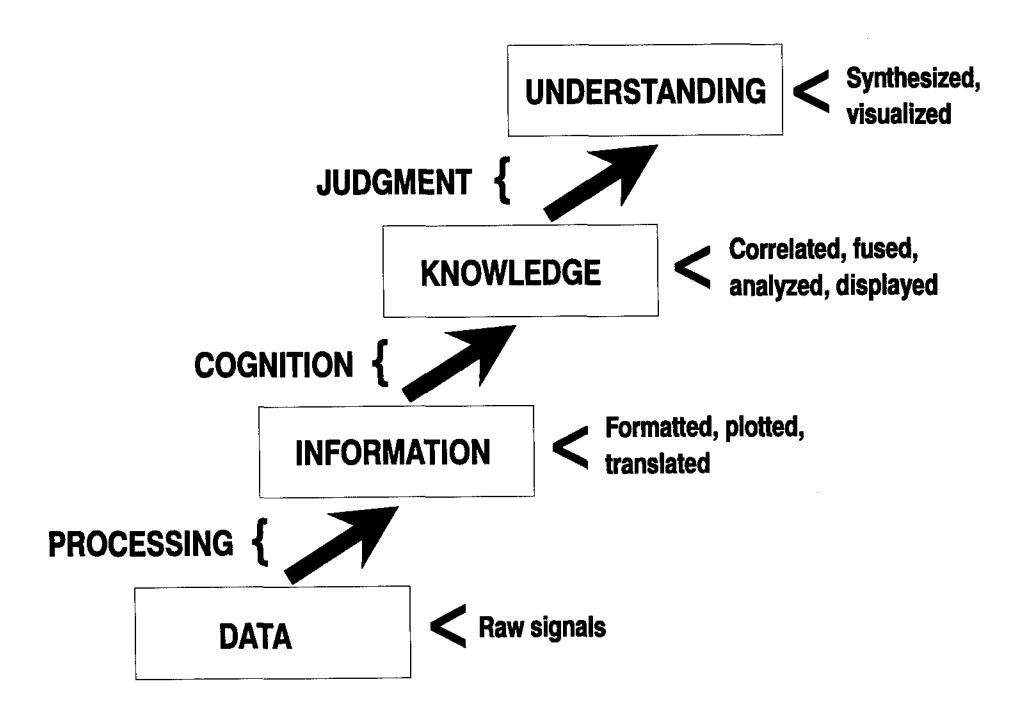
This ladder is the crux of NDP 6's information theory, and it maps cleanly onto Daft & Lengel (1986). Their distinction is between uncertainty — the absence of data, curable by collecting more — and equivocality — ambiguity of meaning, curable only by richer communication that lets people negotiate an interpretation. NDP 6's lower rungs (data, information) are the uncertainty problem: gather and process. Its upper rungs (knowledge, understanding) are the equivocality problem: what does this mean, and what will the adversary do next? Daft & Lengel's managerial punchline — "a major problem is lack of clarity, not lack of data" — is exactly NDP 6's warning that "more information is not always better information."
At the outset, it is important to understand that certainty is a function of knowledge, not of information. The two are clearly related, but the distinction is important—information is the raw material from which knowledge is generated. Knowledge results from people adding meaning to information through the process of cognition.
Because the raw material is imperfect and can be manipulated, NDP 6 gives the commander an explicit quality standard — six criteria "listed in order of relative importance" — for what information is worth acting on:
| Criterion (NDP 6 order) | NDP 6 definition | Design reading |
|---|---|---|
| 1–2 · Relevance, Accuracy | "Information that applies to the mission … that conveys the true situation." | First-order filters. NDP 6's rule of thumb: "irrelevant or inaccurate information is worse than no information at all." Worse than silence |
| 3–4 · Timeliness, Usability | "Available in time to make decisions … in common, easily understood formats and displays." | The tempo and media-richness rung. "Untimely or unusable information is the same as no information at all." Equal to silence |
| 5–6 · Completeness, Precision | "All necessary information … the required level of detail or granularity." | Last, deliberately. "Incomplete or imprecise information is better than no information at all" — a doctrinal license to act on partial knowledge. Better than silence |
The ordering is itself a design statement. A civilian dashboard culture tends to prize completeness and precision; NDP 6 ranks them last and explicitly authorizes acting without them. That inversion — timeliness over completeness — is only rational once you accept the environment the course frame describes: an intelligent opponent and irreversible stakes, where a late perfect answer is a defeat.
The decision-and-execution cycle and relative tempo
NDP 6 adopts Boyd's OODA loop by name and makes orientation the hinge of the whole process. Its deeper claim is competitive: what matters is not the speed of your decision cycle but its speed relative to the enemy's.
Chapter 2 renders command and control as "a continuous, cyclical process" — "each naval commander's decision and execution cycle—or 'OODA Loop'." NDP 6 credits the model explicitly to "Col John R. Boyd, USAF (Ret), 'An Organic Design for Command and Control.'" The document wraps Boyd's four phases inside its own information plumbing: sensing feeds a common tactical picture, from which the commander derives situational awareness, from which he issues commander's intent and orders, which produce actions in the battlespace, which are sensed again.
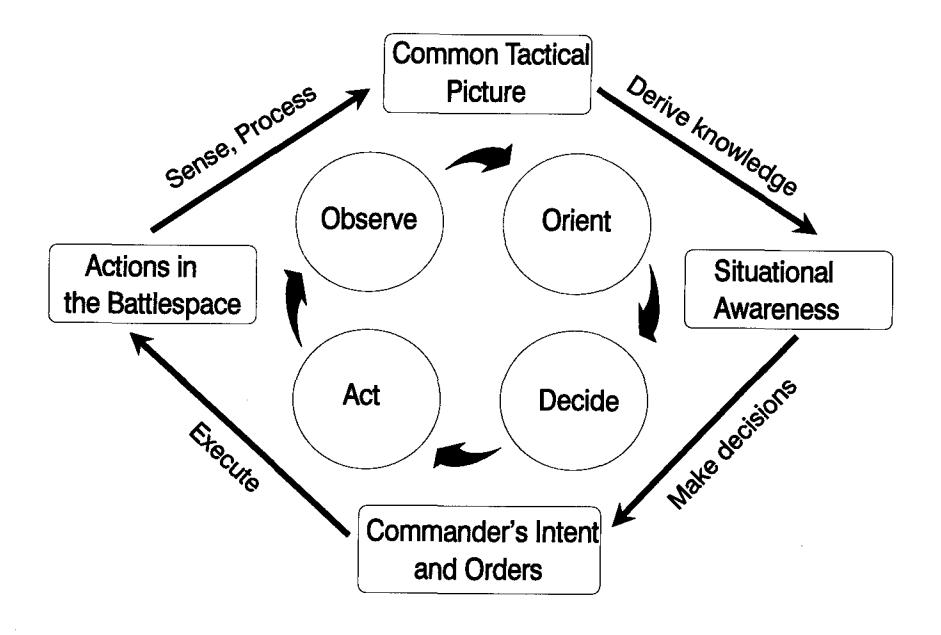
NDP 6 names orientation as decisive: it "is the key to the entire decision and execution cycle, because it influences the way we observe, decide, and act." Orientation is where equivocality is resolved — where data becomes a mental model shaped by "experience, expectations, culture." This is why the document can insist that a faster network does not, by itself, produce a faster cycle: the binding constraint is the human orientation step, exactly the "purely human" judgment rung of the cognitive hierarchy.
On how the decision is made, NDP 6 gives two theories and assigns each an environment. Analytical decision-making generates several options, scores them against weighted criteria, and picks the optimum — "thorough, but time-consuming," fit for "deliberate planning … when the time is measured in hours or days." Intuitive decision-making "replaces analysis with experience and judgment," seeking "the first solution that solves the problem, rather than … the 'best' solution" — fit for "the fluid, rapidly changing environment of combat." This is Simon's satisficing given a doctrinal home: NDP 6 tells commanders that "there is no perfect solution … so we should not agonize over finding one." It even warns of a point of diminishing returns where "additional information may … only serve to cloud the situation."
Analytical decision-making
Optimize among many options
Generate options, weight criteria, compare concurrently for the best answer. Thorough; slow. NDP 6 assigns it to deliberate planning, hours-to-days, where information can be gathered and processed.
Intuitive decision-making
Satisfice on the first workable answer
Recognize the pattern, take the first solution that solves the problem (coup d'oeil). Fast; experience-dependent. NDP 6 assigns it to combat — the default when time is the scarce resource.
The payoff is competitive tempo. NDP 6: "it is not the absolute speed of decision and execution that matters, but our speed relative to the enemy." The goal is to "be deciding on our next move and executing it while the enemy is still trying to orient himself to our last action" — Boyd's "getting inside" the opponent's loop. Figure 4-1 draws the two cycles as mirror images meeting at a shared battlespace, and it is the picture that turns C2 from an internal plumbing diagram into a contest.
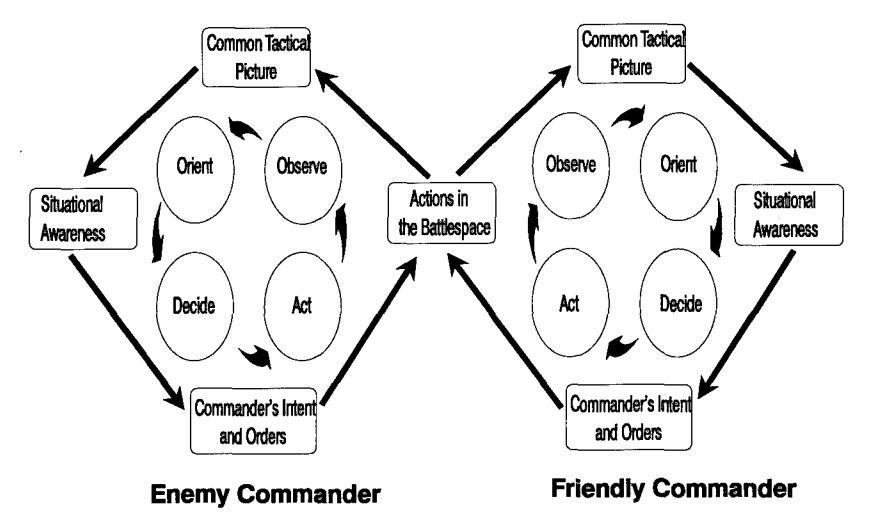
This competitive framing is why NDP 6 treats the enemy's C2 as a target. "Command and control warfare" seeks "to deceive, degrade, or destroy his sensors, communication links, and decision support systems," attacking his orientation directly. The mirror in Figure 4-1 is doing analytic work the course frame anticipates: because the opponent is intelligent and adaptive, your communication design is judged not against a fixed standard but against his — a moving, hostile benchmark.
Two methods of control are two network topologies
NDP 6's detailed control and mission control are not two management styles — they are two communication-network designs, and they line up precisely with Galbraith's two strategies and the Bavelas–Leavitt centralization findings. We read them here as topology; Session 05 will take up the authority question they raise.
Chapter 2 offers "two methods of control." Under detailed control, "command and control is centralized," orders are explicit, and "such control emphasizes vertical information flow, with information flowing up the chain of command and orders flowing down." Under mission control, "command and control is decentralized and flexible," orders are "succinct," and control "emphasizes horizontal information flow among subordinate commands." Note what the document is actually varying: not who is nominally in charge, but the direction and volume of message traffic. These are topologies.
Command and control is decentralized and flexible. Orders and plans are succinct. In addition to keeping the commander informed, mission control emphasizes horizontal information flow among subordinate commands.
Set them beside the Bavelas (1950)–Leavitt (1951) experiments and the correspondence is exact. Their wheel and Y networks — every message routed through a central node — were faster, used fewer messages, and made fewer errors on simple problems, and reliably produced an emergent leader at the center. That is detailed control: vertical flow, central node, efficient when the task is routine and the situation is stable. Their circle and all-channel networks — every node talking to its neighbors — had higher morale and, in later work, outperformed on complex, changing problems. That is mission control: horizontal flow, no chokepoint. Leavitt's result is contingent, not absolute: the best topology inverts with task complexity. NDP 6 makes the same move, pairing detailed control with "specific, precise tasks of a procedural or technical nature—such as controlling airspace," and mission control with "high-tempo operations where judgment, creativity, and initiative are required."
Detailed control · wheel / Y network
Vertical flow, central node
NDP 6: centralized; explicit orders; information up, orders down. Fast and low-error on simple, procedural, safety-critical tasks (airspace, tight maneuvering). Fails "when the vertical flow of information is disrupted" — a single point of failure.
Mission control · all-channel network
Horizontal flow, no chokepoint
NDP 6: decentralized; succinct orders; lateral coordination among subordinates. Wins on complex, high-tempo tasks and — because it "relies on implicit understanding" — is "much less vulnerable to disruption." Robustness bought by pre-loaded common ground.
The robustness claim is the heart of the communication-design argument, so read it literally: mission control "is much less vulnerable to disruption than detailed control." A centralized network dies when its central link is cut; a decentralized network degrades gracefully because the coordinating information was distributed in advance. This is why an organization that expects its nodes to be destroyed — the operating assumption in the course frame — would design toward the all-channel topology even at the cost of the wheel's peacetime efficiency. Redundancy that looks wasteful in garrison is survivability in combat.
Now name the frame that unifies both methods. Galbraith (1974): facing an information-processing load, an organization can either reduce the need to process information or increase the capacity to process it. NDP 6's two methods are the two strategies. The Marine Corps' MCDP 6, published the same year, states the same choice even more starkly — and it is no coincidence: MCDP 6 opens its theory chapter with Martin van Creveld's version of the identical dichotomy ("increase its information-processing capacity" versus "operate on the basis of less information … these approaches are exhaustive; no others are conceivable"), which is Galbraith's claim in a military historian's words. Where NDP 6 describes two "methods of control," MCDP 6 names them as the two responses to uncertainty itself.
Rather than increase the level of certainty that we seek, by mission command and control we reduce the degree of certainty that we need.
Mission control
Lower the certainty required before deciding; act on partial knowledge.
Commander's intent
Pre-load the goal so subordinates need no running instruction.
Doctrine & training
Standardize the codebook so short messages carry long meaning (Session 03).
Common tactical picture
A shared display fuses sensors into one image for all echelons.
C4I systems
Collect, process, disseminate, protect — vertical information systems.
Push–pull & lateral nets
Lateral relations that let subordinates coordinate without the center.
NDP 6's stated preference is the top lane: "We generally favor more decentralized organizations, which can process information more quickly." That is a bet — that reducing the need is more survivable than increasing the capacity, because capacity depends on channels the enemy can cut, while need-reduction depends on understanding that was installed before the shooting started. The 2020 capstone makes the same bet in almost Galbraith's own words, distinguishing three approaches to command — direction, planning, and influence — and declaring one of them the theory's exact echo.
Command by direction and command by planning seek to eliminate uncertainty. In contrast, mission command seeks to reduce the need for certainty.
One boundary to mark before the next session: everything above is about information flow, not about who is allowed to decide. NDP 6 does raise the authority question — commander's intent "allows decentralization of command within centralized, overarching guidance" — but the allocation of decision rights (formal vs. real authority, delegation, negation as a decision protocol) is Session 05's subject. Here the claim is narrower and cleaner: mission control is a channel-economy and robustness choice. Hold the authority question; we hand it off deliberately.
Commander's intent as pre-loaded common ground
Mission-type orders are lean messages that carry rich meaning. They work only because doctrine and training grounded the participants in advance — Clark & Brennan's theory of grounding, fused with media richness, and the direct payoff of the doctrine factory of Session 03.
Here is the apparent paradox. NDP 6 wants "succinct" orders — a few sentences — yet expects them to coordinate dispersed forces through chaos. How can a lean message do rich work? Clark & Brennan (1991) give the mechanism: communication requires common ground, and the cost of grounding a new message falls as shared background rises. Two people with deep common ground can coordinate in a phrase; strangers need paragraphs and still misfire. Commander's intent is a deliberate investment in common ground so that, later, a lean order suffices. The mission-type order and the doctrine that makes it legible are two halves of one design.
Auftragstaktik [mission-type orders] is the leadership action...by which the higher leader does not give his subordinate a binding order, but more an excerpt from his own thought process, through which he demands from [the subordinate] the intellectual cooperation for the accomplishment of the mission.
"An excerpt from his own thought process" is a grounding claim precisely stated: the order transmits a pointer into shared understanding, not a complete specification. NDP 6 institutionalizes it — "every joint mission planning order is required to start with a carefully crafted statement of the commander's intent" — and defines the reciprocal act, mission analysis, by which a subordinate reconstructs his senior's purpose. The system is built so meaning survives the compression.
Media richness (Daft & Lengel) explains where the design still worries. NDP 6 concedes that "we can sense more about a situation from firsthand observation than we can communicate accurately to others," and that secondhand information loses the intuitive feel for its own reliability — "especially dangerous in a high-technology command center, where elaborate displays and decision aids tend to take on an appearance of infallibility." Its remedy, the directed telescope — "the commander's use of trusted and like-minded officers to act as his eyes and ears" — is a media-richness patch: when the routine (lean) channel cannot carry equivocal meaning, insert a high-richness human link. "Trusted and like-minded" is the point; the telescope works because those officers already share the commander's common ground.
The two historical cases NDP 6 chooses are a controlled experiment in grounding — one where common ground was present, one where it had just been lost.
Common ground present · Nelson
Trafalgar, 1805
The "Nelson touch": "a thorough indoctrination before the engagement and near-absolute initiative once it had begun." Three flag signals sufficed because subordinates "thoroughly understood that plan and their place in it well in advance." Grounding installed in peacetime; lean orders in battle.
Common ground absent · Lee & Ewell
Gettysburg, 1863
Lee ordered Ewell to take the hill "if he found it practicable." With Jackson dead and a reorganized corps, the shared code was gone: Lee meant "press the attack," Ewell read "only if certain of success," and did not move. NDP 6's diagnosis is his "lack of implicit communication and understanding." A lean order failed for want of grounding.
The lesson is uncomfortable and worth naming: mission command's robustness is not free and not portable. It is bought with prior investment in shared understanding — the very product of the doctrine factory in Session 03. Where that investment is missing (a new team, a fresh coalition partner, a reorganized command), the lean order that would have coordinated a grounded force instead fragments an ungrounded one. Decentralization does not remove the coordination cost; it moves the cost earlier, into training and doctrine, where it can be paid before the channels degrade.
Designing for degradation: mirroring, span, and survivable structure
NDP 6 states that force structure and communication structure are the same decision — Conway's mirroring hypothesis, avant la lettre — then treats width-versus-depth and redundancy as explicit levers for surviving the loss of nodes.
Chapter 3 makes a claim organizational theory would not formalize until later, and states it more baldly than most theorists dare.
In fact, every organizational decision is a command and control decision, because it establishes the network of relationships among commanders.
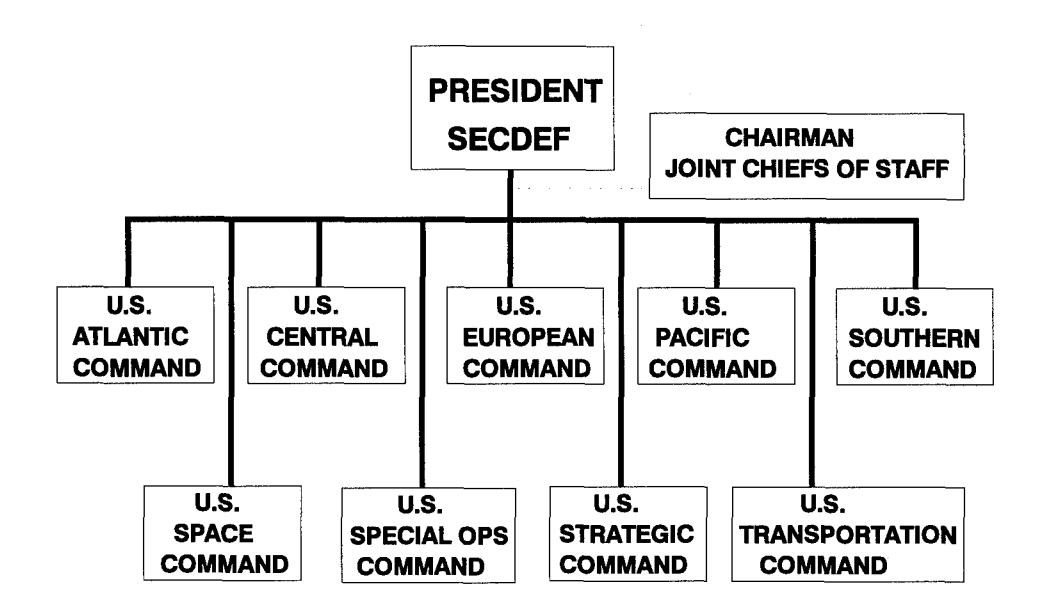
This is Conway's Law (1968) run in reverse and out loud: Conway observed that a system's structure mirrors the communication structure of the organization that built it; NDP 6 asserts that to organize the force is to design its communication network — "the way we organize our forces determines the way we fight." Colfer & Baldwin's mirroring review would later confirm the tendency and its exceptions. The doctrinal consequence is that you cannot reorganize a force without redesigning its C2, because they are one object seen from two sides. Figure 3-1 shows the top of that object: command authority flowing from the President and Secretary of Defense to the combatant commands — with the Chairman of the Joint Chiefs deliberately off the chain, on a dotted line, because he advises but does not command.
NDP 6 then treats the shape of that network as a tunable tradeoff. Narrowing span of control "means deepening the organization by adding layers of command," and "the more layers of command an organization has, the longer it takes for information to move from top to bottom … the less responsive it is." Flattening "increases the speed at which information can be disseminated … but it also requires widening the span of control and puts a premium on lateral coordination." The document states the tradeoff in one line — "A tradeoff thus exists between organizational width and depth" — and refuses to fix a single answer, requiring instead "the ability to organize his forces in whatever manner the situation demands." Depth buys control and reach at the cost of latency and fragility; width buys speed and robustness at the cost of coordination load. The same tension the Bavelas–Leavitt experiments measured, now stated as a live design knob.
The system that carries all this has three components — the C2 organization, information, and C2 support — and its supporting C4I systems are specified by two lists that read as a requirements document. Four functions: collecting, processing, disseminating, protecting. Six characteristics: reliable, secure, timely, flexible, interoperable, survivable. Read the last one as the thesis of the whole section: survivability "can be attained by dispersal and protection of key nodes, physical and electromagnetic hardening, and redundancy of communications paths and information processing nodes." The physical layer these requirements govern is the subject of its own keystone doctrine — JP 6-0, the joint communications-system publication, which describes the Department of Defense Information Network (DODIN) that carries the traffic and insists that "Communications systems are more than electronic boxes, wires, and radio signals." NDP 6 designs the coordination logic; JP 6-0 specifies the wires it runs on — and it is precisely those wires that mission control is built to survive without.
Requirement · redundancy
Duplicate the paths
"Redundancy of communications paths and information processing nodes." The course frame's readiness-over-efficiency logic: hold spare capacity that looks wasteful until a node is lost.
Requirement · dispersal
Spread the nodes
"Dispersal and protection of key nodes … physical and electromagnetic hardening." No single point whose loss collapses the picture — the survivability twin of the all-channel topology.
Requirement · switch it off
Network-optional by design
NDP 1 (2020): commanders "will purposely not use the network, in whole or in part, in order to reduce force signature." The channel is a liability as well as an asset; mission command lets you go silent and still cohere.
Put the pieces together and NDP 6's coherence is striking. It prefers decentralized topology (Section 05) because it expects nodes to die; it invests in commander's intent and doctrine (Section 06) because pre-loaded common ground is the only coordination that survives a severed link; and it specifies dispersal, redundancy, and a network you can deliberately switch off (this section) because, as NDP 6 warns, when the United States has "a distinct edge in combat power, attempting to disrupt our command and control may be one of our adversary's leading war aims." The document is not a list of good practices. It is a single design optimized against one adversary move — the destruction of the communication system itself.
Formalizing the design space: the CCRP model of a "C2 Approach"
Everything above is stated in doctrine's prose. Alberts & Hayes (2006) give the same choices a coordinate system — three dimensions that define any organization's approach to command and control — and it lets us say precisely which axis this session teaches and which it hands to Session 05.
The CCRP authors begin by rejecting the standard doctrinal definition of C2 — the very "exercise of authority and direction" definition NDP 6 and MCDP 6 both borrow — as "not useful for analysis or research," because such definitions "focus on the legal distribution of authority" rather than on how a C2 system actually varies. In its place they propose that any C2 Approach — a service's, a nation's, a coalition's — occupies a point (really a region) in a space with three axes.
The core of understanding Command and Control lies in its definition and the three key dimensions by which alternative C2 Approaches can be characterized and differentiated: the allocation of decision rights, the patterns of interaction that occur, and the distribution of information.
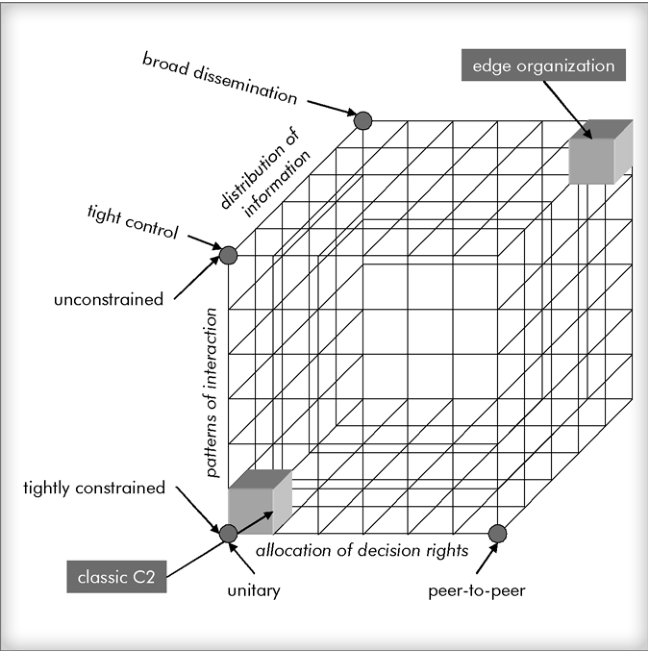
Two of these three axes are exactly what this session has been reading. NDP 6's "vertical versus horizontal information flow" and MCDP 6's broadcast/narrowcast and push/pull distinctions are the CCRP's patterns of interaction — who talks to whom, over what media, how constrained. NDP 6's common tactical picture, its C4I dissemination requirements, and its choice between centralized and distributed access are the CCRP's distribution of information — from "tight control" to "broad dissemination." The two "methods of control" we mapped onto Galbraith's two strategies (Section 05) are, in CCRP coordinates, a coupled move along both of these axes at once: detailed control pulls toward tightly-constrained interaction and tightly-controlled information; mission control pushes toward unconstrained interaction and broad dissemination.
| CCRP dimension (Alberts & Hayes 2006) | What this session has already called it | Where it lives in the course |
|---|---|---|
| Patterns of interaction tightly constrained → unconstrained |
Network topology: vertical vs. horizontal flow; wheel/Y vs. all-channel; broadcast vs. narrowcast; push vs. pull (Sections 05, 07). | This session · communication design Taught here |
| Distribution of information tight control → broad dissemination |
The common tactical picture; C4I collect/process/disseminate/protect; centralized vs. distributed access (Sections 03, 04, 07). | This session · communication design Taught here |
| Allocation of decision rights unitary → peer-to-peer |
Who is allowed to decide: formal vs. real authority, delegation, negation protocols — the question Section 05 deliberately bracketed. | Session 05 · Mission Command Handed off |
This is where the CCRP model earns its place — and where it makes trouble for the tidy handoff. The authors are explicit that the three axes are not independent: drawn as a "waterfall," allocation of decision rights is "the most fundamental dimension," which "impacts the other two" and, together with patterns of interaction, largely determines the distribution of information. On the CCRP account, then, you cannot fully fix a communication design without having already fixed who decides — the authority axis reaches down and shapes the two axes this session claimed it could analyze on their own. The clean boundary we drew at the end of Section 05 ("this is about information flow, not about who is allowed to decide") is, in this model, a convenient simplification rather than a real separation.
This session's working claim
Communication design is separable from authority
Sections 02–07 read mission control as a channel-economy and robustness choice — a matter of topology and information flow — and bracketed the decision-rights question for Session 05. The separation let us analyze the wires without settling who commands.
The CCRP counter-claim
Decision rights drives the other two
Alberts & Hayes: allocation of decision rights is "the most fundamental dimension," shaping patterns of interaction and, through them, the distribution of information. If so, communication design is downstream of authority — and this session was, unavoidably, teaching a projection of Session 05's subject all along.
Hold the tension rather than resolve it; that is the seminar working. The productive reading is that the CCRP model vindicates the handoff even as it complicates it: the reason we could analyze topology and information flow this session, and take up decision rights next, is that all three axes co-vary along the same "classic C2 ↔ edge organization" diagonal. NDP 6's detailed control and mission control are two labeled stops on that diagonal; Session 05 asks what happens when a commander tries to move along the decision-rights axis alone — to delegate authority — while the interaction and information axes lag behind, which is exactly the misalignment the CCRP waterfall predicts will be unstable.
One more coordinate is worth planting, because it sets up the course's later sessions. The CCRP's extreme corner — the "edge organization," with peer-to-peer decision rights, unconstrained interaction, and broadly disseminated information — is the destination of the network-centric program that Alberts, Garstka & Stein (1999) had launched seven years earlier. Their Network Centric Warfare defines the aim as networking "sensors, decision makers, and shooters to achieve shared awareness … and a degree of self-synchronization" — the bet that if you push distribution of information all the way to "broad dissemination," coordination will emerge without central direction. Read against NDP 6, this is the opposite wager: where the 1996 doctrine bets on reducing the need to process information because channels can be cut, the 1999 network-centric vision bets on increasing the capacity so radically that shared awareness itself becomes the coordinating mechanism. Whether that bet survives the contested-network conditions NDP 6 designs for is the live question the first discussion item takes up.
Seminar discussion
Questions to structure the session's second hour. Each has a live tension or a transfer to non-military organizations; none has a settled answer.
- Does better networking undo the case for mission control? NDP 6 bets on "reduce the need to process information" because channels can be cut. Modern C4I — Link 16, cooperative engagement, JADC2 — massively "increases capacity" and can put a live common picture at the top. Does that make centralization safe again, or does it just move the single point of failure from the radio to the data link? Argue whether Galbraith's two strategies are substitutes or whether one is permanently more survivable.
- Is decentralization really more robust, or does it relocate the fragility? NDP 6 claims mission control is "much less vulnerable to disruption." But its robustness depends on shared understanding built in advance. Has the organization actually reduced fragility, or swapped a fragility of channels for a fragility of common ground — one that is invisible in peacetime and only shows up, as with Lee and Ewell, when it is too late?
- Can communication design be analyzed apart from authority? This session read C2 as topology and information flow and bracketed the decision-rights question for Session 05. But the CCRP model (Alberts & Hayes 2006) calls allocation of decision rights "the most fundamental dimension," one that shapes the other two. If that is right, was this session ever really analyzing communication design on its own — or only a projection of an authority decision already made? Where, concretely, would fixing the wiring first and the authority second produce a worse organization than doing it in the reverse order?
- Is "war is a complex task" a finding or an ideology? Bavelas–Leavitt say decentralized networks win on complex problems, centralized on simple ones. NDP 6 makes mission control the default and detailed control the exception (airspace, nuclear release). When does a doctrinal preference for decentralization become a refusal to centralize even where the task is genuinely simple and safety-critical?
- Can you reorganize a force without redesigning its communication system? Take NDP 6 literally — "every organizational decision is a command and control decision." If org structure and comms structure are one object, what does that imply for a company that reshuffles its org chart without touching how information flows — or for the "inverse Conway maneuver," designing teams to force a desired architecture? Where does mirroring break?
- When does a shared display improve grounding, and when does it manufacture false confidence? The common tactical picture is NDP 6's great capacity investment, yet the document warns that displays "take on an appearance of infallibility" and defends the commander's firsthand "directed telescope." Reconcile the two: is a single shared picture a grounding tool or a grounding hazard, and what determines which?
- "The process is more important than the system" — timeless truth or 1996 hedge? NDP 6 keeps the human decisively inside the loop and says automation "plays a very limited role … in generating understanding." Was that a claim about the nature of judgment, or a hedge against immature technology that AI-assisted orientation now overturns? What would have to be true for the top rung of the cognitive hierarchy to stop being "purely human"?
- Whose doctrine grounds a coalition? Commander's intent works because doctrine pre-loads a shared codebook (Session 03). In multinational operations NDP 6 counsels "keep things simple" and settle communications agreements "in advance of war." When partners run different doctrine, is common ground buildable fast enough to support mission command — or does coalition warfare force a fallback to detailed control regardless of preference?
Synthesis and bridge
What this session establishes and what it sets up.
What we established
NDP 6 is an information-processing design document, and its central move is to reduce the need to process information rather than merely increase the capacity.
Read as communication design, the doctrine is coherent end to end: a cognitive hierarchy that reserves understanding to humans; an OODA cycle judged by relative tempo; two "methods of control" that are two network topologies mapped onto Galbraith's two strategies and the Bavelas–Leavitt findings; commander's intent as pre-loaded common ground in the sense of Clark & Brennan; and an organization that mirrors its communication network (Conway) and is deliberately built — dispersed, redundant, network-optional — to keep working after its nodes are destroyed. MCDP 6, its 1996 sibling, states the same design in a more theoretically explicit voice, and the CCRP model (Alberts & Hayes 2006) gives it a coordinate system: patterns of interaction and distribution of information are the two axes this session read.
Next session
Session 05: Mission Command — the authority question we bracketed.
We treated mission control as a matter of information flow and held the question of who is allowed to decide. Session 05 takes up the CCRP's third and "most fundamental" axis directly: decision rights, formal versus real authority (Aghion–Tirole), delegation, and the negation protocols that let a commander stay silent unless he must intervene. This session built the communication substrate; the next asks how authority is allocated across it — and, since the CCRP model warns that decision rights drives the other two axes, what happens when a commander moves along the authority axis faster than interaction and information can follow.
Sources and evidence
Every material claim in this lecture traces to these documents.
Primary and context sources
Figures (extracted from converted source directories)
Theory cited inline (author-year)