Assigned readings
One book read in full — its case studies are the evidence base of the whole session — one Air University research paper, and three theory works that name the mechanisms Mandeles' history exhibits. Then the transformation program's own primary artifacts (the Office of Force Transformation's statements) and its outside auditor (GAO), so both sides of Mandeles' critique can speak in their own voices, with the CBO costing and Boyd's original theory as context.
Mandeles, M. D. (2007). Military Transformation Past and Present: Historical Lessons for the 21st Century. Praeger Security International.
Read all six chapters. Chapter 1 sets the analytic framework (three levels of analysis; no identity between technical performance and operational capability). Chapters 2–5 are the cases: the post–Civil War Army and the Wampanoag; interwar Navy carrier aviation versus the Army Air Corps; USMC amphibious doctrine versus the Royal Marines; and the Navy's Cooperative Engagement Capability program. Chapter 6 states the theory of multiorganizational systems and its design prescriptions. The book began as a study for Andrew Marshall's Office of Net Assessment and is dedicated in part to Martin Landau — the error-correction lineage is explicit.
../sources/doctrine_theory/military_transformation_mandeles_2007.mdBrown, C. Q., Jr. (Col, USAF). Developing Doctrine for the Future Joint Force: Creating Synergy and Minimizing Seams. Walker Paper No. 3, Air University Press.
Written during Brown's 2003–04 Air Force Fellowship at the Institute for Defense Analyses and selected as an inaugural Walker Series Award winner; the author later served as Air Force Chief of Staff and Chairman of the Joint Chiefs. Read chapters 1–7 for the five air-ground integration focus areas and the case evidence from Desert Storm, Afghanistan, and Iraq; read chapter 8 for the synergies-and-seams analysis of the Air Force and Army transformation plans. The appendices summarize the current-doctrine baseline he is amending.
../sources/joint/developing_doctrine_future_joint_force_walker_2003.mdOffice of Force Transformation (2003). Military Transformation: A Strategic Approach. Office of the Secretary of Defense.
The primary artifact of the rhetoric Mandeles critiques — Cebrowski's own office stating the case in its own voice. Read the Director's message, "What Is Transformation?", and the four pillars (esp. Pillar Three, concept development and experimentation). Note the claim the whole session tests: transformation "begins and ends with culture," and the promise to "anticipate and create the future." Held against Mandeles' "there is no crystal ball," this is the collision the session stages in primary sources.
../sources/transformation_ai/oft_military_transformation_strategic_approach_2003.mdU.S. Government Accountability Office (2004). Military Transformation: Clear Leadership, Accountability, and Management Tools Are Needed to Enhance DOD's Efforts to Transform Military Capabilities. GAO-05-70.
The outside auditor's verdict on the program OFT was selling. Read "What GAO Found" and the "Results in Brief." GAO finds the transformation effort has "no one person or entity" accountable and an integrating group with "no charter." Its prescribed fix — single leadership and results-oriented metrics — is precisely the centralization Mandeles argues creates monopolies that hide error, so read GAO against both OFT and Mandeles: a three-way disagreement, not two.
../sources/transformation_ai/gao_05_70_defense_transformation_2004.mdOffice of Force Transformation (2005). The Implementation of Network-Centric Warfare; and (2004) Elements of Defense Transformation. Office of the Secretary of Defense.
Two compact OFT statements of the program's doctrine. The NCW booklet is Cebrowski's implementation case for network-centric warfare — "the network is a noun… to network is the verb," speed of command, self-synchronization. Elements distills the whole program to innovation, experimentation, implementation, and creativity. Skim for how the office frames its own mechanisms; both feed the register.
../sources/transformation_ai/oft_implementation_of_network_centric_warfare_2005.mdCongressional Budget Office (2003). The Long-Term Implications of Current Defense Plans. CBO Study.
The costing of the program. Under DoD's own estimates, current plans reach unprecedented peacetime levels; under CBO's historical cost-growth ("cost risk") case, they average $398 billion over 2003–2007 and could peak at $488 billion — higher than any point in 22 years. The budget backdrop against which OFT promised revolutionary capability and GAO could not trace where the "$263 billion" for transformation was going. Skim the summary.
../sources/transformation_ai/cbo_long_term_implications_defense_plans_study_2003.mdBoyd, J. R. Patterns of Conflict (1986; Richards & Spinney eds.); and Destruction and Creation (1976).
The intellectual insurgency that transformation rhetoric domesticated. Patterns of Conflict is the source of the OODA loop — win by operating "at a faster tempo… inside the adversary's observation-orientation-decision-action loop" — which OFT's "speed of command" institutionalizes. Destruction and Creation is its epistemological floor: we "shape and be shaped by a changing environment" by destroying and rebuilding mental patterns. Read the abstracts; note how much thinner the sanctioned program is than the theory it cites.
../sources/transformation_ai/boyd_patterns_of_conflict_1986.mdMarch, J. G. (1991). Exploration and exploitation in organizational learning. Organization Science, 2(1), 71–87.
The session's spine. Organizations that exploit their current competence crowd out the exploration that would find the next one — and adaptive processes are biased toward exploitation because its returns are near, certain, and attributable. Ask, case by case, where Mandeles' communities kept exploration alive and who paid for it. Pair with Tushman & O'Reilly (1996) on ambidexterity, cited in the register.
doi.org/10.1287/orsc.2.1.71Orton, J. D., & Weick, K. E. (1990). Loosely coupled systems: A reconceptualization. Academy of Management Review, 15(2), 203–223.
Loose coupling is not weak coupling: elements are responsive to one another and retain separate identity. Mandeles names his interwar systems "loosely coupled" — coordination supplied by argument before the General Board, not by a fixed sequence of routines. Read for the dialectic that lets distinct organizations disagree productively.
doi.org/10.5465/amr.1990.4308154Colfer, L. J., & Baldwin, C. Y. (2016). The mirroring hypothesis: Theory, evidence, and exceptions. Industrial and Corporate Change, 25(5), 709–738.
Organizational ties tend to mirror the technical dependency structure of the work. Brown's Operation Iraqi Freedom fires network is a textbook exhibit — five parallel control structures mirroring five service organizations — and his proposals are an inverse-Conway maneuver in the sense of Skelton & Pais (2019): redesign the teams to force the integrated architecture.
doi.org/10.1093/icc/dtw027The transformation trap: no crystal ball, no identity relation, wrong level of analysis
Mandeles opens by dismantling the premises of 1990s–2000s transformation rhetoric: that the future can be predicted, that better technology equals better capability, and that a single organization — or a single visionary — can be the unit of change.
The Department of Defense's fascination with "transformation" began in the early 1990s, when Office of the Secretary of Defense documents called for "fundamental change" through the Revolution in Military Affairs. The services wrote transformation road maps, created battle laboratories, and ran wargames; Congress in 1998 required a Defense Science Board task force, which in 1999 defined transformation as pursuing "bold new ways of conducting military operations to meet new security challenges of the 21st century" — while warning that DoD leadership was underestimating "the focus and effort needed" and that there was no "pervasive sense of urgency." That September, candidate George W. Bush pledged transformation at the Citadel; Secretary Rumsfeld later installed Vice Admiral Arthur Cebrowski, theoretician of network-centric warfare, to lead an Office of Force Transformation. Mandeles' book is a sustained argument that this entire apparatus rested on three errors.
First, there is no crystal ball. No operations-research method can determine the single most effective apportionment of roles and missions or identify in advance the technologies, operational concepts, and organizational structures that will improve capability qualitatively. "The best the national security community can do," Mandeles writes, "is to organize to learn" — collect and catalog information, develop means to test it critically, and pose alternatives systematically. Second, the assumption underneath most transformation programs is analytically false:
The assumption underlying many of the military Services' proposals for new transformational technologies is the same as that for components of military revolutions: higher technical performance equates to higher operational capability. Unfortunately, this assumption is wrong. There is no identity relationship between technical performance and operational capability.
Third — the book's methodological signature — most studies of innovation look at the wrong level of analysis. Historians and social scientists examine significant individuals or single innovating organizations; useful, Mandeles concedes, but "unable to generate effective broad policy guidelines." His claim is that the multiorganizational environment — the interactions among groups of organizations — "is the most powerful determinant of how actions are conceived, examined, and acted upon, and makes error identification and correction possible." This is bounded rationality (Simon 1947) taken seriously as a design constraint: no individual and no single organization can hold enough knowledge to choose new weapons and operational concepts. Mandeles quotes the Brodies' conclusion that the military problem of choosing new weapons systems is "not only beyond the competence of any one person or group of persons but beyond the competence of any one profession" — so the design question becomes how professions, offices, and organizations are made to interact.
The planning horizon compounds the problem. Some transformations took twenty to thirty years to be recognized, meaning the officials who start them will not be in office to see them mature. In 1973, no one in the Army anticipated how precision-guided munitions would ripple through force structure — yet analysis of the Yom Kippur War triggered what Weigley called "the most complete rearming in the Army's history." The operational concept that stunned a Northern Alliance commander in October 2001 — a bomb arriving nineteen minutes after an airman's call, not the day or two he expected — closely resembled the Marine Corps' Hunter Warrior experiment of March 1997, itself the product of five years of wargames and argument; Mandeles notes the similarity may be coincidence, which is precisely his point about unpredictable convergence. Examination of real cases shows that "concrete objectives and clear metrics are not necessary components of successful transformation" — and given the pace of technological change, "regardless of our plans, roadmaps, and metrics, we will see one or more 'military transformations' every fifteen to twenty years." Meanwhile legacy runs deep: Elting Morison's time-motion expert, puzzling over why two members of a World War II British gun crew froze at attention for three seconds at each firing, got his answer from an old artillery colonel — "They are holding the horses." Behaviors outlive by decades the systems that made them rational.
The officials who begin a transformation will not be in office to see it, or the myriad ways their plans change (Mandeles, Ch. 1).
The Afghan commander expected a day or two of approvals. The concept resembled Hunter Warrior (1997) — begun as an idea in 1992 and refined through five years of wargames and debate.
Given resources and technological pace, transformations will occur regardless of plans, road maps, and metrics. The design question is error correction, not prediction.
In March's (1991) vocabulary, transformation rhetoric applies an exploitation-style instrument — a plan, a road map, a metric — to an exploration problem, where returns are distant, uncertain, and often negative. Mandeles' alternative is organizational: "military transformation will result more effectively from enhancing the interaction among DoD components to confront risk, coordinate, experiment, discuss, and set priorities." Exhortations to build a "culture of innovation," as the 2003 Transformation Planning Guidance demanded, "will be ignored in practice, unless organizational arrangements inherently encourage them." Rules of evidence for judging new concepts cannot even be legislated first — they "will emerge through partisan argument and mutual adjustment among individuals in organizations and between organizations, as they learn."
Until now the session has read the transformation apparatus through Mandeles, in paraphrase. The primary artifacts let the program answer in its own voice. The Office of Force Transformation's 2003 strategic statement — the office Rumsfeld created in October 2001 and gave to Cebrowski, theoretician of network-centric warfare — does not describe transformation as an organizational-design problem at all. It describes it as a cultural one, and locates the engine exactly where Mandeles says it cannot be:
Military transformation is about changing the culture of the U.S. Armed Forces. Therefore, transformational activity must facilitate a culture of change and innovation in order to maintain competitive advantage in the information age. That culture must foster leadership, education, processes, organizations, values, and attitudes that encourage and reward meaningful innovation.
The document's own vision statement promises a force that will "anticipate and create the future" — the crystal-ball premise Mandeles opens by denying — and frames the whole enterprise as "a strategy for large-scale innovation" pursued through four pillars, the third of which, concept development and experimentation, sounds Mandelesian on its face. The lineage runs deeper than the memo: OFT's network-centric-warfare booklet builds its case on "speed of command" and "self-synchronization" — the institutional, sanctioned descendants of John Boyd's maneuver-warfare theory, whose Patterns of Conflict tells a commander to "operate at a faster tempo… inside the adversary's observation-orientation-decision-action loop," and whose Destruction and Creation grounds that loop in an epistemology of continuously destroying and rebuilding one's mental models to "shape and be shaped by a changing environment." Transformation rhetoric domesticated an intellectual insurgency into a program office with a road map — and OFT's compact Elements of Defense Transformation reduces the whole inheritance to four tidy nouns: innovation, experimentation, implementation, creativity.
Then the outside auditor arrived. In December 2004 the Government Accountability Office examined the same program — by then a planned $263 billion across fiscal years 2004–2009, against a defense budget the Congressional Budget Office had just projected could peak near $488 billion under historical cost growth — and found not a culture problem but a structure problem, described in almost the terms Mandeles' cases would predict:
The responsibility for transforming military capabilities is currently spread among various DOD organizations, with no one person or entity having the overarching and ongoing leadership responsibilities or the accountability for achieving transformation results. In addition, although DOD established an informal crosscutting group that meets occasionally to discuss transformation issues, this group has no charter, formal responsibilities, or authority to direct changes.
The detail underneath the finding is sharper than the finding. GAO records that Cebrowski himself testified he "is a catalyst for" and "encourages" but does not "direct" transformation, and that the Office of Force Transformation's own charter, three years after its creation, "as of September 2004, had not been approved." The office chartered to produce transformation was, by its director's own account, an office with no authority to direct it — and no minutes were kept of the informal group that met in its place. Now hold the two primary voices against each other, because the collision is the session's argument:
OFT's claim (2003) · the program's own voice
Transformation is a culture problem, solved from the top
"Transformation begins and ends with culture." The Secretary supplies the vision; the office is a "catalyst" that "encourages"; the mechanism is a strategy for large-scale innovation that will "anticipate and create the future." No claim that the design of interacting organizations is the variable — the exhortation to build a culture of innovation is the plan.
GAO's finding (2004) · the outside auditor
Transformation is an accountability vacuum, to be centralized
No one person or entity is accountable; the integrating group has no charter, no directive authority, no minutes. Fix it with clear single leadership, a formal implementation team, and results-oriented performance metrics — so Congress can trace the billions. The remedy is consolidation and measurement: the opposite of a culture exhortation, and the opposite of Mandeles' overlap.
Mandeles referees both and endorses neither. Against OFT: a culture of innovation "will be ignored in practice, unless organizational arrangements inherently encourage them" — culture is an output of structure, not a substitute for it, and a strategy that promises to "anticipate and create the future" has mistaken an exploration problem for a prediction problem. Against GAO: its diagnosis is correct that no forum structurally forces criticism, but its cure is the reflex Mandeles spends Chapter 6 dismantling — "the primary outcome of removing policy, jurisdictional, task, and mission overlap is to create public monopolies that disguise rather than expose their errors." A single accountable transformation czar with a metrics dashboard is a monopoly, not a multiorganizational system; it would answer GAO's audit while defeating the very error-correction the audit exists to protect. The seminar's task, in the sections that follow, is to read four historical cases and decide which auditor — if either — the evidence supports. Whether an accountability vacuum should be filled by a single owner or by a designed structure of rival owners is Question 1 below; the primary sources do not settle it.
The baseline: smart people without an organization that learns, 1865–1900
Chapter 2 establishes the negative control. The post–Civil War Army and Navy had intelligent leaders who saw the new technologies clearly — and no organizational means to turn observation into evidence, evidence into doctrine, or doctrine into acquisition.
Post–Civil War officers were not blind. McClellan warned in 1874 that traditional formations could not survive modern fire; Sheridan's 1884 annual report predicted trench warfare "much along the lines of World War I's Western front" — "armies will then resort to the spade, the pick, and the shovel." Sherman wrote that modern war "calls for a larger measure of intelligence… necessitating more study and preparation." What was missing was structure. Congress had organized the War Department to minimize cost, not to learn: ten administrative bureaus answered to the secretary and Congress, independent of the Commanding General, who "could not order systematic testing or maneuvers over several years" and could not pose tradeoffs across bureaus. The nineteenth-century Army, as Jamieson records, "had no permanent process for creating and revising an officially authorized set of tactical principles, recognized and taught throughout the service." Field exercises existed but produced little: those managing them "gave little thought… to stating clearly what combat outcomes they expected so that deviations from expectations could be analyzed." A field telephone appeared at an 1882 Artillery School exercise — and vanished from development for decades. Major Edward Williston's battery ran the only systematic machine-gun experiments before the early 1900s, on his own initiative; the Army "was not organized to do on a wide-scale what Williston did on his own." The questions the Gatling gun raised in the 1860s were still unresolved in the 1890s.
-
1866 · Congress structures the War Department
Learning made structurally inconceivable. Regiment counts set by statute; ten bureaus independent of the Commanding General. Authority relationships that made it "extremely difficult even to conceive of the need for institutionalized experimentation."
-
1867–1888 · Tactics by lone authors and swamped boards
Upton's manuals, then twenty years of drift. Upton's 1867 single-rank tactics drew criticism from the year of introduction; alternatives surfaced through the 1880s but none won approval. The 1888 Endicott board was "swamped with proposals from theorists," each draft reviewed by a single officer per combat arm.
-
1868 · The Wampanoag proves out — and is discarded
The fastest ship in the world, decommissioned in three months. Isherwood's screw frigate averaged more than 16.7 knots over 37.5 consecutive hours into a mid-winter gale — performance no American ship matched for twenty-one years. Commissioned September 1867; decommissioned 5 May 1868; sold 1885.
-
1891 · Authorized tactics, twenty-six years late
The Leavenworth manuals. The first official documents to treat offensive and defensive fighting separately — arriving twenty-six years after the war whose lessons they encoded. No maneuvers were ever designed to test the manuals' most-criticized claim, command and control of loose-order formations.
-
1873 / 1884 / 1900 · The Navy grows the organs of a system
Naval Institute, Naval War College, General Board. A private discussion forum (1873); the world's first designated war college (Luce, 1884); and an advisory board with no command authority (General Order No. 544, 1900) coordinating the NWC and the Office of Naval Intelligence. The infrastructure of a multiorganizational system — assembled without anyone intending the system.
The Wampanoag episode is the chapter's crux because every conventional explanation of its rejection is individual-level. Morison saw line officers defending a way of life under sail; Buhl saw a status war between line officers and engineers; Koistinen saw a Congress uninterested in naval power. Mandeles accepts all three and adds the level they miss: there was no arrangement of interacting Navy organizations to "produce evidence and incentives to learn." Had there been, a fleet of Wampanoags might still have been rejected — Captain van Tol notes the coaling-station logistics were forbidding — but the issues would have been "raised, discussed, and debated." Instead, "the absence of interacting Navy organizations prevented such issues from being raised… and thereby obviated choice." That is the book's engine stated negatively: without structured interaction there is no error correction, because there is no forum in which an error can be named. Note the design of the General Board itself: it was given no administrative or executive responsibilities and no command authority — its power was entirely the power to demand justification, a pure error-detection organ in Landau's (1969) sense of productive redundancy.
The natural experiment: carrier aviation versus the Army Air Corps
Chapter 3 is the book's centerpiece comparison. Same interwar budgets, same immature aviation technology, opposite organizational structures — and opposite results in doctrine, technology, and combat readiness.
Interwar aviation was radically uncertain: von Kármán described aerodynamics as late as 1946 as "mathematical and half-digested, isolated, experimental results." Senior officers evaluating aviation enthusiasts' claims "could only know that they did not have the knowledge to make decisions." The Navy's response, "in an unplanned way," was a system: within a decade of World War I, the General Board, the Fleet, the Naval War College, and the Bureau of Aeronautics (authorized 1921) were locked in a feedback loop. Rear Admiral Sims at the NWC ran aviation wargames from 1919 using rules written from real fleet-exercise data, with faculty corresponding regularly with fleet aviators. Rear Admiral Moffett at BuAer used NWC games and fleet exercises to write requirements for higher-performance aircraft — and fed estimates of future aircraft performance back to the wargamers. Fleet exercises tested what the games suggested; results returned to the games and to BuAer as new technical requirements. The General Board, hearing testimony and demanding empirical proof, "created informal rules of analysis and evidence."
Hear claims
Demanding questions on tactics, concepts, technology risk.
Set rules of evidence
Informal but binding: proponents must bring proof, not assertion.
Wargame the concepts
Rules written from fleet-exercise data (Sims, from 1919).
Publish inferences
How aviation should be based, supported, employed.
Test at sea
Exercises examine operational issues the games raised.
Return results
Outcomes feed later games and new requirements.
Write requirements
Moffett converts game and exercise findings into aircraft specs.
Project performance
Estimates of future aircraft flow back into NWC simulations.
The loop metabolized ambiguous evidence without collapsing into either camp. The 1921 Ostfriesland bombing tests — Mitchell's aircraft sinking an anchored, obsolete German battleship in ideal weather, with no return fire and no modern compartmentation — were "ambiguous to military professionals," and the Navy treated them that way: the General Board's February 1921 report had already rejected pinning the fleet's faith on "mere theories as to the future development of new and untried weapons," and the 1925 Special Policy Board still reasoned incrementally from known operations. Yet the exploration never stopped. When Captain Joseph Reeves left the NWC wargames in 1925 to command Aircraft Squadrons, he carried the games' central finding — a carrier's aircraft matter as a massed group — into operational trials on the Langley, cut take-off and recovery cycle times, and raised the number of aircraft operated from fourteen to as many as forty-two. Personnel rotation was the system's knowledge transport.
It is worth reiterating that the creation and evolution of the multiorganizational naval aviation community was partly accidental. No naval leader decided that interaction among offices concerned with aviation would be an effective forum for learning. Yet, once the interaction among the General Board, the Fleet, NWC, and Bureau of Aeronautics began to direct analysis and testing, the relationships among these organizations strengthened.
Two corollaries matter. First, no single office could have pursued carriers against battleship interests — innovation was a system property, not an office's victory. Given the decision problem, Mandeles writes, "the most effective strategy was to discover organizational goals through action" rather than to announce vision statements and build an acquisition program on them. Second, the system was local, not cultural: the same Navy's torpedo development, lacking interacting offices, shipped torpedoes into World War II with three distinct failure modes, prompting Rear Admiral Blandy's 1943 rebuke that the work "could and should have been accomplished years ago." Structure, not service culture, is the variable.
| Dimension | Navy aviation community | Army Air Corps |
|---|---|---|
| Doctrine formation | Concepts treated as open questions; General Board hearings force evidence; battleship-vs-carrier decision deliberately deferred as premature. Hypothesis-driven | ACTS doctrine of long-range bombardment — bombers win wars, the bomber gets through, airmen must control air assets — "not subjected to vigorous debate, historical analysis, or field experiments." Assertion-driven |
| Use of exercises | Fleet problems designed against wargame-derived expectations; results recycled into games and requirements. | 1931 maneuvers run as logistics-and-airshow spectacle; umpire concluded interception was impossible and that developing fighters was therefore "inconsistent with the employment of air force." |
| Treatment of disconfirming evidence | Ambiguous Ostfriesland results parsed for what they did and did not show; aviation continued under battleship primacy. | Chennault intercepted every bomber raid at Fort Knox (1933) using three cavalry field radios plugged into the warning net; the response was to restrict the defenders' free play. Spanish Civil War evidence unwelcome, no doctrine reexamined. 1935 Air Corps Board ruled the high-speed pursuit plane a technological impossibility. |
| Ancillary requirements anticipated? | Carrier design, aircraft numbers, cycle times worked through games, trials, and bureau requirements. | No doctrinally directed calls for droppable fuel tanks, long-range escorts, or even the earth-moving equipment bombing campaigns would need; observation aircraft designed without working with the field artillery — too fast to spot, too heavy to operate forward. |
| Combat consequence | Carrier aviation ready enough by 1941 that doubts dissolved in combat; Furer credits early investment in training aeronautical engineers. | "Hundreds of unprotected B-24's and B-17's… shot down over Europe" (Chennault); air-ground coordination improvised in the field in 1942–43; the Piper Cub artillery-spotting requirement emerged from the 1941 Louisiana Maneuvers over AAF opposition. |
Read through March (1991), the multiorganizational system is an ambidexterity mechanism — but located between organizations rather than inside one. Tushman & O'Reilly (1996) prescribe structurally separated exploratory and exploitative units under one senior team; the interwar Navy got the same effect with no designer: the battleship community exploited, the aviation community explored, and the General Board arbitrated with rules of evidence, so that exploration was neither crushed by the dominant coalition (the AAC's fate for pursuit aviation) nor allowed to become untested orthodoxy (the fate of ACTS bombardment doctrine — exploration that congealed into exploitation without ever passing through a test). Mitchell, the archetypal visionary, ran "public relations stunts—not experiments within a systematic program to learn"; Mandeles' verdict is that prewar air doctrine was "assertions unsupported by evidence." The visionary is not the engine of transformation; unchecked, he is one of its failure modes. Goal displacement completes the pathology set: Captain Beach's account of prewar training competitions — machine guns overhauled just before practice firings and repacked in grease, depth-charge attacks graded on the neatness of the charts, a battleship winning the engineering "E" by becoming uninhabitable — shows measurement substituting for the goal. Mandeles finds the same disease in the modern US Joint Forces Command experimentation program, whose tightly scheduled events left "inadequate time between each event to apply what is learned from a previous experiment to the next."
Replication: the Marines learn amphibious assault; the Royal Marines do not
Chapter 4 reruns the experiment with a different mission and a transatlantic comparison — and adds the theoretical resolution: Wildavsky's self-evaluation paradox dissolves at the multiorganizational level.
Gallipoli (1915) was the shared shock: a catastrophic amphibious failure that most European pundits — Kiralfy, Liddell-Hart — read as proof that opposed landings had become infeasible. The two marine corps then diverged. In Britain, the policymaking circle was tiny and closed: the Committee of Imperial Defence had only five members for most of 1919–1939, drawn largely from an aristocracy "generally unimpressed with the concept of merit appointment," and, in Herman Finer's words, "it was etiquette that each [chief of staff] should not criticize the conceptions of the other." Churchill's Ten Year Rule (1919) — plan on no major war for a decade — outlived its 1932 revocation as an ingrained spending reflex ("Good God, the Ten-Year Rule starts in again this morning," Lord Hankey recalled waking to think). The official Gallipoli histories satisfied no one and seeded no program of experiments. Joint exercises between 1925 and 1935 "were not tactical": time studies of unloading ships, erecting guns, building piers. Staff-college analysis ran isolated from operational forces and acquisition. The Inter-Services Training and Development Centre — the institutional advocate finally created in 1938 with a £30,000 research budget — was disbanded on the outbreak of war in September 1939 and revived only in January 1940. By 1939 exactly one senior army officer, Montgomery, had ever commanded an amphibious landing force, in a single 1938 exercise.
Royal Marines · closed, tightly held
Five men, one etiquette, no forum for error
A small elite that depended on each other's good opinions; criticism suppressed by custom; academic analysis decoupled from forces and acquisition; exercises that measured logistics, not tactics. When war came: little doctrine, prototype equipment only, poor quantity estimates, no planning staff, no training organization. Churchill's wartime improvisation produced equipment and techniques faster than strategies and routines — Mandeles' evidence that "it is utterly impossible to improvise military organizations" (Marshall).
U.S. Marine Corps · overlapping, loosely coupled
Five organs arguing over one problem
General Board, Naval War College, Office of the Commandant, Marine Corps Schools, and the Fleet — partially overlapping jurisdictions, coordinated by discussion and argument. Gallipoli treated as a laboratory (Dunlap's 1921 error catalog), War Plan Orange as the forcing function, exercises as tests. Ideas from maneuvers corrected doctrine; doctrine set the agenda for the next maneuvers. Mandeles: the interaction "became self-organizing."
The American side reads as deliberate hypothesis-testing even though no one designed the system. The General Board had assigned the advance-base mission in 1900; War Plan Orange made seizing Japanese-held islands the Corps' survival-relevant specialty — a mission Lejeune pressed at every opportunity, and one made institutionally urgent by MacArthur's 1933 proposal to absorb the Corps into the Army. Major "Pete" Ellis wrote the 30,000-word Advanced Base Force Operations in Micronesia in seven months (endorsed July 1921), predicting that reducing the Marshalls, Carolines, and Palaus was "practically imperative." Colonel Dunlap's Gallipoli study itemized British planning errors down to "the packing of equipment." The 1923–24 fleet maneuvers put 3,300 personnel through the first landing problem, at Culebra and the Canal Zone, in maneuvers "distinguished by an empirical attitude": errors discovered there — friend-or-foe aircraft recognition, for one — got engineered fixes (a coded challenge system, telephone links from observation posts to antiaircraft guns) and fifteen years of follow-up. In 1933 the Marine Corps Schools cancelled classes so students and instructors could write doctrine full-time; the Tentative Manual for Landing Operations (1934) became, after Fleet and CNO review, "the authoritative guide within the Navy Department for future amphibious exercises and for research and development," codified as Fleet Training Publication 167 in 1938. The FLEX series (1935–1941) escalated to FLEX-7 at New River: 17,000 soldiers and marines, the Higgins boat's debut, night landings, parachute operations — and a post-maneuver report with thirty-eight practical recommendations. Instruction on landing operations grew from two hours in 1924–25 to more than one hundred by 1927; from about a quarter of the curriculum in the mid-1920s to sixty percent by the mid-1930s.
The interaction among a set of organizations having partial overlap of jurisdiction allows the establishment of "self-correcting organizations" on the basis of rational criticism, as described by eminent political scientist Martin Landau. The seeming contradiction between the two is resolved at the level of multiorganizational systems.
This is the chapter's theoretical payoff. Wildavsky held that self-evaluation fails inside a single organization — evaluators and administrators cannot share power, budgets, or blame. Landau held that redundancy and overlap enable error correction. Mandeles' resolution: both are right, at different levels. A single organization cannot criticize itself; a set of organizations with partial jurisdictional overlap criticizes its members structurally, because each organization's advocacy doubles as scrutiny of the others. Orton & Weick's (1990) reconceptualization names the required coupling: the five American organs were responsive to one another (through hearings, shared exercises, doctrine review) while retaining distinct identities and interests — loose coupling as a productive dialectic. The British system had the inverse configuration: tight coupling among five like-minded men at the top, and decoupling everywhere below — between analysis and forces, between doctrine and experiment, between the services and Parliament. The verdict fell in 1940: the British "pioneered" specialized landing techniques only under wartime duress, whereas Vandegrift could claim the Corps' "greatest contribution to World War II victory was doctrinal… largely shaped… mainly between 1922 and 1935." As Holland Smith reported in 1946, doctrine written before the first 1942 landings, "without the benefit of the combat experience of this war… has proved remarkably sound."
The modern case: Cooperative Engagement Capability and the design prescriptions
Chapter 5 finds the same anatomy in a present-day acquisition program — thirteen-plus organizations netting the fleet's radars — and Chapter 6 converts the historical pattern into explicit design doctrine: treat doctrine as hypothesis, operations as experiments, and overlap as the machinery of criticism.
Cooperative Engagement Capability is an air-defense network that shares raw sensor data among ships and aircraft so that every unit computes an identical composite, real-time air picture — letting a ship engage a target its own radar cannot see. Mandeles reads the concept itself as error-correction engineering: it "exploits the insights of… John von Neumann on the role of redundancy in designing reliable systems from unreliable components," carrying the track on multiple independent lines to drive error arbitrarily low — fewer dual and swapped tracks, fewer inconsistent identifications, and (a little-noticed implication) lower stress and cognitive load on the sailors watching the displays. The organizational story wraps around the technical one:
-
1958–1975 · Concept before constituency
APL forecasts the need; nobody wants it. A 1972 Aegis milestone imagined sharing sensor data across a battle group when "no technology was available to perform these tasks" — Navy officers saw no need for sensor netting, and industry feared it would undercut sales of individual advanced radars. APL invented the "force weapon-control system" concept anyway (1972–75).
-
1977–1990 · Evidence accumulates
BGAAWC, the Outer Air Battle Study, Demo 90. Fleet experience with Talos/Terrier/Tartar and Link-11 exposed severe shortfalls; CNA's 1983 study argued netted defenses were needed against cruise missiles. The CEC program stood up in July 1987; Demo 90's two weeks at sea proved distributed tracking and measurement-level sensor networking.
-
1994–1996 · Conversion by test, not briefing
"Kill" what you cannot "see." In the Eisenhower battle-group tests, ships engaged targets outside their own radar coverage; Secretary Perry: "this is the greatest thing since stealth." Captain Balisle, commanding Anzio, was "shocked and suspicious" — until predeployment exercises, when "the light bulb turned on." Mountain Top (1996) achieved the first-ever beyond-radar-horizon engagement of a cruise missile from a ship.
-
1997–2000 · The error surfaces
Interoperability failure, honestly measured. Tests on Wasp, Hue City, and Vicksburg overwhelmed operators "with inconsistent data, alerts, and identification conflicts." Deadlines slipped to 2001; an Interoperability Task Force was chartered — created only after the technical problems were well understood, which bounded the task. Created at program start, Mandeles notes, it would have faced "a far larger and more diffuse intellectual problem."
-
1999–2005 · Institutionalized pre-audit
The Distributed Engineering Plant. Land-based combat-system mock-ups linked by high-bandwidth channels simulate a battle group before it sails — in public-administration terms, a "pre-audit" that catches schedule, performance, and budget errors prior to operation. Full-rate production approved April 2002 (up to 215 systems); full operational capability May 2005; fleet-wide equipage projected for 2008 — twenty-one years after program start.
The CEC system displays the interwar anatomy at industrial scale: more than thirteen geographically distributed government offices and companies under the Program Executive Office, with APL as "technical direction agent" arbitrating between Navy and industry; Congress pushing speed while the OSD test office pushed rigor; contractors competing for priority — and conflicts resolved by "bargaining or negotiation that employs empirical arguments, data, and experimental results." The system also learned structurally, spawning the joint Single Integrated Air Picture engineering organization as its successor. Its documented failure is equally instructive: knowledge diffusion. The CEC experience of the Eisenhower group, Balisle admits, largely stayed "in the family" of those who deployed with it — a reminder from Session 06's territory that error correction and knowledge diffusion are different functions.
First, we assume that doctrine, like plans and policies, is hypothetical; operations, like programs, are experimental. It is obvious that the object of doctrine is to direct, control, or influence future events and conditions. Doctrinal statements, therefore, are "if-then" propositions—they are unverified when formulated. The operations or activities that derive from doctrine are experiments, and provide real evidence of the power or inadequacy of the doctrine.
Chapter 6 generalizes. A multiorganizational system is a social system of two or more organizations whose interaction produces "an identity separate from its members"; its "potential… to identify and correct error exceeds that of any single organization." Against the reflex of every reorganization plan — merge agencies, eliminate duplication, centralize jurisdiction — Mandeles argues that consolidation lengthens the chain of command, tightens coupling, and overloads executive attention — and that "the primary outcome of removing policy, jurisdictional, task, and mission overlap is to create public monopolies that disguise rather than expose their errors." His reading of Goldwater-Nichols (via its principal staff author, Locher) is that its centralizing logic answers the wrong question:
The appropriate question to ask concerning the organization of national security community is not, "How can we have a more unified and 'efficient' structure?" but, "How can we organize to foster criticism and correct errors?"
Prescription · parallel strategies
Run competing approaches with controls
"The policy of experimentation should allow several competing strategies to be pursued separately and simultaneously so that comparisons can be made." A project not conceived as an experiment "amounts to a waste of our time, money, and effort." Medawar's rule applies: conviction has no bearing on truth.
Prescription · error as signal
Expect and capitalize on error
"Objectives are expectations; error is the violation of those expectations. Experiments test the expectations." Effectiveness is the gap between actual and expected outcome — measurable only if expectations were stated in advance, the discipline the 1880s exercises lacked.
Diagnosis · formal ≠ actual
Ad hoc organs reveal formal failure
DoD reported 733 committees and 179 subcommittees in 1960; a 2006 QDR working group member counted 861. Leaders create ad hoc teams (the Ault air-to-air study, IPTs) because formal organizations do not monitor their own environments — CNA had not even noticed the Navy's Vietnam kill-ratio problem.
The through-line to March (1991) is exact: exploitation's returns are proximate and attributable, exploration's are distant and diffuse, so unmanaged systems purge exploration. Mandeles' multiorganizational overlap is a structural subsidy for exploration — rival organizations have career and budget incentives to develop evidence against each other's orthodoxies — and the Distributed Engineering Plant lowers the unit cost of experiments enough to make parallel exploration affordable. What McNamara's PPBS and Rumsfeld's capabilities-based planning share, on this reading, is the opposite move: hiding bargaining "under a veneer of analytic rigor" and presenting chosen alternatives "as if there were no analytical shortcuts, trial and error, or blind alleys" — the linear-innovation myth in management dress.
Inside the doctrine process: Brown's five seams and the inverse-Conway repair
The Walker Paper is the view from within the machinery Mandeles theorizes about. A fighter-weapons colonel audits joint doctrine against three recent wars and finds that integration happened by serendipity and field improvisation — then proposes organizational redesigns to make the architecture produce it on purpose.
Brown's premise, stated in the paper's foreword: the services "have developed and published their doctrine separately," and joint doctrine was built by "melding" service doctrines — a construct whose shortcomings "are most often manifested where we least likely want to see them—on the battlefield." Recent successes were "more reliant on the innovation and tenacity of our warriors than forward-thinking joint doctrine." His framework is disciplined: the Joint Operations Concept (2003) defines the force the DoD says it wants in 15–20 years — fully integrated, expeditionary, networked, decentralized, adaptable, decision superior, lethal — and Joint Publication 0-2's nine command-and-control tenets define what will not change. He maps five focus areas onto those tenets: supported/supporting relationships, establishing directives, synchronization of interdiction and maneuver, joint fires, and fire support coordination measures. In each, the diagnosis is the same shape: doctrine encodes yesterday's structure; operations have already outrun it.
However, recent operations have demonstrated that serendipity drives synchronization of interdiction and maneuver more than doctrine.
The evidence is uncomfortable for the official narrative of each war. Desert Storm's "Highway of Death" looked like synchronized interdiction and maneuver, but the fire support coordination line was misplaced, air and land components fought over it for days — and Schwarzkopf said afterward he knew little of the debate. In Afghanistan, no area of operations existed below the combatant commander for the opening months; special operations teams with the Northern Alliance were a de facto maneuver force without targeting expertise or an air-support organization, receiving fires that "were neither close air support nor air interdiction as defined in joint doctrine, but somewhere in between," while a burdensome approval process let fleeting leadership targets escape. In Iraq, the celebrated sandstorm "pause" — air power hammering Iraqi units that moved under weather cover while ground forces refit — "was more a result of circumstance than design." Doctrine caught up afterward, each time: JP 3-30 (June 2003) resolved a formal dispute — put to the service operations deputies as two options — by ending the practice of doctrine pre-assigning supported-commander status by mission, leaving it to the joint force commander; JP 3-31 (March 2004) gave land operations their first approved joint doctrine; the joint terminal attack controller was defined only in September 2003, replacing four unrecognized qualification standards; kill boxes remained "not well understood or codified"; and three combatant commands ran three incompatible grid-reference conventions "for no apparent operational reason."
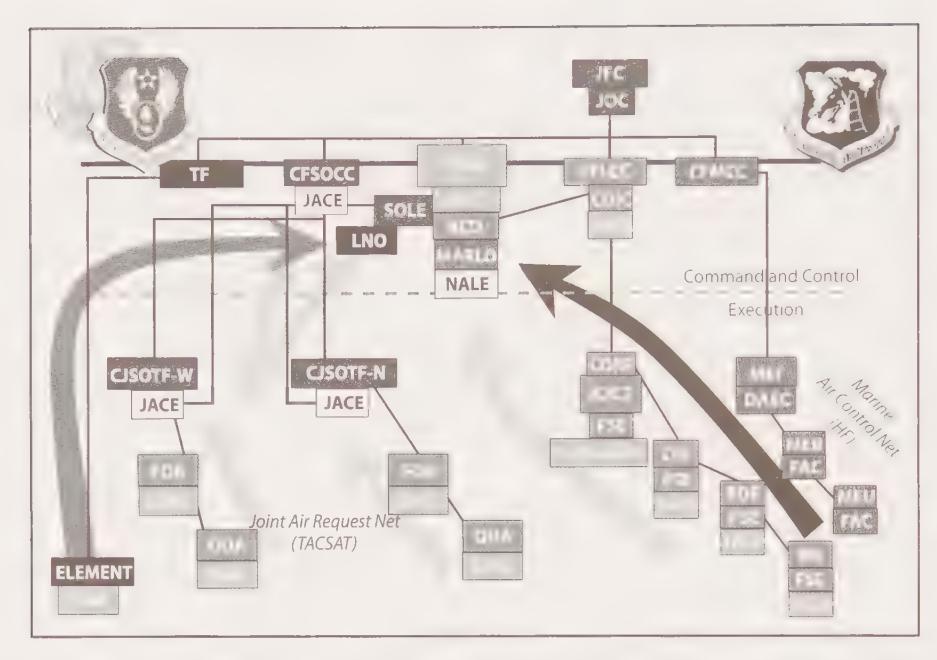
The joint-fires chapter is where the mirroring hypothesis (Conway 1968; Colfer & Baldwin 2016) does real analytic work. Command and control of fires ran through "five disparate and complex service-specific structures" — the Army and Marines each with habitually associated air support centers (two Air Force ASOCs for V Corps; four Marine DASCs, one airborne), the special-operations task forces with their own joint air control element — all performing the same functions with different philosophies. Ground commanders monitored "up to 12 different and incompatible information systems to execute fire support"; the 3rd Infantry Division cleared cross-boundary fires through Marine liaison officers on Iridium phones; V Corps fired three ATACMS missiles without adequate airspace coordination; and most headquarters "defaulted to using Microsoft Office applications and chat rooms" — the informal organization (Mandeles, Ch. 6) silently doing the integration the formal architecture could not. The communication structure of the force reproduced the organizational structure of the services that built it, seam for seam.
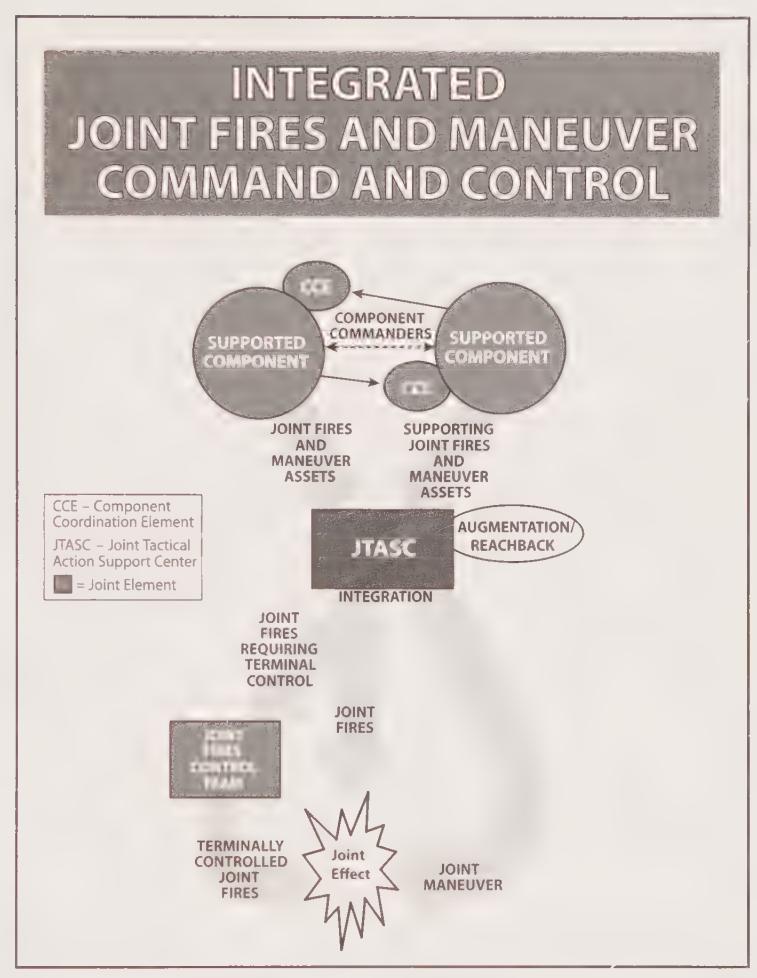
Brown's repairs are, precisely, organizational redesigns intended to force a different architecture — the inverse-Conway maneuver Skelton & Pais (2019) codified. Redefine "joint" itself: not "two or more services," but "operating under a single joint force commander," so all fires supporting joint objectives are joint fires. Put component coordination elements — senior cross-component staff, modeled on the air component coordination element that Operation Iraqi Freedom stood up seven of, from scratch — permanently on every component headquarters. Merge the collocated-but-separate air support operations center and fires cell into a single joint tactical action support center with a standard joint task list, standard communications, and reachback, so any qualified operator of any service can serve in any center. Replace the universal terminal controller (two years to train for the air segment alone; "mile-wide, inch-deep") with a joint fire control team of complementary specialists. Communicate intent through expanded establishing directives in one cross-functional format — Operation Iraqi Freedom's western-desert supported commander never published one, because tactics-techniques-procedures existed and nobody knew an establishing directive was expected — plus prioritized effects lists and effects tasking orders in place of domain-centric air tasking orders. And replace the fire support coordination line, placed 100-plus kilometers beyond doctrine's 30–40 in Iraq because moving it took six hours of coordination against a division covering 350 kilometers in 48 hours, with a standardized three-dimensional common grid (5,000-foot altitude increments) and digitally auto-reshaping no-fire and coordination areas around tracked friendly forces.
Live tension · seams versus overlap
Brown wants to eliminate the seams; Mandeles argues the seams are where errors get caught.
Hold the two sources against each other honestly. Brown's ideal is a "seamless," fully integrated force with minimum essential common systems — and Mandeles warns that removing "policy, jurisdictional, task, and mission overlap" creates monopolies that hide error. The resolution may be layered: Brown standardizes execution interfaces (grids, orders, qualification standards) while his own epistemics stay Mandelesian — he offers the concepts "not the approved solution" but as "tools to stimulate discussion," measures his paper's success by the argument it generates, and channels redesign through the very hypothesis-testing venues Mandeles prizes: Millennium Challenge 02 (13,500 troops), Unified Quest, Pinnacle Impact. Whether execution-layer seamlessness can coexist with development-layer overlap is Question 4 below — not settled here.
Chapter 8 closes the paper by auditing the Air Force Transformation Flight Plan and Army Transformation Roadmap against his concepts — modular AEF/AETF packages and warfighting headquarters on one side, units of action/employment and home-station operations centers on the other — and tabulating synergies against seams: no methodology exists for capabilities-based tradeoffs when composing a joint package; no minimum essential joint communications list; liaison concepts lag the new headquarters (the Army keeps four standing battlefield coordination detachments; the Air Force improvised seven coordination elements in one war); no maneuver-control counterpart to the joint fires system-of-systems. It is Mandeles' argument delivered as a staff paper: the services' parallel transformation road maps will mirror themselves into the next war's seams unless the interaction structure between them is redesigned first.
Seminar discussion
Questions to structure the session's second hour. Each turns on a live tension in the sources; none has a settled answer.
- Can a multiorganizational system be designed, or only permitted? Every successful system in the book was "partly accidental" — no leader designed the aviation or amphibious loops, and the same Navy failed at torpedoes. Mandeles nonetheless insists participation should become "a strategic and deliberate choice." Argue both sides: does deliberately chartering the interaction (with budgets, memberships, reporting lines) collapse the productive rivalry into a single organization with internal divisions — or is the General Board proof that a designed, authority-free forum suffices?
- Where does ambidexterity live? Tushman & O'Reilly locate exploration and exploitation in separate units under one senior team; March warns exploitation crowds out exploration inside any one adaptive system. Mandeles' cases suggest the balance survived only between organizations with independent budgets and identities. Is intra-organizational ambidexterity a stable design, or a temporary truce that lasts until the first budget fight — and what does the Army Air Corps (an exploratory unit that captured its own evaluation function) prove?
- Was Mitchell useful? Mandeles is scathing: stunts, not experiments; assertions, not evidence. Yet Mitchell's public agitation demonstrably forced the Navy's hand — Mandeles records that Mitchell's public attacks changed senior officers' views on creating a Bureau of Aeronautics, and the 1921 bombing tests were run largely because the press took up his challenge. Can a multiorganizational system metabolize a demagogue as a hypothesis generator, and does Posen's civilians-plus-mavericks model of doctrinal change survive Mandeles' reinterpretation of it?
- Seams versus overlap. Brown wants seamless integration; Mandeles wants preserved overlap. Propose a principled boundary: which interfaces should be standardized to invisibility (grids, qualification standards, data links) and which jurisdictional overlaps should be deliberately preserved (competing doctrine centers, parallel experiments, rival program offices)? What happens to error detection when the execution layer becomes so standardized that only one way of fighting remains testable?
- Metrics for exploration. JFCOM scheduled experiments so densely there was no time to learn between them; interwar training competitions produced greased machine guns and gundecked reports; yet Mandeles also says transformation needs no concrete objectives and clear metrics. Design the measurement regime for an experimentation command that resists goal displacement. What do you count, who counts it, and — Wildavsky's question — who can afford to report failure?
- Doctrine as hypothesis, combat as experiment. If doctrinal statements are unverified if-then propositions and operations are the experiments, what is the epistemic status of a victory won by field improvisation — Afghanistan's SOF-airpower combination, the OIF sandstorm week? Brown says serendipitous integration "should be the exception, not the norm." Is that right, or is a force that reliably improvises exactly what an exploration-preserving system produces, with doctrine correctly trailing as codification (Session 03's factory) rather than leading as prophecy?
- Transfer: the transformation office. Cebrowski's Office of Force Transformation was a single organization chartered to produce transformation — on Mandeles' analysis, a category error. Now consider the corporate equivalent: a central "AI transformation office" with a road map, metrics, and a mandate. Using the four-case evidence, specify what such an office could legitimately do (convene, set rules of evidence, fund parallel trials, run the pre-audit) and what it structurally cannot (predict the concept, mandate the culture, substitute for interacting units). What is your firm's General Board?
Synthesis and bridge
What this session establishes and what it sets up.
What we established
Innovation is a property of interacting organizations, not of visionaries or plans — and the machinery is hypothesis generation plus error correction.
Across four cases spanning 140 years, the variable that separated learning from stagnation was the same: a set of organizations with partially overlapping jurisdictions, loosely coupled through argument before an evidence-demanding forum, running wargames, exercises, and tests as experiments against stated expectations. Where the system existed (carrier aviation, amphibious doctrine, CEC), concepts no one predicted emerged and matured; where it did not (the post–Civil War services, the Army Air Corps, the Royal Marines), smart people with correct intuitions produced untested doctrine and unbuilt capabilities. Brown showed the same logic operating inside today's joint-doctrine process — integration achieved by improvisation, codified afterward — and demonstrated that repairing it means redesigning organizational interfaces, not writing better exhortations. The session's warning label: consolidation in the name of efficiency creates monopolies that hide error; the appropriate design question is how to organize so that criticism is structurally unavoidable.
Next session
Session 09: Doctrine for the AI-Native Firm — the transfer.
The seminar's final session asks what all of this buys a designer of contemporary organizations — particularly firms rebuilding themselves around AI. Session 08 supplies the change theory: transformation cannot be commanded from a road map, exploration must be structurally protected from exploitation, and the unit of design is the system of interacting organizations with its rules of evidence. Session 09 assembles the full nine-session argument — doctrine as codified knowledge, C2 as communication design, mission command as delegation under uncertainty, systems thinking as leader cognition, and now multiorganizational error correction — into a doctrine for organizations whose "force structure" is being transformed under them, every fifteen to twenty months rather than years.
Sources and evidence
Every material claim in this lecture traces to these documents.
Primary and secondary sources
The transformation program in its own voice and its auditors'
Figures (extracted from the Walker Paper converted source directory)
Theory cited inline (author-year)