Assigned readings
This session's primary sources are the eight completed session pages themselves — the seminar rereads its own findings before spending them. Add the course synthesis's borrowing rules, the org-theory synthesis that supplies the four-spine frame and names the AI gap, and three canonical theory anchors the transfer map leans on hardest.
Session 01 — The Military as an Organizational Design Problem
Reread the five environmental conditions and the table of bent classical predictions. The conditions are this session's transfer test: every pattern below is licensed by some subset of them.
lecture-01-design-problem.htmlSession 02 — Doctrine as Organizational Memory
Reread the "authoritative but requires judgment" analysis and the Carney closing. The judgment clause — codify to the tacit boundary, label the remainder — is the single most transferable artifact in the corpus.
lecture-02-doctrine-as-memory.htmlSession 03 — The Doctrine Factory
Reread the settled point: process properties are knowledge properties. The staffing latency, veto points, and consensus requirements of your context-revision process determine what your agents can know.
lecture-03-doctrine-factory.htmlSession 04 — Command and Control as Communication Design
Reread the two-topologies argument and the degradation design. NDP 6's bet — reduce the need to process information rather than increase the capacity — is the direct ancestor of intent-based agent tasking.
lecture-04-command-and-control.htmlSession 05 — Mission Command: Decision Rights Under Uncertainty
Reread the command-relationship taxonomy and the incomplete-contract reading of commander's intent. The typed authority menu and the non-delegable responsibility anchor are this session's central command-side transfers.
lecture-05-mission-command.htmlSession 06 — Knowledge Management in the Field
Reread the latency section and the failure modes: unread repositories, canonical-versus-noncanonical practice, acquisition mistaken for absorption. Every one recurs, amplified, in an agent-facing knowledge base.
lecture-06-knowledge-management.htmlSession 07 — The Leader as Systems Thinker
Reread the cognitive-hierarchy discussion and the enemy-in-the-system caveat. The question of which cognitive rungs remain "purely human" is this session's open frontier.
lecture-07-systems-thinking.htmlSession 08 — Transformation: Innovation as a Multi-Organizational Problem
Reread Mandeles' design prescriptions and the seams-versus-overlap tension. The change theory for AI adoption — parallel experiments, rules of evidence, preserved overlap — comes from here.
lecture-08-transformation.htmlCourse synthesis: Military Organizational Properties — Part V and Conclusion
The borrowing rules this session operationalizes: eleven practices worth adopting, eight imports to refuse, and the warning that "copying military appearance without military necessity is usually harmful." Read Part V as this session's null hypothesis.
../01_military_org_properties.mdDepartment of Defense (2022). Summary of the Joint All-Domain Command and Control (JADC2) Strategy
The military's own AI-era C2 doctrine, arriving after the seminar built its transfer map from internal material. Read the Approach and Lines of Effort. It is the institution attempting exactly this session's design — command across all domains at machine tempo, "sense, make sense, and act" inside the adversary's decision cycle — and the real-world test of whether the transfer claims survive contact with the institution running them.
dod_jadc2_strategy_summary_2022.mdDepartment of Defense (2023). Data, Analytics, and Artificial Intelligence Adoption Strategy: Accelerating Decision Advantage
DoD writing AI-adoption doctrine in real time, its stated objective named in the subtitle: decision advantage. Read the Strategic Environment and Key Outcomes. It is the "doctrine for machines" argument made by the institution itself, and its emphasis on decentralized adoption, an AI Hierarchy of Needs, and governance-as-consensus tests Sections 03 and 05 directly.
dod_data_analytics_ai_adoption_strategy_2023.mdDepartment of Defense (2022). Responsible Artificial Intelligence Strategy and Implementation Pathway
The governance-and-trust half of the military's AI turn, built around six tenets — RAI Governance, Warfighter Trust, and the rest. Read the Executive Summary and Tenet 2. It maps onto this session's legitimacy and anti-transfer material: the machinery the Department builds to earn "justified confidence" in AI outputs is exactly what Section 05 argues cannot be borrowed as agent "trust."
dod_responsible_ai_strategy_pathway_2022.mdCongressional Research Service (2022). Joint All-Domain Command and Control (JADC2) (In Focus)
A neutral three-page explainer of the JADC2 concept and its open questions — including who holds cross-domain decision authority and how much human involvement remains. Read it first for orientation; it frames the DoD strategy without the institution's advocacy.
crs_jadc2_in_focus_2022.mdHeadquarters, Department of the Army (2022). FM 3-0, Operations
Capstone Army doctrine metabolizing two decades of change into multidomain operations. Skim the Foreword and the multidomain-operations definition. It is the institution doing at doctrine scale what this session does at seminar scale — folding lessons from Nagorno-Karabakh and Ukraine into a revised operating concept.
army_fm_3_0_operations_2022.mdWalsh, M., et al. (2021). Exploring the Feasibility and Utility of Machine Learning-Assisted Command and Control, Vol. 1 (RAND)
Which C2 tasks can and cannot be delegated to machines — the empirical engagement with Section 04's commander-of-record anchor and permission-bundle argument. Read the Findings and Recommendations.
rand_machine_learning_assisted_c2_vol1_2021.mdWong, J. P., et al. (2025). One Team, One Fight: Insights on Human-Machine Integration for the U.S. Army, Vol. I (RAND)
The organizational obstacles to human-machine integration — the empirical friction the transfer map predicts. Read it as the field report against which Section 05's anti-transfer claims are checked.
rand_one_team_one_fight_hmi_army_2025.mdAlberts, D. S., & Hayes, R. E. (2003). Power to the Edge: Command… Control… in the Information Age
The 2003 information-age org-design argument — push power and information to the edge once bandwidth ceases to bind — now citable in primary voice (shared with Session 05). Read the opening argument: it is the intellectual ancestor of both JADC2's edge empowerment and this session's intent-based agent tasking.
alberts_hayes_power_to_the_edge_2003.mdCourse research synthesis: The Architecture of Organized Knowledge Work (org-theory synthesis)
Read the TL;DR, Key Findings, and Section III. It supplies this session's frame — four orthogonal design spines (decision rights, coordination mechanism, channel design, knowledge architecture) — and names AI-augmented cognition as the classical canon's open gap: the information-processing view assumed human decision-makers with fixed cognitive limits.
../../research/org-theory-synthesis.mdGalbraith, J. R. (1974). Organization design: An information-processing view. Interfaces, 4(3), 28–36.
The seminar's most-used theory returns for the final argument: an organization facing uncertainty either reduces the need to process information or increases the capacity. The AI-native firm faces Galbraith's choice with a new scarce channel — human attention over agent output — and the military's answer, pre-positioned shared understanding, is the one the canon under-develops.
doi.org/10.1287/inte.4.3.28Aghion, P., & Tirole, J. (1997). Formal and real authority in organizations. Journal of Political Economy, 105(1), 1–29. · Hansen, M. T., Nohria, N., & Tierney, T. (1999). What's your strategy for managing knowledge? Harvard Business Review, 77(2), 106–116.
The two theory results the transfer map stresses hardest. Aghion–Tirole: real authority follows information — and the informed party is now sometimes a model. Hansen et al.: codification and personalization are a strategic either/or — and an agent workforce forces the choice in a way no human organization ever faced.
doi.org/10.1086/262063What eight sessions established: the military case on four spines
Before spending the seminar's findings, state them. The military package is one coherent design, legible on the org-theory synthesis's four spines — and the whole of it is selected by five environmental conditions that must be re-audited before any pattern moves.
What has changed since this session was written
The institution has now written its own AI-era doctrine, and it is running this session's experiment for us.
This session first argued the human-AI transfer thesis from the seminar's internal material — the doctrine corpus read as design evidence. Since then the military's own AI-era attempts have arrived: the Joint All-Domain Command and Control (JADC2) Strategy (2022), building command across all domains at machine tempo, and the Data, Analytics, and AI Adoption Strategy (2023), whose stated objective is "decision advantage." The institution is now attempting exactly the design this session reasoned toward — coordinating capable, partly automated action under contested, degraded communication. That converts the transfer map from a thought experiment into a falsifiable prediction: where the institution independently rebuilds the seminar's patterns, the transfer is corroborated; where its strategies collide with Section 05's refusals, the tension is real and worth staging. The CRS explainer supplies the neutral outside view; FM 3-0 (2022) shows the same metabolizing move at doctrine scale, folding two decades of change into multidomain operations.
The seminar's method was set in Session 01: treat doctrine as data — an organization's explicit, reviewed, legally grounded statement of how it intends to stay an organization while an adversary degrades it. Eight sessions of that reading produced one repeated result: classical organization theory survives the military limit only in modified form, and the modifications bend in a consistent direction. The compressed arc:
-
Foundations · Session 01
Structure is environmental logic. Five conditions — intelligent adversary, irreversible failure, self-degradation, coercible membership, political subordination — jointly select the military package. Burns & Stalker's poles fail (the answer is a layered hybrid); Galbraith's capacity branch collapses (channels are attacked, so weight shifts to need-reduction); Lawrence & Lorsch is confirmed and then legislated (Goldwater-Nichols); Thompson's buffering inverts (buffer the coordination capacity, expose the core).
-
Memory and its factory · Sessions 02–03
Doctrine is engineered organizational memory with a marked tacit boundary — and a production function. "Authoritative but requires judgment in application" resolves Hansen's codification-versus-personalization either/or by layering the strategies by knowledge type and labeling the remainder. The memory is manufactured by a consensus machine whose measurable properties — 8–10-month cycles, three rank-tiered review gates, a one-comment veto, 25-page attention budgets — determine what the institution can know and when. Exploration (concepts) is structurally quarantined from exploitation (doctrine).
-
Coordination machinery · Sessions 04–06
Communication, authority, and knowledge are one design. NDP 6's two methods of control are two network topologies mapped to Galbraith's two strategies; commander's intent is pre-loaded common ground that lets lean orders do rich work; JP 1's authority taxonomy is a standardized menu of formal-authority contracts with a non-delegable responsibility anchor, and mission command deliberately transfers real authority to the informed on-scene actor. Beneath it all runs a working KM system whose binding constraint is write-latency and whose failure modes — unread repositories, canonical-versus-noncanonical drift — are the classical KM literature made flesh.
-
Cognition and change · Sessions 07–08
The design assumes cognition it may only select for, and changes only through interacting organizations. TR 1420 specifies the systems-thinking capability the whole structure presumes — and documents a training pipeline too thin to guarantee it. Mandeles shows that successful transformation was never commanded from a road map: it emerged from sets of organizations with overlapping jurisdictions, arguing before evidence-demanding forums, running operations as experiments against stated expectations.
Sound organization should provide for unity of command, centralized planning and direction, and decentralized execution. Unity of effort is necessary for effectiveness and efficiency. Centralized planning and direction is essential for controlling and coordinating the efforts of the forces. Decentralized execution is essential because no one commander can control the detailed actions of a large number of units or individuals.
Now place the findings on the four spines the org-theory synthesis identifies as the cleanest orthogonal design dimensions. This is the seminar's answer sheet, and the left column of every transfer below:
| Design spine | What the military case showed | The design principle extracted |
|---|---|---|
| 1 · Distribution of decision rights |
A typed, nested menu of formal-authority bundles (COCOM, OPCON, TACON, support), each defined by its exclusions and delegation rules; responsibility non-delegable even when authority is delegated; mission command as the deliberate transfer of real authority to the informed actor, bounded by documented intent, ROE, and law. Sessions 01, 05 |
Keep formal authority and accountability anchored; push real authority to where the information is; write the grant, its exclusions, and its renegotiation protocol down in advance. Aghion–Tirole, run on purpose |
| 2 · Coordination mechanism |
Standardize interfaces — terminology, formats, command relationships, qualification standards — precisely so that execution can decentralize into disciplined mutual adjustment. Doctrine standardizes terminology, relationships, and processes to free commanders "to focus their efforts on solving strategic, operational, and tactical problems" (JP 1, ch. I); the escape clause prices deviation instead of forbidding it. Sessions 01–03 |
Standardize what must be predictable so agents can improvise where adaptation is necessary. Mintzberg's mechanisms are layered by knowledge type, not chosen once. Interfaces tight, methods loose |
| 3 · Communication-channel design |
Two methods of control are two topologies: detailed control is the wheel network (vertical flow, single point of failure), mission control the all-channel (horizontal flow, robust). The doctrine bets on reducing the need to process information — intent, doctrine, drills pre-position understanding — because capacity depends on channels the adversary can cut. Dispersal, redundancy, and a network you can deliberately switch off complete the design. Session 04 |
Design the channel system for its degraded state, not its nominal state; pre-load common ground so lean messages carry rich meaning when the rich channel is gone. Galbraith's need-reduction branch |
| 4 · Knowledge / memory architecture |
A four-century stratified archive — capstone philosophy to torpedo maintenance — with an authority gradient, a marked tacit boundary, a consensus-driven production factory, a formal lessons loop (AAR → CALL/NLLIS → doctrine revision → training), fast provisional channels (TACMEMOs, handbooks) time-boxed against the slow canonical core, and write-latency of 18 months to 5 years as the binding constraint. Sessions 02, 03, 06 |
Treat the knowledge base as a governed system: owned, versioned, layered by update speed, revised through a loop that routes field experience back into the canonical artifacts — and honest about where the artifacts stop working. Memory with a maintenance schedule |
The transfer question is now precise. The synthesis's Part V warns that borrowing is legitimate only where the borrowing organization faces the conditions that made the practice necessary. So audit the five conditions against the AI-native firm — an organization whose work is increasingly executed by capable, semi-autonomous software agents — before touching the patterns:
Condition 1 · Adversarial — partial
The opponent targets the channel, sometimes
Most firms face market competition, not an opponent attacking their structure. But agent-facing channels are genuinely contested: prompt injection, data poisoning, and adversarial inputs attack the agent's context the way electronic warfare attacks a radio net. The condition holds at the interface, not across the organization — which bounds how much C2W-style paranoia transfers.
Condition 2 · Irreversible — holds where agents act
Errors are consequential
An agent that writes to production, moves money, contacts customers, or deletes data can produce outcomes no rollback recalls. Where agent actions are cheap to attempt and hard to reverse, the military's speed-with-restraint problem — and its graduated-control answer — applies directly.
Condition 3 · Self-degrading — holds, transposed
Degraded communication is the steady state
The military designs for the exceptional moment when leaders are unreachable. The AI-native firm lives there permanently: sessions end and context evaporates; the human principal is offline while agents run; supervision is intermittent by construction. Every agent session is a total personnel rotation. Degradation is not the contingency — it is the operating condition.
Conditions 4–5 · Absent
No coercible membership, no political subordination
Employees retain the right of withdrawal the soldier surrenders; the firm answers to markets and regulators, not to civilian control of state force. These two conditions generated the military's legitimacy, trust, and obedience machinery — which is why Section 05 refuses those transfers. Their absence is stated in text, not just color: this is where the analogy must stop.
Transfer I: knowledge architecture for colleagues who cannot attend the wardroom
The deepest transfer is forced codification. An agent absorbs no culture, joins no community of practice, and remembers nothing across sessions except what the artifacts carry. The military's answer to mass rotation — engineered, layered, governed memory — becomes not one option among two but the load-bearing design.
Session 02 established that the military straddles Hansen, Nohria & Tierney's (1999) either/or by layering codification and personalization by knowledge type — and Session 06 showed the personalization half is real machinery: wardrooms, the Chiefs' Mess, embedded lessons representatives, commander apprenticeship. For an agent workforce, that half largely does not exist. In Walsh & Ungson's (1991) retention-bin terms, an agent arrives at each session with the individuals bin empty and the culture bin inaccessible; everything it will know about your organization must be carried by the transformations bin — explicit, transmissible artifacts — or already internalized in the model's weights. Nonaka & Takeuchi's (1995) socialization channel, tacit-to-tacit transfer through shared experience, has no agent analogue; what remains of their spiral is externalization and combination (write the knowledge down, structure it) and a machine version of internalization (training and fine-tuning, which bake artifacts into dispositions). That is why the seminar's proof-of-function story reads today like a design specification for AI organizations:
But to me, in retrospect, the vital and important thing is that … all of those separated commanders were thinking in sufficiently like terms to construct a mosaic of tactical victories fitting together into a greater mural of strategic victory which effectively terminated Japanese sea power. There were gaps in communications and gaps in mutual understandings among the commanders, but the great principles of sea power had been inculcated in all of those commanders and were literally second nature to them, so that even without authoritative coordinating command, they instinctively moved in directions which were basically sound.
Carney names the two load paths an AI-native firm actually has. Knowledge can be made "second nature" — internalized into the model through training, the analogue of years of professional formation — or it can be issued as context at session start, the analogue of the pre-battle briefing and the doctrine library carried aboard. Both paths run through explicit artifacts, and the military's doctrine hierarchy is the most battle-tested design for organizing them. The mapping is close enough to draw lane by lane:
Military artifact
JP 1, NDP 1: who we are, what we are for, the values and constraints that bind everything below. Changes rarely; signed at the top.
Property to preserve
Precedence — joint doctrine over Service doctrine — and a stated authority gradient: lower layers must be consistent with higher ones.
AI-native artifact
The organization-level charter an agent always receives: mission, values, hard constraints, unacceptable outcomes. The system-prompt stratum — versioned, owned, slow to change.
Military artifact
Keystone publications (JP 5-0, NWPs): how the organization plans, decides, and coordinates. "Authoritative but requires judgment in application."
Property to preserve
The judgment clause as an interface contract: the document states where it stops working and assigns the residual to the practitioner.
AI-native artifact
Domain and team context files: decision rules, escalation criteria, coordination conventions — carrying an explicit escape clause that tells the agent when to stop following the document and surface the situation.
Military artifact
NTTPs, technical manuals, EOSS casualty procedures: absolute where the task recurs identically; no judgment clause needed at the bottom of the stack.
Property to preserve
Codification gradient: tolerance for deviation shrinks as tasks become procedural and safety-critical.
AI-native artifact
Runbooks, tool schemas, API contracts, output formats — the layer where standardization is total and agent improvisation is a bug, not initiative.
Military artifact
Concepts stamped "DRAFT — NOT FOR IMPLEMENTATION"; TACMEMOs that self-cancel at ~24 months unless validated into doctrine.
Property to preserve
Exploration quarantined from exploitation (March 1991): speculation must not silently harden into settled practice, and TRADOC even polices the verb tense that separates them.
AI-native artifact
Time-boxed provisional context: experimental guidance labeled as such, carrying an expiry date and an evaluation obligation — promoted to the canonical layers only after validation, deleted otherwise.
Two more knowledge-side transfers follow from Sessions 03 and 06, and both are about process rather than content. First, the doctrine factory's settled point — process properties are knowledge properties — applies without modification: the latency of your context-revision process is the staleness of your agents' knowledge; the review gates determine whose experience gets encoded; where consensus fails, the disagreement ships as ambiguity that every agent inherits. An organization that lets anyone edit the agent-facing context has no authority gradient; one that routes every edit through a quarterly committee has rebuilt the 18-month revision cycle that Session 06's maps called a losing race against operational tempo. The military's answer is stratification by update speed — Doctrine 2015 deliberately separated fast-changing techniques from stable principles so the two could revise on different clocks — and that is the correct answer for context architecture too. Second, the lessons-learned loop transfers as the post-run review: the AAR's four questions (what was expected, what happened, why, what changes) applied to agent transcripts, with the Navy debrief's routing rule attached — was the deviation operator error, or is the doctrine itself flawed? For agents: was the failure a task-specification error, a context error, or a model limitation? Each answer routes to a different fix — the prompt, the canonical artifact, or the model choice — exactly as DOTMLPF-P forces a military fix to consider doctrine, training, and organization before materiel. And Session 06's warning travels whole: ninety thousand stored lessons are evidence of acquisition, not absorption. A transcript archive is not a learning loop until validated diffs land in the artifacts agents actually receive.
This is where the seminar's synthetic argument meets the institution's own hand. The DoD Data, Analytics, and AI Adoption Strategy (2023) is doctrine for machines written in real time, and it independently reaches for the same design vocabulary this section derived. Its governing metaphor — "value data as a product," managed by "data domain owners and data product teams" rather than a central authority — is the authority-gradient-with-ownership the section prescribes for agent-facing context; its "AI Hierarchy of Needs," which places quality data at the base and reaches Responsible AI only at the apex, is the same layered stack the doctrine hierarchy taught, redrawn for a data-and-model force. And its founding conviction restates the seminar's premise in the institution's voice:
The Department leverages these strengths by distributing authority, empowering leaders in our All-Volunteer Force to innovate at the edge and apply their own judgment to combine old and new capabilities into superior operational concepts. The latest advancements in data, analytics, and artificial intelligence (AI) technologies enable leaders to make better decisions faster, from the boardroom to the battlefield.
Note what the strategy does not claim. It insists the AI turn "depends on our people," and the judgment it distributes to "the edge" is still human judgment; the technologies "enable leaders to make better decisions," they do not replace the leader. Read against Section 05's blocking constraint, that is corroboration, not tension: the institution writing the most aggressive AI-adoption doctrine in the world still seats judgment in a human. The genuine collision — its simultaneous pursuit of machine speed and decision advantage "at the speed of relevance" — is staged in Section 05, where the seminar's whole evidence base weighs against removing the human from the judgment seat.
The price of memory the whole institution has signed (Session 03). The transfer question: which of your agent-facing artifacts deserve this consensus cost, and which need the fast channel.
Exploration with an expiry date (Session 06). Provisional agent guidance without an expiry date silently becomes doctrine — the failure the time-box exists to prevent.
An explicit attention budget (Session 03). The agent analogue is the context window: compression for absorption is a design discipline, not a limitation to lament.
The scale at which storage stops being learning (Session 06). Retrieval, tagging to a task taxonomy, and boundary-spanning humans made it usable; volume alone did not.
Transfer II: command architecture for semi-autonomous agents
The command-side transfers answer one question: how does a bounded human principal direct capable agents it cannot continuously supervise? The military's answer — intent as incomplete contract, typed authority bundles, control regimes matched to task, degradation designed in — maps onto agent operations with uncomfortable precision.
Start where Session 05 ended. JP 1's mission-type order is a textbook incomplete contract: it directs a subordinate to perform a task without specifying how, transmits the what and the why, and assigns the residual decision rights over method as work, not permission. The clause that governs the states of the world the order cannot enumerate is commander's intent:
Commander's intent represents a unifying idea that allows decentralized execution within centralized, overarching guidance. It is a clear and concise expression of the purpose of the operation and the military end state. It provides focus to the staff and helps subordinate and supporting commanders take actions to achieve the military end state without further orders, even when operations do not unfold as planned.
Translate clause by clause and you have the specification for an agent task document. "Purpose of the operation and end state": the task's why and its success condition, stated so the agent can re-derive correct action when the situation moves — not a step list that becomes obsolete at the first surprise. "Without further orders": the document must anticipate the human's absence, because the human will be absent; an agent blocked on approval for every deviation is Session 01's permission-seeking failure mode, automated. And JP 1's five-part mission grammar — who, what, when, where, why, with how conspicuously missing — is a better prompt template than most prompt-engineering guides, for the reason Session 01 identified: a subordinate holding only a task must ask for new orders when circumstances change; one holding task-plus-purpose can act. The renegotiation protocol transfers too: JP 1 requires that any departure from the plan be coordinated in advance if possible and reported "as soon as practicable" afterward — deviation priced as a reporting obligation, not forbidden. An agent framework that implements exactly this — act within intent, log departures, surface them at the next contact — has imported the doctrine's actual mechanism rather than its vocabulary.
Session 05's second export is the authority taxonomy. JP 1 refuses to treat delegation as one bit; it maintains a menu of standardized bundles, each defined by its exclusions — and an agent platform needs precisely this resolution. The anchor transfers first and matters most: commanders "may not absolve themselves of the responsibility" for delegated missions. Authority can be handed to an agent; responsibility cannot. Every agent action needs a commander of record — a human whose accountability survives the delegation — which is the military's constitutional answer to the accountability vacuum that fully autonomous systems otherwise create. Below the anchor, the graduated bundles map naturally: standing broad grants over an owned domain (assignment under OPCON-like authority); narrow, borrowed capability for one task without institutional obligations (TACON — the agent may direct this workflow but cannot reorganize the systems it touches); a deliberately vague support relationship disciplined by an establishing directive — ends specified by the requesting side, means retained by the providing side — for agent teams serving other teams; and consultation rights without decision rights (coordinating authority) for agents that advise but may not compel. The design rule underneath: standardize the contract forms so grants are legible and transfers cheap, and state the exclusions, because what OPCON does not include is what makes it safe to give.
The seminar reasoned to that menu from JP 1 and organizational theory. The institution has since reached the same design under load — and named it in almost the seminar's own words. Confronting AI and machine speed in its own C2 doctrine, the JADC2 Strategy's human-enterprise line of effort concludes that automation forces the authority contracts to be written and packaged in advance:
LOE 2 has a specific focus on human performance in C2 capabilities and addresses the use of innovative Artificial Intelligence and Machine Learning tools. Such innovations, in turn, will drive the need to produce predetermined, pre-approved, event-driven, bundled authorities that enable rapid, relevant decision-making from the strategic level to the tactical edge.
"Predetermined, pre-approved, event-driven, bundled authorities" is the permission-bundle argument arrived at independently, and its logic sharpens the transfer. The military's driver is machine tempo — action must fire faster than a human can be consulted, so the authority must be packaged and granted ex ante, exactly as an agent's tool permissions and escalation thresholds must be set before the run, not adjudicated mid-task. Yet JADC2's authorities still bottom out where Section 04 insisted they must: in a human Joint Force Commander who owns the outcome. RAND's study of machine-learning-assisted C2 (2021) works the same seam empirically — which C2 tasks can responsibly be delegated to a machine, and which must stay with the commander of record — and the deeper lineage is Alberts and Hayes's 2003 "power to the edge," which argued two decades early that once bandwidth stops binding, both authority and information should move outward to the edge: the org-design ancestor of JADC2's bundled edge authorities and of this session's intent-based agent tasking alike.
The third export is the control-regime choice, and here the seminar's most quoted sentence earns its place one last time:
Command by direction and command by planning seek to eliminate uncertainty. In contrast, mission command seeks to reduce the need for certainty.
Detailed control · the wheel network
Step-approved agents: right where errors are irreversible
Explicit instructions, human approval at each step, vertical information flow. This is command by direction for agents — and NDP 6 assigns its domain precisely: "specific, precise tasks of a procedural or technical nature," and the catastrophic-error cases the Navy itself exempts from mission command (nuclear release). The agent analogues are enumerable: destructive writes, external communications, financial commitments, credential changes. Its cost is also the doctrine's: the human is the single point of failure, and throughput collapses to the speed of the approval channel.
Mission control · the all-channel network
Intent-tasked agents: right where tempo and complexity dominate
Succinct orders, pre-loaded purpose, lateral coordination among agents, the human informed rather than consulted. This is command by influence — and its robustness claim transfers literally: a system coordinated by pre-positioned intent "is much less vulnerable to disruption" than one coordinated by live instruction, because it keeps working while the human sleeps. Its precondition also transfers literally: grounding. Lean orders do rich work only where common ground was installed in advance (Clark & Brennan 1991) — which for agents means the context architecture of Section 03, plus evaluation evidence that this model actually construes this organization's intent correctly. Lee's order to Ewell failed for want of shared code; an intent document handed to an ungrounded model fails the same way, at scale.
Finally, the degradation design of Session 04 — the part of C2 doctrine written for the moment the channel dies — becomes the agent platform's fallback architecture. Pre-scripted succession ("interim command will pass to the deputy commander," then to the next eligible officer, automatically) becomes the default-rule ladder that operates when the human is unreachable: proceed within intent for reversible actions; act and report for the time-critical middle; queue for review where stakes rise; halt only at the enumerated detailed-control boundary. NDP 6's information-quality ordering licenses the middle rungs: timeliness and relevance outrank completeness and precision, and "incomplete or imprecise information is better than no information at all" — a doctrinal warrant for acting on partial knowledge that any agent-autonomy policy must either adopt or consciously reject, domain by domain. Even the network-optional principle transfers: NDP 1 (2020) contemplates commanders who "purposely not use the network … to reduce force signature," and a well-designed agent system similarly treats the human-approval channel as a resource to be spent where it buys the most safety, not a reflex — because a principal interrupted for everything reviews nothing well. That is Aghion & Tirole's overload result, and Session 05's warning: formal authority over everything converges to real authority over nothing. Here again the institution's AI-era doctrine corroborates the transfer rather than complicating it: the JADC2 Strategy's own "Act" function insists subordinate commanders be "empowered with the tenets of Mission Command" precisely so they retain "the ability to act when communications linkages are broken" — the degraded state designed for, not exceptioned away, exactly as this session argued the AI-native firm must treat the vanishing human. One caution closes the section: Session 05 also documented that every advance in communications technology precipitates a centralizing trend, and agent platforms offer the most complete surveillance any commander has ever had — full transcripts of every subordinate's every step. Whether total observability re-centralizes real authority and reproduces detailed control under a mission-command vocabulary is discussion question five, and the Navy's two centuries of relapses suggest the pull will be constant.
The anti-transfer: where the analogy breaks
The course synthesis's Part V is the seminar's own warning label, and it binds this session most of all: the patterns above are licensed by conditions 1–3; the machinery below was built for conditions 4–5, which the AI-native firm does not face — and for human beings, which its agents are not.
A technology company does not become more effective because executives call themselves commanders and employees “troops.” It becomes more military-like in a useful sense only when it develops clearer purpose, distributed execution, resilience, disciplined learning and responsibility.
The synthesis's refusal list — unquestioning deference to rank, command language for ordinary disagreements, excessive secrecy, forced conformity, punitive responses to good-faith dissent, mission rhetoric justifying chronic overwork — is not a list of military vices. It is a list of practices that are rational under conditions the firm lacks and corrosive without them. The AI-native translation adds a second, subtler failure class: patterns that transfer badly not because the firm lacks the conditions but because the agents lack the properties the pattern was designed around. The military's design is saturated with the moral facts of ordering mortal, morally responsible humans into danger; agents have no mortality, no moral standing, and no stake in legitimacy. Machinery built to manage those facts does not translate — it parodies.
Break 1 · Mission primacy without coercible membership
The lexical ordering is illegitimate here
The military ranks mission above preservation of the force because condition 4 — members ordered into danger under a legitimacy the state supplies — is offset by law, ethics, and civilian control. A firm importing "the mission comes first" imports the ordering without the offsetting machinery; the synthesis names the result: mission rhetoric used to justify chronic overwork. For human employees the correct ordering remains the civilian one. For agents, "preservation of the force" is a cost line, and pretending otherwise is theater.
Break 2 · Trust machinery aimed at things that cannot be trusted
The tenth tenet has no agent analogue
JP 1's mutual trust — "demonstrated competence, and planning and training together" — is relational capital between morally responsible persons; Edmondson's (1999) psychological safety governs whether humans risk speaking up. An agent has no career, no shame, no fear of blame; "trust" in a model is a calibration statistic maintained by evaluation, and "psychological safety" for it is a category error. The transferable residue is real but narrow: humans reviewing agent output need genuine psychological safety to report failures honestly — the safety machinery applies to the human loop around the agents, never to the agents.
Break 3 · The error-forgiveness asymmetry inverts
Fault inaction less than error — for humans only
NDP 1's norm — a subordinate who errs in judgment is faulted less than one who fails to act — subsidizes initiative because human initiative under fire is scarce, costly, and morally weighty. Agent action is cheap, parallel, and tireless; the scarcity runs the other way. For irreversible agent actions the subsidy must invert: the design should make not acting the default at the enumerated boundary, exactly as the military itself excepts nuclear release from mission command. Copying the asymmetry into agent policy because it sounds empowering is importing a solution to the opposite problem.
Break 4 · Obedience without a legal chain
Agent compliance is not lawful obedience
Military obedience is owed to lawful authority through a legal chain, bounded by the duty to refuse unlawful orders and enforced by accountability that runs in both directions. An agent's instruction-following has none of this structure: no legal personhood, no duty of refusal it can own, no accountability it can bear. What transfers is the anchor from Section 04 — responsibility stays with the human commander of record — and what must not transfer is the fiction that instruction-following constitutes the disciplined, ethically bounded obedience the military spent centuries constructing. Condition 5's civilian-control analogue (regulation, governance) constrains the firm, not the agent.
Break 5 · Secrecy without an adversary
Compartmentation where condition 1 is weak
Classification, need-to-know, and emission control are priced against an opponent who exploits disclosure. Where the adversarial condition holds only at the agent interface (injection, poisoning), the correct import is input hygiene and least-privilege tool grants — not organizational secrecy. Session 01's paradox 3 names the failure mode waiting for over-importers: "a force that protects information from itself more successfully than from its adversary," which for an agent organization means context so compartmented the agents are ignorant by design.
Break 6 · Ceremony
Doctrine as legitimating myth
Meyer & Rowan (1977) predict organizations adopt structures for legitimacy and decouple them from practice — and the seminar found the military itself not immune: capstone documents that argue "upward" toward funders (Session 02), a doctrine library the digital-native sailor will not open (Session 06), manuals preaching decentralization while garrison culture trains permission-seeking. The AI-native version is already visible: the "AI doctrine" binder written for the board, unread by the people who write the prompts, mirrored nowhere in what agents actually receive. The detection test is Session 06's: compare canonical practice to noncanonical — what the artifacts say against what the transcripts show.
Collision · where the institution's AI-era strategies meet this section
The DoD strategies press exactly on the two refusals Section 05 draws hardest.
The confirmations in Sections 03–04 were the easy case. Two genuine tensions remain, and honesty requires staging them rather than reconciling them. First, tempo versus the judgment seat. The JADC2 Strategy aims to "act inside an adversary's decision cycle" and to run "automatic machine-to-machine transactions" that "extract, consolidate and process massive amounts of data … directly from the sensing infrastructure"; the Adoption Strategy chases decision advantage "at the speed of relevance." Machine tempo is the whole point — and it is precisely the pressure that pushes the human out of the loop the blocking constraint below says must hold. The institution's answer, so far, is to keep a commander of record; whether that survives the tempo it is itself demanding is unresolved, in the doctrine and in the transfer. Second, "trust" applied to the machine. The Responsible AI Strategy exists so that "warfighters, and leaders can trust the outputs of DoD AI capabilities" and commits to AI that is "responsible, equitable, traceable, reliable, and governable." Read against Break 2, that phrasing collides with the seminar's claim that trust in a model is a calibration statistic, not relational capital — yet the collision is instructive, not fatal: the document itself splits the concept, making Warfighter Trust (a human tenet, aimed at "justified confidence") a separate thing from the machinery of assurance and governance that makes a model reliable. That split is Section 05's distinction, drawn by the institution: the trust is the human's; what the model earns is verification. RAND's field study of Army human-machine integration (2025) reports the organizational friction this predicts — the obstacles are not the machines but the human and institutional loop around them, exactly where the transferable residue was said to live.
Blocking issue · the straddle cannot be copied whole
Full autonomy deletes the escape valve the design depends on.
The military's knowledge system works because the judgment clause assigns the tacit remainder — everything the documents cannot carry — to a trained human who is always present at the point of use. Hansen's straddle holds there because the personalization half is real. An AI-native firm that pushes toward full autonomy removes the human from the point of use, and with it the place where the residual has always lived. The choice is stark and should be made explicitly: either keep a human in the judgment seat for consequential decisions (the commander of record, holding the escape clause), or accept that the codified layer must carry everything — which the seminar's entire evidence base, from "authoritative but requires judgment" to the CTC failure vignettes, says no codified layer ever has. This is a blocking design constraint, not a tuning parameter.
Open research questions: the seminar's exit
The org-theory synthesis names AI-augmented cognition as the classical canon's open gap: the information-processing view assumed human decision-makers with fixed cognitive limits, and generative AI "alters both processing capacity and the tacit/explicit boundary." The seminar ends by stating what it cannot yet answer — as questions precise enough to research.
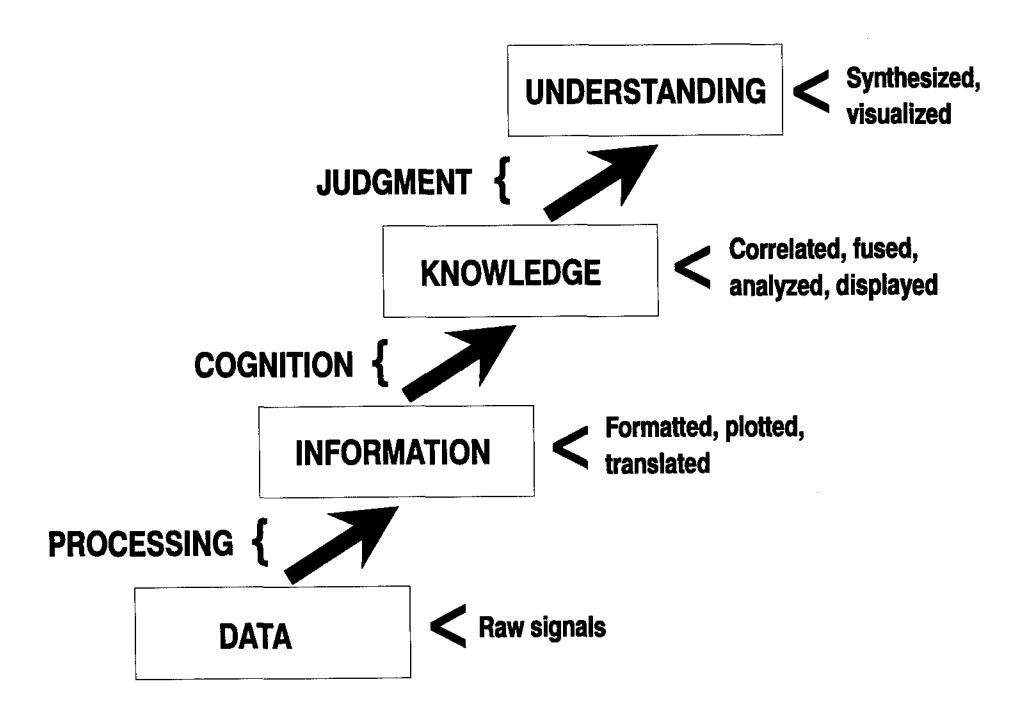
The military corpus itself marks the frontier. NDP 6 (1996) built its cognitive hierarchy — data, information, knowledge, understanding — and reserved the top transition to "judgment, a purely human skill," noting that automated systems "play a very limited role at present in generating understanding." That hedge, "at present," is now thirty years old, and every question below is some version of asking which rungs the machine has climbed since — and what the organizational design must do about it.
Open question 1 · Authority theory
Does real authority follow information when the informed party is a model?
Aghion & Tirole's result assumed agents with careers, incentives, and private information worth trusting. When the best-informed actor in a decision is a model whose "initiative" is a sampling parameter and whose reliability is a measured distribution, what disciplines the delegation? The seminar's candidate answer — evaluation evidence replaces relational trust; the delegation dial is set by measured calibration per task class — is a research program, not a finding.
Open question 2 · The judgment clause
Where does "requires judgment in application" live in a human-AI stack?
Session 02 read the clause as the institution's marker for the tacit boundary. If parts of judgment become machine-performable, the boundary moves — but who moves it, on what evidence, and how is it written into the artifacts? A doctrine for AI-native firms needs the equivalent of the 2020 revision that sharpened the clause ("authoritative but not prescriptive"): a governed, versioned statement of which decisions the artifacts may settle and which must surface to the commander of record.
Open question 3 · Memory without individuals
Can an organization learn when its members do not persist?
Walsh & Ungson's individuals bin is empty at every agent session start; the AAR's "what will we do next time" has no we that remembers. The lessons loop must close entirely through artifacts and weights — organizational memory with no individual memory beneath it. Whether the full loop (observe, validate, revise canon, verify absorption) can run at agent tempo without the human boundary-spanners the Navy embeds at every fleet is unknown; Session 06 predicts the validation stage, not the storage, will bind.
Open question 4 · Doctrine cycle time
What is the revision clock when the force structure changes every model generation?
Session 08 found transformations arriving every fifteen to twenty years and doctrine revising in eighteen months to five; the AI-native firm's "force structure" — model capabilities — turns over in months. Is the answer stratified update speeds pushed to their limit (stable capstone, fast provisional layer, TACMEMO-style expiry everywhere), or does validated doctrine become impossible below some cycle time, leaving only Mandeles' alternative: organize to correct errors rather than to predict?
Open question 5 · Requisite variety inverted
What does supervision mean when the subordinate's variety exceeds the supervisor's?
TR 1420 worried that leaders cannot match their environment's variety; the agent case inverts it — the principal cannot even read everything the agents produce. Inspection becomes sampling; the observer-controller becomes an evaluation harness; and Ashby's law now runs through the design of the sampling regime. What is the CTC — the instrumented, adversarial, consequence-free training environment — for an organization of agents, and who plays the opposing force?
Open question 6 · The mirror
Does the mirroring hypothesis govern context architecture?
NDP 6 asserted that organizing the force and designing its communication network are one decision; Conway (1968) and Colfer & Baldwin (2016) showed organizations mirror their communication structures into their products. If agent organizations mirror their context architecture — team boundaries reproducing context-file boundaries, seams in the artifacts becoming seams in execution, as Brown's five parallel fires networks mirrored five services — then the inverse-Conway maneuver applies: design the context architecture first, and let the organization form around it. Whether that holds empirically is a dissertation waiting for data.
One excerpt earns the last word before discussion, because it converts the whole seminar into a single design question — and it is the question this session hands to every organization now writing its AI road map:
The appropriate question to ask concerning the organization of national security community is not, "How can we have a more unified and 'efficient' structure?" but, "How can we organize to foster criticism and correct errors?"
Seminar discussion
Questions to structure the session's second hour — and to close the course. Each turns on a live tension in the transfer map; none has a settled answer.
- The conditions audit. Take the organization you brought. Score it honestly against the five conditions: at what intensity does it face an adaptive opponent, irreversible failure, self-degradation, coercible membership, political subordination? Now defend your chosen transfer and your chosen refusal using only the condition scores. Which patterns in Sections 03–04 did your audit just revoke?
- Minimum viable grounding. Commander's intent worked at Trafalgar because grounding was installed by years of indoctrination, and failed at Gettysburg the year the shared code died with Jackson. For a model, what installs the code — the pretraining corpus (a "common professional education" no one designed), fine-tuning, the context stack, or evaluation-driven model selection? Is there a principled test, before delegation, that the agent construes your intent the way Nelson's captains construed his — and what is your Gettysburg detector?
- Who holds the escape clause? Military doctrine binds "except when, in the judgment of the commander, exceptional circumstances dictate otherwise" — and the deviator owns the outcome. Should agent-facing doctrine carry the same clause? If the agent deviates well, who gets the credit; if badly, the commander of record owns it — does that asymmetry make humans write tighter, more detailed-control artifacts, recreating exactly the brittleness mission command exists to avoid?
- The Hansen endgame. The agent workforce forces codification: no wardroom, no Chiefs' Mess, no socialization lane. Does the AI-native firm finally achieve the pure codification strategy Hansen said winners choose — or does the tacit remainder simply relocate into the shrinking human rump, which becomes the organization's binding constraint and single point of failure? What happens to the firm's knowledge architecture when the last person who held the tacit layer leaves?
- Total observability. Every agent action is transcribed; the principal can replay anything. Session 05 documented that every advance in communications technology precipitates a centralizing trend, and the digital COP question asked whether shared visibility destroys the information asymmetry that grounds delegation. Agent platforms are that question at maximum. Design the interruption policy: who may read what, when may the human intervene mid-run, and what standing rule keeps sampling from sliding into detailed control?
- The AAR without blame — or shame. The military separates accountability from learning so that admission of error stays cheap. For agents, "blame" is a gradient update and admission costs nothing — but the humans who wrote the task spec, the context, and the eval are in the room. Does the blameless norm now protect the right people, or does it let context authors off the hook the way ritual AARs let commanders control the narrative? Who, concretely, is accountable when the artifact was wrong?
- Your General Board. Mandeles says transformation offices are a category error: single organizations chartered to produce what only interacting organizations with rules of evidence can produce. Most firms are standing up exactly such an office for AI. Using the four-case evidence, write its charter: what it may do (convene, set rules of evidence, fund parallel pilots against stated expectations, run the pre-audit) and what it structurally cannot (predict the concept, mandate the culture, substitute for the interacting units). What jurisdictional overlap must survive the efficiency review?
- The ceremony test. Meyer & Rowan predict your AI doctrine will decouple from practice while legitimating the firm to boards and markets. Specify the observation that would catch it: which artifact would you diff against which transcript, what gap between canonical and noncanonical practice would count as decoupling, and — the seminar's final discipline — what would convince you that your own transfer map, argued today, is itself the myth?
Synthesis and bridge
What the seminar established, and where it releases you.
What the seminar argued
The military is a two-century field experiment in the design problem AI-native organizations have just acquired.
Coordinating capable, semi-autonomous agents under degraded communication, intermittent supervision, consequential error, and mandatory-explicit knowledge is not a new problem; it is the problem the doctrine corpus was written to solve, and the corpus states its solutions with rationales attached. The transfers that hold: intent as incomplete contract, a typed authority menu under a non-delegable human responsibility anchor, control regimes matched to task risk and reversibility, standardization of interfaces as the platform for improvisation, layered and governed context with a marked tacit boundary and stratified update speeds, post-run reviews that route failures to the artifact that caused them, and change organized as parallel experiment plus error correction rather than road map. The refusals that protect you: everything built for coercible membership, political subordination, and the moral standing of human subordinates — mission primacy's lexical ordering, the trust and cohesion machinery, the error-forgiveness asymmetry, obedience language, and the ceremonial import of military appearance without military necessity.
The seminar's exit
Return to the syllabus — and reread Session 01 with the transfer map in hand.
The course is a loop, not a line. Session 01 taught you to read an organization's structure as a response to its environment; this session gave you a map for moving structures between environments. The final exercise is to run the loop once more on your own organization: state its five conditions, name the package they select, and check every borrowed pattern against the condition that licenses it. Where the seminar cannot follow — the open questions of Section 06 — is where the research, and the designing, now begins.
Sources and evidence
Every material claim in this lecture traces to these documents. Doctrine excerpts are re-quoted from passages verified against the converted sources by the sessions that own them.
Primary: the seminar's eight session pages
Course documents
Doctrine and monographs re-quoted (verified by owning sessions against converted sources)
The military's own AI-era doctrine (this session's integrated expansion sources)
Theory cited inline (author-year)