Assigned readings
One practitioner primer read in full, four AI-generated research syntheses treated as cross-checking maps of the system rather than as primary documents, and three theory readings that give us the analytic vocabulary. Behind these sits a cluster of Army doctrine and lessons-learned publications — the two editions of ATP 6-01.1 and their 2012 predecessor, the training and after-action-review manuals, and the ARI research reports underneath them — which we mine narrowly in sections 02 and 05 to read the KM process and the AAR as primary doctrine rather than through the maps. A caution on the maps: they were machine-synthesized from public sources and collected into this corpus; the fourth embeds the first nearly verbatim, so they provide at most three independent views, and we flag their factual conflicts explicitly in section 04.
Executing Knowledge Management in Support of Mission Command: A Primer for Senior Leaders (Center for Army Lessons Learned, 2017; circulated as CALL 18-02)
Read all of it, including both appendices. The main body gives the KM definition, objective, four components, and five-step process, plus three failure vignettes drawn from Combat Training Center observations. Appendix A specifies the KM team (commander, chief of staff, KMO, KMRs, KMWG); Appendix B presents the KM Maturity Model. This is the session's core text: the institution's own operating manual for its knowledge system.
../sources/army/army_km_mission_command_primer_2017.mdComprehensive Review of U.S. Navy Doctrine and Knowledge Management (AI research synthesis, corpus copy)
The most document-grounded of the four maps. Read for the Navy Warfare Library taxonomy (NDP, NWP, NTTP, NTRP, FXP, TACMEMO), the TACMEMO mechanism with its 24-month self-cancellation, and the Navy Lessons Learned Program: NLLIS, the annual workshop, embedded fleet representatives, and the "Get Real, Get Better" initiative.
../sources/knowledge_systems/navy_doctrine_km_comprehensive_review.mdThe Architecture of Naval Wisdom (AI research synthesis, corpus copy)
The most analytical map. Read the executive summary and sections 4–8 for the doctrine development lifecycle, the governance architecture (OPNAV N7, NWDC, the Warfighting Development Centers), and the report's central diagnosis: an 18-to-24-month revision cycle racing software-speed warfare, and a "publication-centric" model transitioning to a "knowledge-centric" one under initiatives like High Velocity Learning and Web-Enabled Doctrine.
../sources/knowledge_systems/navy_doctrine_km_system_gemini.mdThe Cognitive Citadel: The US Military's Knowledge Management, Doctrine, and Evolutionary Architecture (AI research synthesis, corpus copy)
The Army-and-joint map. Read sections 1, 5, 7, and 8 for the Doctrine 2015 taxonomy (ADP/FM/ATP separation of principles from techniques), the After Action Review as "the most significant knowledge management invention of the modern US Army," CALL's role, the DOTMLPF-P institutionalization framework, and the digital transformation (Central Army Registry, apps, audiobooks, MilWiki).
../sources/knowledge_systems/us_military_knowledge_and_doctrine_systems.mdNavy Doctrines — US Military Knowledge System (AI research conversation, corpus copy)
A conversation export whose final section embeds the Comprehensive Review nearly verbatim — read it as secondary, for its unique earlier material: the layered-system summary (doctrine, regulatory, training, technical, infrastructure layers) and the deep stack the other maps skip — NAVEDTRA curricula, Personnel Qualification Standards with their Model Managers, Naval Ships' Technical Manuals, and the Engineering Operational Sequencing System.
../sources/knowledge_systems/navy_doctrines_us_military_knowledge_system.mdHansen, M. T., Nohria, N., & Tierney, T. (1999). What's your strategy for managing knowledge? Harvard Business Review, 77(2), 106–116.
The session's central tension. Hansen et al. found successful firms choose either codification (people-to-documents, repository reuse) or personalization (person-to-person tacit transfer), split roughly 80–20, and warned that firms which straddle both tend to fail. The military straddles deliberately and at maximum intensity — our question is whether it is the exception or the confirmation.
hbr.org/1999/03/whats-your-strategy-for-managing-knowledgeWegner, D. M. (1987). Transactive memory: A contemporary analysis of the group mind. In Theories of Group Behavior (pp. 185–208). Lewis, K. (2003). Measuring transactive memory systems in the field. Journal of Applied Psychology, 88(4), 587–604.
Wegner's claim: groups store knowledge as a division of cognitive labor plus a shared directory of who knows what. Lewis operationalizes it with three indicators — specialization, credibility, coordination. Read before section 03: the Army's KM team, battle rosters, terms-of-reference documents, and "expertise location system" line items are a transactive memory system designed on paper.
doi.org/10.1037/0021-9010.88.4.587Brown, J. S., & Duguid, P. (1991). Organizational learning and communities-of-practice. Organization Science, 2(1), 40–57.
The canonical statement (with Lave & Wenger 1991) that knowledge lives in situated practice, not documents — and that "canonical practice" (what the manual says) systematically diverges from "noncanonical practice" (what working communities actually do). Pair with Cohen & Levinthal (1990) on absorptive capacity, cited in the register, for section 05's argument that a lessons repository is not the same thing as learning.
doi.org/10.1287/orsc.2.1.40ATP 6-01.1, Techniques for Effective Knowledge Management (2015) and ATP 6-01.1, Knowledge Management (2024) — the comparison pair
The Army's own KM doctrine, nine years apart. Read only the definition and process chapters of each: the 2015 edition gives each of the five KM steps its own chapter; the 2024 edition collapses them into one process chapter and adds a chapter on learning organizations, interoperability, and change management. We read them side by side in section 02 to see what the KM process kept, dropped, and added over a decade.
../sources/km_cognition/atp_6_01_1_techniques_for_effective_knowledge_management_2015.md ../sources/km_cognition/atp_6_01_1_knowledge_management_2024.mdTC 25-20, A Leader's Guide to After-Action Reviews (1993)
The origin document for the AAR as a structured process, not just a set of questions. Read Chapter 1's planning-and-execution sequence for the four-step loop — plan, prepare, conduct, follow up — that section 05 uses to upgrade the maps' "most significant KM invention" claim to a primary source.
../sources/km_cognition/tc_25_20_leaders_guide_to_after_action_reviews_1993.mdPredecessor and lineage: FM 6-01.1 (2012); FM 7-0 (2021); ARI SR 42 (1999); ARI RR 1998 (2016); CALL 11-33 (2011); CALL 15-11 (2015)
Context titles cited once each where they matter. FM 6-01.1 (2012) is the ATP's direct predecessor — it already framed KM as a five-step process, extending the comparison to three editions. FM 7-0 (2021) is the AAR's current doctrinal home (Appendix K). ARI SR 42 (1999) is the empirical foundation beneath the AAR; ARI RR 1998 (2016) is the learning-organization research the 2024 ATP imports as its maturity model. CALL 11-33 (2011) and CALL 15-11 (2015) document the lessons-learned program and CALL's own services.
The doctrine of knowledge: what the CALL primer actually says
The Army did something unusual: it wrote doctrine about its own knowledge processes, made commanders formally responsible for them, and then published a primer admitting that senior leaders don't know how to use it. The primer's content is a compact, opinionated KM theory — and it is emphatically anti-tool.
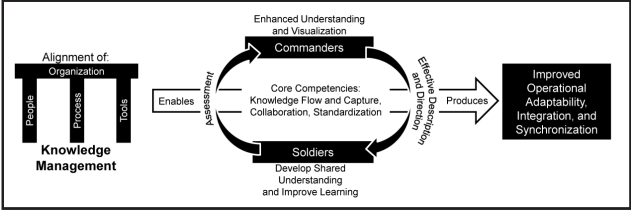
Start with the definitions, because they are load-bearing. Army doctrine (ATP 6-01.1, Techniques for Effective Knowledge Management) defines KM as "the process of enabling knowledge flow to enhance shared understanding, learning, and decision making." The stated objective is a five-part chain: "Getting the right information, to the right people, in the right format, at the right time, in order to arrive at the right decision." KM has four components that must be aligned and balanced — people (those who create, organize, apply, and transfer knowledge, and their leaders), process (the methods of creating, organizing, applying, sharing, and transferring it), tools (digital and non-digital), and organization (the matrix in which the other three function). And KM is executed as a five-step process: assess information flow, design the program, develop the solution, pilot it on a small scale with soldiers, implement it with training and monitoring. The primer's doctrinal anchor is heavier still: conducting KM is one of ADP 6-0's four primary staff tasks, and knowledge management is named as one of the five components of the mission command system itself, alongside people, the operations process, command posts, and the Army's information network. This is the direct continuation of session 05 — decision rights were delegated on the promise of shared understanding, and KM is the machinery that is supposed to produce it.
Knowledge management (KM) has been an important part of Army doctrine for over a decade, and a significant element of mission command for nearly as long. In that time, KM programs have become embedded in Army and Department of Defense organizations at all levels and integral to operational success. Yet, we still find senior Army leaders who are unsure how to employ their KM personnel, and combat units at the Combat Training Centers unable to employ the knowledge management process effectively.
That foreword is the whole session in miniature: a mature, doctrinally mandated KM program, embedded at all levels for a decade — and field observations showing it routinely fails in execution. The primer names three recurring failure areas from the Combat Training Centers and the Mission Command Training Program: units cannot develop and maintain an effective common operational picture, cannot understand critical paths and battle rhythm, and cannot reliably access information across the Army. We return to all three in section 03 with the evidence.
Tension · The anti-tool polemic
"KM is SharePoint" is the failure the doctrine writes against.
The primer devotes striking energy to attacking tool-centrism: "Although tools, especially digital tools, are often misconceived as the primary component of KM, the far more important aspects of KM are the people and the processes they use." It dismisses the industry framing of KM as a subset of Big Data — which "will not solve cultural and manpower issues" and "does not capture, preserve, or analyze tacit knowledge" — and warns that leaders treat KM "as little more than establishing SharePoint in their organizations." In Hansen, Nohria & Tierney's (1999) terms, this is an institution whose official doctrine argues for personalization — knowledge flow between people, tacit knowledge, trust — while its infrastructure investments (portals, repositories, libraries) are almost entirely codification. Hold that contradiction; it is the seminar's core problem.
The primer paraphrases doctrine, but we can read the doctrine itself, and read it across time. The Army rewrote its KM field manual at least three times in a decade — FM 6-01.1, Knowledge Management Operations (2012), then ATP 6-01.1, Techniques for Effective Knowledge Management (2015), then ATP 6-01.1, Knowledge Management (2024) — which gives us a rare thing: a controlled comparison of an institution editing its own definition of knowledge over nine years. The result is striking for how little the core moved. All three editions define KM identically as "the process of enabling knowledge flow to enhance shared understanding, learning, and decision making," carry the same four components (people, processes, tools, organization) and the same five-step process (assess, design, develop, pilot, implement), and repeat the "right information, right people, right format, right time, right decision" objective. The 2012 predecessor already framed KM as that five-step process. The definitional spine is frozen; what changed is the framing around it.
| Element | 2015 — Techniques for Effective Knowledge Management | 2024 — Knowledge Management | Reading |
|---|---|---|---|
| The KM definition | "The process of enabling knowledge flow to enhance shared understanding, learning, and decisionmaking" — sourced to ADRP 6-0. | Word-for-word the same sentence — but sourced to ADP 6-0, and "decisionmaking" respelled "decision making." Kept | The concept is frozen; only its authority citation moved, tracking the ADRP→ADP renumbering under the Doctrine 2015 consolidation. Provenance drifts even when meaning does not. |
| The five-step process | Assess, design, develop, pilot, implement — each step gets its own chapter (Chapters 2–6), with worked scenarios. | The same five steps, collapsed into a single "The Knowledge Management Process" chapter presented as "an iterative cycle." Kept, compressed | Not a change of method — a change of emphasis. Consolidating the how-to frees room for the new material below; the process itself is treated as settled. |
| The four components | People, processes, tools, organization — "must be aligned and balanced." | Identical four components, now called "four common pillars," plus a newly stated set of KM principles. Kept | The anti-tool argument the primer makes is baked in unchanged: tools remain one component of four, never the whole. |
| Learning organizations | Mentioned in passing ("adaptive learning organizations"); no dedicated treatment. | A whole new Chapter 4; ATP 6-01.1 becomes "the proponent for one new term, learning organization." Added | The 2024 edition imports the ARI learning-organization research as its Army Learning Organization Maturity Model (Appendix H) — doctrine absorbing behavioral science. |
| New emphasis areas | — | "Increases emphasis on four key topics: interoperability, change management, learning organizations, and sustaining a KM program." Added | All four are answers to the execution failures section 03 documents — the institution's response to a decade of CTC observations was to write more doctrine. |
The 2024 edition is unusually candid about its own edits, and the candor is the point. Its introduction states plainly what changed — and every addition is a topic the 2015 doctrine's own field record showed it needed:
This version of ATP 6-01.1 has changed from the previous version in several ways. First, it discusses the role KM plays to support the Army, and it articulates a framework for how KM is approached in the Army. It reflects new doctrine to support C2 as discussed in ADP 6-0. It also increases emphasis on four key topics: interoperability, change management, learning organizations, and sustaining a KM program.
Read against the primer, this is the same tension one edition deeper. The definition insists KM is a human process; the 2024 additions — change management, sustaining a program, a validated maturity model — are all attempts to make that human process survive without a heroic commander, exactly the equilibrium problem the primer could not solve. Whether adding doctrine can close a gap that is fundamentally about executing doctrine is left open here; it is discussion question three by another name.
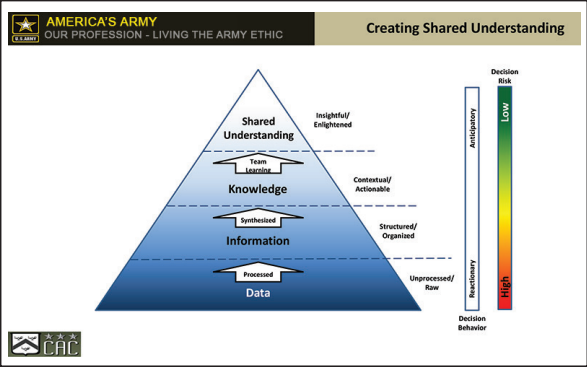
The primer's epistemology is a four-layer ladder — data (unprocessed, raw) → information (processed; structured, organized) → knowledge (synthesized; contextual, actionable) → shared understanding (team learning; insightful) — annotated with a claim about decision quality: as an organization climbs the ladder, decision behavior shifts from reactionary (high risk) to anticipatory (low risk). "There is a direct correlation between decision behavior and risk to shared understanding," the primer states. Seminar veterans will recognize this as the same cognitive hierarchy NDP 6 built in session 04 — the two services codify an identical DIKW-style ladder — but the primer adds the organizational move: the top rung is not individual understanding but shared understanding, produced by team learning. That is Wegner's move too: cognition as a group-level property.
Finally, note who the primer holds responsible. Not the technologists: "Knowledge management is primarily a human process and is heavily dependent on organizational leadership for direction and supervision." The senior leader must function as the organization's "knowledge leader" — understanding KM doctrine, establishing the program, providing knowledge requirements, implementing training, focusing effort "on knowledge processes instead of knowledge tools," and personally using and evaluating the products. The primer is blunt that identifying the commander's own knowledge requirements — a KM reading of the commander's critical information requirements — "often gets lost in the rush to implement technical tools." An organizational theorist should find this simultaneously impressive and alarming: impressive because the doctrine assigns knowledge work a named owner at the top; alarming because a system that only works when the commander personally drives it has no equilibrium behavior — a design question we take up in discussion.
The KM team as an engineered transactive memory system
The Army does not wait for a shared "who knows what" directory to emerge from experience — it staffs one. KMO, KM section, KMRs, KMWG, battle rosters, terms of reference, an expertise location system: Lewis's three TMS indicators, written into a manning document. The CTC evidence shows what happens when the paper structure exists but the transactive system does not.
Wegner (1987) described transactive memory as a group-level memory system built from individual memories plus a shared directory: members specialize, know who holds what expertise, trust each other's domains, and coordinate retrieval. Lewis (2003) measures it by three indicators — specialization, credibility, and coordination. The Army's KM team, specified in the primer's Appendix A, is this structure made explicit. The commander is decision maker and knowledge leader, supplying guidance and intent. The chief of staff or executive officer must "visualize the staff's processes for collecting, analyzing, and transferring knowledge," and ensure the KMO "has visibility of all staff processes and a means to implement change in those processes." The knowledge management officer directs the KM section and functions as a "knowledge catalyst" — the primer insists the successful KMO "must be well grounded in mission command, the operations process, and the military decisionmaking process," while an understanding of technology is "useful, but not critical." Knowledge management representatives sit inside each staff section as developers and "enforcers" of metadata standards and "managers of knowledge flow." The knowledge management working group, chartered by the chief of staff as an extension of the staff, is "the primary venue for the leadership to assess and improve knowledge flow within the organization."
However, there is a continuing problem in that the KMO is often only thought of as "the SharePoint guy." Although technological tools are the most common means of implementing knowledge processes, experience has shown that the successful KMO must be more than a technologist.
Read through Lewis, "the SharePoint guy" is a credibility failure, not a job-description dispute. A transactive memory system only functions if members trust the directory — if the staff believes the KMO's map of who-knows-what and follows the retrieval paths it prescribes. A KMO coded as an IT administrator has no credibility over the operations process, so the directory he maintains goes unused, and each staff section falls back on its private networks. The deeper theoretical problem is that Wegner's and Lewis's TMS develops through shared experience — Liang, Moreland & Argote's (1995) classic finding is that groups trained together outperform groups of individually trained members precisely because training together builds the directory. Army units cannot rely on that: personnel rotate constantly (the primer notes every unit "especially in the early stages of sustainable readiness, experiences problems with untrained or incompletely trained Soldiers"). So the institution writes the directory down — battle rosters, terms-of-reference documents ("a summary of key people within an organization and their specific roles and responsibilities," which "enhances shared understanding regarding roles and responsibilities"), continuity files, an expertise location system. The KM program is an attempt to make transactive memory survive turnover by codifying the transactive layer itself.
Does it work? The primer's own evidence, drawn from Combat Training Center and MCTP observations, says: often not. The three vignettes are worth close reading because each is a different classical failure.
| Failure area | Evidence (as quoted in the primer) | Theoretical reading |
|---|---|---|
| Common operational picture |
MCTP observations, "consistent over several years": "the COP was not effective in contributing to shared understanding during movement or when troops were in contact with the enemy"; units "fail to develop and maintain a COP that allows the commander (and staff) to quickly assess the operational environment." CALL Bulletin 17-05 (2017) |
The shared display exists but shared understanding does not — the codified artifact substitutes for, rather than produces, the transactive layer. The prescribed fix is procedural: the KMWG assesses the knowledge processes that feed the COP. TMS coordination failure |
| Battle rhythm |
"Battle rhythms do not follow a critical path to lead to branches, sequels, or recommendations for commander decisions … As a result, divisions are challenged to achieve the shaping effects desired and are quickly reduced to combat-ineffective ground forces." CALL Bulletin 17-05 (2017) |
Meeting inflation: events accumulate without analysis of what decision each supports. The prescribed fix — the "7-minute drill" or event charter, presented to the chief of staff before an event earns a battle-rhythm slot — is an attention-allocation gate in Simon's sense: rationing the scarcest resource, senior-leader attention. Attention economics |
| Content management |
"Self assessments from the field indicate that a majority of units struggle with content management" — a finding the primer notes mirrors industry, where "less than one in four rated their organization's content management as effective." APQC (2015), as cited in primer |
The retrieval half of organizational memory (Walsh & Ungson 1991): storage without findability. Units succeed only where KMRs actively develop and enforce metadata standards — codification requires ongoing human labor, exactly Hansen's point that a codification strategy is an investment, not an IT purchase. Retention-bin retrieval failure |
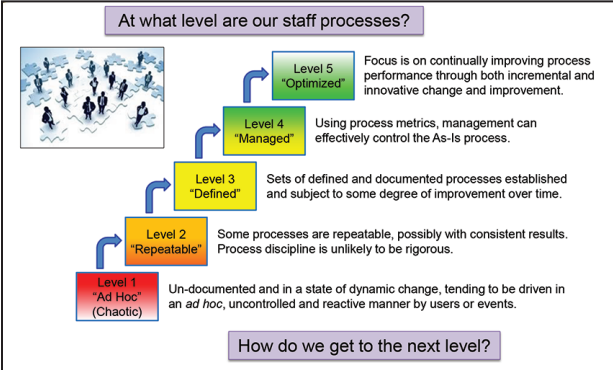
The primer's answer to "how do we even know where we stand" is the Knowledge Management Maturity Model (KM3) — developed from a 2009 Army War College paper, drawing on Carnegie Mellon's and APQC's private-sector maturity models. It defines 42 KM efforts grouped under the four components (people, process, tools, organization/culture), each scored on a 1–5 Likert scale, rolled up into five maturity levels: ad hoc (chaotic), repeatable, defined, managed, optimized. The primer's worked example scores 119 of 210 points — 56.7 percent overall maturity — with the telling detail that tools and culture outscore process. Even the illustrative unit is better at buying tools than at running knowledge processes.
One more institutional detail completes the picture: KM is a credentialed specialty. The Army Knowledge Management Qualification Course awards a Professional Skill Identifier (SI/ASI 1E), and a distance-learning basics course sits on the Army Learning Management System. The institution has professionalized the role of directory-keeper. Whether a transactive memory system can be staffed into existence — rather than grown through shared experience, as the theory says it must — is discussion question two.
The codification machine: library, lifecycle, and the layered stack
Session 03 followed a publication through the doctrine factory. This session maps the warehouse and the loading docks: the Navy Warfare Library's product lines, the governance that maintains them, the repositories that deliver them — and beneath doctrine, the training, qualification, and technical layers where codified knowledge finally reaches hands.
All four maps agree on the skeleton. The Navy Warfare Library (NWL) — governed by its own "manual for manuals," NTRP 1-01 — organizes Navy publications into product lines by function and altitude: NDPs (capstone philosophy; six were conceived in the 1990s, and the maps agree NDP 3, Naval Operations, was never published — the capstone series has a permanent hole), NWPs (keystone operational doctrine, numbered to mirror the joint J-code series: 1 general, 2 intelligence, 3 operations, 4 logistics, 5 planning, 6 C4), NTTPs (tactical how-to for platforms and mission areas), NTRPs (reference data — tables, planning factors, terminology), FXPs (fleet exercise publications), and the agile layer of TACMEMOs, TACBULs, and TACNOTEs. Custody of the whole is federated: OPNAV N7 sets policy; the Navy Warfare Development Center (NWDC) in Norfolk is executive agent, publisher, and approval authority; the Warfighting Development Centers — SMWDC for surface and mine warfare, NAWDC (home of TOPGUN) for aviation, UWDC for undersea, NIWDC for information warfare — serve as Primary Review Authorities so that "a manual on missile defense is written by the experts … who practice it daily, rather than by a generalist staff officer"; fleet and type commanders act as Coordinating Review Authorities who verify the doctrine is physically executable.
TACMEMOs are used to publish developmental tactics for evaluation. They are issued for a specific period of time (normally 24 months) and [are] incorporated into applicable doctrine, TTP, or reference publications when validated.
The TACMEMO deserves a theorist's attention. It is a time-boxed exploration channel in March's (1991) sense: a provisional tactic pushed to the fleet for evaluation, carrying an evaluation plan and a feedback obligation, that self-cancels at roughly 24 months unless validated into permanent doctrine. The design solves the exploration–exploitation problem structurally — experiments cannot silently harden into doctrine, and doctrine cannot silently block experiments — while leaving the slow core untouched. Whether that is organizational ambidexterity or a pressure-release valve that lets the core stay slow is discussion question four.
The lifecycle around the library (per the Architecture of Naval Wisdom map, citing OPNAVINST 3510.17) runs in five phases: assessment and initiation (a validated need produces a Program Directive assigning the PRA and milestones); development and drafting (SME working groups — the map reports that replacing emailed Word drafts with a web-based collaborative review tool cut review timelines "by up to 50%, reducing a 6-week process to under 3 weeks"); critical review by cross-domain CRAs plus legal and security review; approval and promulgation (a NAVPUB general message, upload to the library); and maintenance (urgent changes by message for safety-critical errors; a mandatory periodic review — typically five years — after which an unreviewed publication risks automatic cancellation). Distribution is its own infrastructure: the Navy Doctrine Library System (NDLS), a CAC-gated SharePoint-hosted portal on both unclassified and classified networks, and — because ships fight under emissions control with no connectivity — Collaboration at Sea, which replicates the library onto shipboard servers so "a destroyer operating in the middle of the Pacific, under strict radio silence, still has access to the latest tactical guidance." The Army's parallel machinery: the Army Publishing Directorate authenticates, the Central Army Registry serves as "single source of truth," EPUB formats make manuals reflowable on phones, and doctrine now ships as apps and even audiobooks.
NDP
Capstone philosophy; NDP 1 (2020) tri-signed by Navy, USMC, USCG.
NWP
Keystone operational doctrine, J-code numbered.
NTTP / NTRP / FXP
Tactical how-to, reference data, exercise serials.
TACMEMO
Developmental tactic, ~24-month self-cancel.
TACBUL / TACNOTE / urgent change
Rapid dissemination by message.
Validation or expiry
Folded into NTTP/NWP, or discarded.
NAVEDTRA
Curricula and training-process manuals (M-142 series).
PQS / JQR
Watch-station qualification standards; Model Managers keep them current.
NSTM
Ships' technical manual chapters.
EOSS
Step-by-step plant operating and casualty procedures, maintained as structured XML/SGML documents.
NATOPS / NATIP
Standardized flight and weapons-system procedures.
NDLS / CAR
Authoritative repositories, CAC-gated, NIPR and SIPR.
Collaboration at Sea
Shipboard replication for disconnected operation.
NLLIS / JLLIS
Lessons repositories feeding back into every layer above.
The bottom lanes matter as much as the top. The conversation-export map is the only one that traces knowledge all the way down: doctrine becomes human behavior through NAVEDTRA curricula and Personnel Qualification Standards — "a written compilation of knowledge and skills required to qualify for a watch station" — each PQS maintained by a designated Model Manager command; and it becomes machine behavior through NSTM chapters and the Engineering Operational Sequencing System, whose casualty-control procedures are formalized down to document type definitions. Knowledge flow in this institution is not complete when a publication is promulgated; it is complete when a qualification standard, a curriculum, and a step-by-step plant procedure have all been rewritten to match. In Hansen's terms this is codification pursued to its logical extreme — people-to-documents at every altitude from warfighting philosophy to pump maintenance, with reuse economics to match (write once at NWDC, execute on every ship).
Source discipline · Where the maps conflict
Four maps, three independent views, and real contradictions.
These reports are AI-generated syntheses and must be cross-checked, not trusted. Where they conflict: (1) Revision latency — the Architecture of Naval Wisdom asserts a "standard 18-to-24-month doctrine revision cycle" in its executive summary but a "traditional 3-year doctrine cycle" in its unmanned-systems section, and a mandatory five-year review threshold in its lifecycle section; the Cognitive Citadel gives the Army "3-5 years." Treat the true clock speed as uncertain within 18 months–5 years, varying by publication tier. (2) NWP 5-01 edition — the Comprehensive Review cites December 2013; the conversation export cites May 2021. (3) Naming drift — NLLIS vs. NLLS for the lessons system; Navy Warfare Development "Command" vs. "Center." (4) Independence — the conversation export embeds the Comprehensive Review nearly verbatim, so agreement between those two documents is not corroboration. None of these conflicts undermines the structural picture, which all maps share; all of them illustrate this session's theme — repositories decay, and provenance is a KM problem even for documents about KM.
The lessons-learned loop: intake, validation, and absorptive capacity
The military's answer to organizational learning is a formal pipeline from battlefield observation to revised doctrine, with the After Action Review as its cultural ritual and CALL and NLLIS as its repositories. Cohen & Levinthal predict exactly where the pipeline strains: storing ninety thousand lessons is acquisition, not absorption.
The intake ritual is the After Action Review, which the Cognitive Citadel map calls "arguably the most significant knowledge management invention of the modern US Army." We can retire the hedge in that claim by going to the source. The AAR is not merely the four diagnostic questions everyone remembers — What was supposed to happen? What actually happened? Why did it happen? What will we do next time? — governed by one norm, that it is blameless, "focused on learning rather than discipline," so honesty is cheap. Underneath the questions is a four-step process, specified since 1993 in TC 25-20, A Leader's Guide to After-Action Reviews, that turns a debrief into a repeatable organizational routine with resource costs and a feedback obligation.
The AAR process has four steps:
Step 1. Planning
Step 2. Preparing
Step 3. Conducting
Step 4. Following up (using AAR results)
The four steps matter more than the four questions, because they are where the routine either learns or does not. TC 25-20 makes "following up" a step in its own right — "Fix the problem — retrain immediately, revise standing operating procedures … use to assist in making commander's assessment" — so a review that produces no changed behavior has skipped a doctrinal step, not merely underperformed. This is a lineage worth naming: TC 25-20 (1993) is the origin; the Army Research Institute's Foundations of the After Action Review Process (Special Report 42, 1999) is the empirical study that put the ritual on a research footing; and FM 7-0, Training (2021) is its current doctrinal home, treating the AAR in the execution chapter and Appendix K. A thirty-year-old feedback loop, continuously re-validated — which is precisely why the maps can call it the Army's signature KM invention. The Navy's tactical equivalent embeds intake in the Plan–Brief–Execute–Debrief cycle, where the debrief grades execution against the doctrinal standard and asks the diagnostic question that makes the whole system self-correcting: was the deviation operator error, or is the doctrine itself flawed? Every training event thereby becomes a data point with a routing rule attached.
Dissemination: CALL produces "Handbooks," "Newsletters," and "Initial Impressions Reports." These are not doctrine, but they are faster than doctrine. They serve as the "beta patch" for the military operating system.
Above the ritual sits the machinery. On the Army side, the Center for Army Lessons Learned (Fort Leavenworth, since 1985 — the publisher of this session's primer) collects AARs, embeds collection teams with deployed units, analyzes trends across thousands of reports, disseminates the "beta patch" products, and hands validated lessons to the Combined Arms Doctrine Directorate for formal incorporation — closing the loop. On the Navy side, the Navy Lessons Learned Program, with NWDC as program director, runs the Navy Lessons Learned Information System — an enclave of the DoD-wide Joint Lessons Learned Information System, holding "over 90,000 documents" as of 2013, searchable by keyword, filterable by type, and — critically — tagged to the Universal Joint Task List and Universal Naval Task List, so a lesson is indexed to the doctrinal task it bears on. The process is a filter chain: units submit observation reports after deployments and exercises; analysts validate — the Architecture of Naval Wisdom map's example is filtering "my coffee maker broke" from "the logistics software fails in low-bandwidth environments"; validated lessons get a Remedial Action Project that drives change across DOTMLPF-P — doctrine, organization, training, materiel, leadership, personnel, facilities, policy — the checklist that forces every fix to consider non-materiel solutions before purchases and prevents "orphan" capabilities where the weapon arrives but the manual, training, and maintenance bays do not.
-
Unit level
Observe and record. AAR after every training and combat event; PBED debrief against the doctrinal standard; observation reports submitted to NLLIS/JLLIS after deployments and major exercises.
-
CALL / NWDC analysts
Validate and aggregate. Filter local noise from systemic signal; synthesize trends across thousands of reports; link lessons to UJTL/UNTL tasks and to the doctrine they implicate.
-
Fast channel
Publish interim guidance. CALL handbooks, bulletins, and Initial Impressions Reports; Navy TACMEMOs, bulletins, and fleet messages — faster than doctrine, explicitly provisional.
-
Doctrine authorities
Institutionalize. Change recommendations to NWPs/NTTPs or FMs/ATPs; Remedial Action Projects drive DOTMLPF-P changes so the fix arrives with its organization, training, and materiel.
-
Training and technical base
Instantiate in people and machines. Schoolhouse curricula updated (NAVEDTRA; the Army's ADDIE process — knowledge is not "transferred" until embedded in the program of instruction); PQS revised by Model Managers; NSTM/EOSS technical procedures aligned.
Now the theory. Cohen & Levinthal (1990) defined absorptive capacity as an organization's ability to recognize the value of new knowledge, assimilate it, and apply it — and argued it is a function of prior related knowledge: you can only absorb what you already almost know. The military's loop is a deliberate, expensive construction of absorptive capacity. The UJTL/UNTL tagging scheme gives every incoming lesson a slot in an existing knowledge structure — that is prior related knowledge, institutionalized as taxonomy. The validation stage is a recognition filter staffed by experts. And the most interesting investment is human: NWDC embeds lessons-learned personnel at each numbered fleet, who "push" relevant lessons to staffs during planning and "pull" lessons from the repository on request — boundary spanners compensating for the fact that a database, however large, cannot recognize relevance on a staff's behalf. The Navy's own governance shows it understands intake is not absorption: the annual Navy Lessons Learned Workshop convenes practitioners from every community — with Army CALL and Air Force counterparts invited to benchmark — and its 2022 consensus was that the process must be "flexible and agile to support different organizational missions … while providing common programmatic standards to share collective insights." The current cultural push, the CNO's "Get Real, Get Better" initiative, frames candid self-assessment as a command responsibility, with the lessons program as "the framework and tools required to facilitate the transfer of timely, relevant and credible information across the fleet and accelerate learning."
Data · The absorption gap
90,000 stored lessons are evidence of acquisition, not learning.
Cohen & Levinthal's path-dependence warning cuts both ways here. The taxonomy that enables assimilation (every lesson tagged to an existing task list) also constrains it: a lesson that does not fit an existing UJTL category — say, an unprecedented unmanned-systems interaction — must either be forced into an old slot or risk being unclassifiable, which is how absorptive capacity produces lockout. And Walsh & Ungson (1991) would add that of their five retention bins — individuals, culture, transformations, structures, ecology — the repository captures only the transformations bin. The COP vignette of section 03 showed what happens when an organization mistakes a well-stocked bin for a functioning memory.
Latency, the digital native, and the publication-centric trap
The binding constraint on this whole system is the write-latency of its codified memory: 18–24 months to revise doctrine, against adversaries iterating tactics weekly. The maps converge on the diagnosis — a publication-centric model straining toward a knowledge-centric one — and on two aggravating failures: users who won't use the repositories, and practice that has already left the page.
Put the clock speeds side by side. The Architecture of Naval Wisdom map states that "the acceleration of warfare, driven by unmanned systems, artificial intelligence, and cyber capabilities, threatens to outpace the standard 18-to-24-month doctrine revision cycle" (elsewhere it says three years; the mandatory review threshold is five — see the conflict register in section 04). The Cognitive Citadel sharpens it with Ukraine: "While Ukraine iterates drone tactics weekly (e.g., FPV drone swarms), US doctrine development involves multi-year review cycles. This creates a dangerous 'doctrine gap.'" The institutional responses are all attempts to shorten write-latency without sacrificing validation: TACMEMOs and Rapid Action Revisions; CALL handbooks as the fast channel; the Navy's Task Force 59 experimenting with unmanned vessels in live operations, generating tactics "much faster than the traditional PRA process"; Doctrine 2015's stratification, which deliberately isolated fast-changing techniques (ATPs) from stable principles (ADPs) so the two could update on different clocks; and "Agile doctrine" — releasing "Beta" versions to the fleet and iterating. The most structurally interesting proposal is Web-Enabled Doctrine: decomposing publications from static PDFs into XML modules so that "a change in a specific technical specification (e.g., the range of a missile) [can] automatically propagate across all relevant manuals" — modularity applied to the knowledge base itself, dependencies made explicit so updates localize.
Per the Architecture of Naval Wisdom executive summary — though the same report elsewhere says ~3 years, the Cognitive Citadel says 3–5 years for the Army, and the mandatory review threshold is 5 years. The write-latency of codified memory, uncertain by a factor of three even to its mappers.
The fast channel's time-box: developmental tactics self-cancel unless validated into permanent doctrine — exploration with an expiry date.
NWDC's shift from emailed Word documents to simultaneous web-based review reportedly cut coordination timelines by up to 50 percent — process latency, unlike validation latency, is compressible.
The scale of the codified lessons bin — and of the retrieval problem that scale creates.
Latency is only the first failure mode. The second is adoption. The Gemini map's critique is blunt enough to quote in full:
The analysis also highlights cultural and technical barriers to accessibility, noting that while the Navy possesses robust secure repositories like the Navy Doctrine Library System (NDLS), the user experience for the "digital native" sailor often falls short of commercial standards, potentially impeding self-study and rapid knowledge absorption.
This is Hansen's codification economics failing at the last yard: the strategy's entire payoff is cheap reuse, and reuse is priced not at the repository but at the reader. A library the sailor cannot open from the barracks — no personal-device access, CAC-gated portals, security constraints commercial KM never faces — collects its returns only on duty, on a government terminal, with intent. The security trade-off may nonetheless be correct; whether KM theory built on consultancies can even price that trade-off is discussion question five. The third failure mode is the one Brown & Duguid (1991) predicted: canonical practice diverges from noncanonical practice. The Cognitive Citadel documents an "interpretation gap" between "Espoused Doctrine (what the book says) and Theory-in-Use (what units actually do)": mission command preaches decentralized trust while "the risk-averse nature of garrison bureaucracy often trains leaders to seek permission for everything," a system the map calls "schizophrenic" — "the manual says 'Go,' but the culture says 'Stop.'" The conversation-export map adds the temporal version: units adapt faster than manuals, so best practices "live in SOPs, briefings, or unofficial docs before they become formal doctrine." And where does knowledge live in the meantime? In communities of practice. The Gemini map is explicit that the Navy "relies heavily on the CPO community as the repository of tacit knowledge" — the Chiefs' Mess as retention bin — and that communities of practice ("Logistics Planners," "Helicopter Pilots") use collaborative tools "to bypass formal hierarchies and solve problems laterally." The Army's MilWiki experiment institutionalized exactly this and then discovered its limits: it "serves more as a collaborative feedback tool than a direct publishing platform for authoritative doctrine," because authority still requires validation.
Publication-centric model (the incumbent)
Knowledge is what has been promulgated.
Unit of value: the authenticated document. Strengths: validation, authority, interoperability, survival of turnover — the codified bin outlives every crew. Costs: write-latency measured in years; retrieval friction; the map is always older than the territory. Failure mode: the library is current, complete, authenticated — and unread.
Knowledge-centric model (the aspiration)
Knowledge is what the force can use now.
Unit of value: the answered question. Mechanisms: High Velocity Learning, Web-Enabled Doctrine modules, wikis and communities, AI over the lessons corpus, "digital twins" merging doctrine into the combat system itself. Costs: validation weakens, provenance blurs, authority diffuses — the exact goods the publication model exists to supply. Failure mode: fast, current, and wrong.
Organizations too often only adjust along the margins of process or technology change that has limited impact on their performance. The causes primarily are due to cultural friction or inertia. In most cases, the information needed for effective and timely decision making has been captured within the organization; it just is not being shared.
Seminar discussion
Questions to structure the session's second hour.
- The Hansen test. Hansen, Nohria & Tierney warn that firms which straddle codification and personalization fail, and that winners pick one at roughly 80–20. The military runs both at full intensity: a total codification stack (NWL to EOSS) and a total personalization apparatus (KMOs, embedded fleet reps, the Chiefs' Mess, working groups). Is it the exception that disproves the rule — because it separates the strategies by knowledge type, codifying the explicit and personalizing the tacit — or do the CTC failures and the unread repositories show Hansen collecting his fee?
- Staffing a group mind. Lewis's transactive memory develops through shared experience; Liang, Moreland & Argote showed you cannot substitute individually trained members. The Army, facing constant rotation, tries to codify the transactive layer itself — battle rosters, terms of reference, a credentialed KMO with an ASI 1E identifier. Can a TMS be staffed and documented into existence, or does the "SharePoint guy" credibility failure show that the directory only works when it is grown?
- The heroic-leader dependency. The primer's most repeated claim is that KM programs succeed only with active senior-leader involvement. Is a knowledge system that requires the commander's personal drive well-designed (attention from the top is the scarcest, therefore most credible, signal) or badly designed (it has no stable equilibrium — the program decays the day the committed commander rotates out)? What would a KM system that runs at equilibrium even look like in a two-year command-tour institution?
- TACMEMO as ambidexterity. March's exploration–exploitation tension is usually managed structurally (separate units) or temporally (cycles). The TACMEMO manages it by expiry date: exploration that self-cancels in 24 months unless validated. Is this an elegant ambidexterity mechanism — or a safety valve that protects the slow core from the pressure that would otherwise force it to speed up? What evidence would distinguish the two?
- Pricing the CAC wall. The "digital native" critique treats the CAC-locked, no-personal-device library as a UX failure. But the classified/unclassified boundary is a real constraint that Hansen's consultancies and Brown & Duguid's copier technicians never faced. Does classical KM theory have any way to price the security–absorption trade-off, or does the military case expose a boundary condition of the whole literature?
- Whose memory is it? If the Chiefs' Mess is the real repository of tacit knowledge and communities of practice solve problems laterally around the formal system, what does the codified library actually do — transfer knowledge, or legitimate and standardize knowledge that was transferred by other means? (Recall Meyer & Rowan from session 02: formal structure as myth and ceremony.) What observation would tell you which is happening?
- Taxonomy as absorptive capacity — and as lockout. Tagging every lesson to the Universal Joint Task List gives incoming knowledge a slot in prior knowledge (Cohen & Levinthal's condition for absorption) and makes lessons searchable by doctrinal task. It also forces the genuinely novel into old categories. Where in the mapped system is the mechanism for absorbing a lesson that the task list cannot classify — and if you cannot find one, what does that predict?
- Studying memory through unreliable memory. Our own maps of this system are AI syntheses that disagree on the system's basic clock speed and partially plagiarize each other. What does the experience of cross-checking them teach about provenance, validation, and authority as KM design requirements — the very goods the publication-centric model supplies and the knowledge-centric model risks?
Synthesis and bridge
What this session establishes and what it sets up.
What we established
The doctrine hierarchy rests on a working KM system that instantiates — and stress-tests — the entire KM literature.
Codification at maximum scale (NWL → NDLS → PQS → EOSS) run simultaneously with engineered personalization (KM teams as designed transactive memory; embedded lessons reps; communities of practice as the acknowledged tacit store). A formal learning loop builds absorptive capacity through taxonomy, validation, and boundary spanners. And the binding constraint is organizational-memory write-latency — 18 months to 5 years, by the maps' own conflicting accounts — against which the institution deploys time-boxed exploration channels, stratified update speeds, and a still-incomplete shift from publication-centric to knowledge-centric design. The failure modes are not exotic: they are Hansen's straddle, Lewis's credibility condition, Cohen & Levinthal's lockout, and Brown & Duguid's canonical–noncanonical gap, all observable in the institution's own field reports.
Next session
Session 07 — The Leader as Systems Thinker
Every mechanism this session examined ends by placing its burden on one person: the primer makes the commander the "knowledge leader," the maturity model asks leadership to assess 42 interacting efforts, the lessons loop needs commanders who ask whether the doctrine itself is flawed. That is a demand for a specific cognitive capability — seeing the organization as a system of flows, delays, and feedback loops. Session 07 asks whether that capability can be specified, trained, and selected for: the point where organizational structure meets individual cognition.
Sources and evidence
Every material claim in this lecture traces to these documents. The four knowledge-systems reports are AI-generated syntheses; their internal conflicts are itemized in section 04, and claims sourced to them are attributed as such.
Source register